
Over the past three weeks we’ve established three ideas. Splitting a cross-domain project has hidden costs. Not every asset needs battery-free sensing — but some do, and for those, nothing else works. And battery-free sensors are the hardest proof of a broader cross-domain engineering capability.
This week, all three ideas converge in a single application: predictive monitoring for high-voltage equipment.
This is our flagship application. Not because it’s the largest market, but because it demands every engineering domain we possess, simultaneously, with constraints that make it impossible to split across specialists — and because battery-free sensing is genuinely the only viable option.
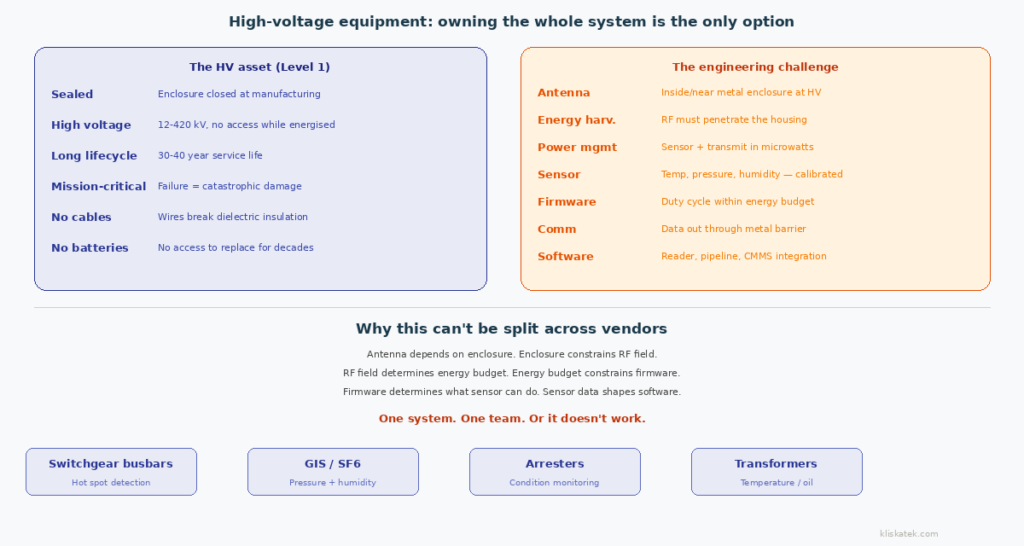
1) The asset: sealed, lethal, and built to last 40 years
High-voltage equipment — switchgear, gas-insulated switchgear (GIS), arresters, power transformers — operates at voltages ranging from 12 kV to 420 kV and beyond. These are the critical nodes of the electrical grid: the equipment that switches, protects, and distributes power.
The monitoring challenge comes from how these assets are built and operated:
Sealed enclosures. Switchgear cabinets and GIS compartments are sealed during manufacturing. The internal environment is controlled — often filled with insulating gas (SF6 or its alternatives). Opening the enclosure for routine monitoring is not an option. Some compartments are designed to remain sealed for the entire service life of the equipment.
Lethal voltages. The internal conductors — busbars, contacts, connections — carry current at voltages that preclude any physical access while the equipment is energised. Planned shutdowns for inspection are expensive, disruptive, and increasingly difficult to schedule in grids with rising demand.
Decades of service. A medium-voltage switchgear panel has a typical service life of 25-40 years. A GIS installation can operate for 40 years or more. Any monitoring solution installed in this equipment needs to last as long as the asset — without maintenance, without battery changes, without physical intervention.
Mission-critical. A failure in switchgear or GIS can be catastrophic: equipment damage, grid outages, safety hazards. Early detection of degradation — a hot spot on a busbar connection, moisture ingress in a sealed compartment, a pressure drop in gas-insulated equipment — prevents failures that cost orders of magnitude more than the monitoring system.
This is Level 1 in the filter we published three weeks ago. Not “battery-free would be nice.” Battery-free is the only technology that can work here.
2) Why battery-free is the only option
Let’s walk through the alternatives and explain why each one fails:
Wired sensors. Cables running from the monitored point (inside the enclosure, at high voltage) to an external data acquisition system would need to cross the dielectric barrier. At 36 kV, that cable becomes a path for arcing and insulation failure. The cable itself compromises the very thing the equipment is designed to provide: electrical isolation. This is not a practical limitation — it’s a fundamental one.
Battery-powered wireless sensors. A battery inside a sealed enclosure that nobody can access for 40 years is not a monitoring solution — it’s a deferred problem. Coin cells have a shelf life of 5-10 years under ideal conditions, less under temperature cycling. When the battery dies, the monitoring stops. Nobody knows until someone opens the enclosure, which may not happen for another decade. And opening the enclosure to replace a battery defeats the purpose of sealing it.
Energy harvesting from the environment (solar, vibration, thermal). Inside a sealed switchgear cabinet, there’s no light (solar fails), no significant vibration (vibration harvesting fails), and the thermal gradient is usually too small and too variable for reliable thermoelectric harvesting. The one energy source that can penetrate the enclosure from outside, through metal and dielectric barriers, is an RF field.
Battery-free RF energy harvesting. An RF field generated by a reader or transmitter outside the enclosure penetrates the housing and delivers energy to a sensor tag inside. The tag harvests enough energy to power a sensor measurement and transmit the data back. No cables. No batteries. No access required. The sensor can operate for the lifetime of the equipment without any intervention.
This is not a preference. It’s physics-driven elimination of alternatives.
3) The engineering challenge: seven domains inside a metal box
Building a battery-free sensor for HV equipment is the most extreme version of the cross-domain integration challenge we described in our capability post. Every domain is pushed to its limits:
Antenna design must account for a metal enclosure that reflects, absorbs, and detunes the antenna. Standard dipole designs from evaluation boards don’t survive contact with the reality of a switchgear cabinet. The antenna must be designed specifically for the mounting position, the enclosure geometry, the materials, and the proximity to conductors at high voltage. This is custom RF engineering for every installation type.
Energy harvesting must work through the enclosure. The RF field from the external reader must penetrate the housing with enough power density to energise the tag on the other side. Metal enclosures attenuate the field. The position and orientation of the tag relative to the reader antenna — separated by a metal wall — determines whether the system works or doesn’t. Margins are tight.
Power management must squeeze every microjoule. The energy available inside the enclosure is a fraction of what’s available in an open-air deployment. The power management circuit, the storage capacitor, the voltage monitor — all need to be optimised for minimum loss. There is no room for the 15% efficiency hit that a standard design might tolerate.
Sensor signal conditioning must deliver calibrated measurements at extreme low power. Temperature on a busbar requires an NTC probe routed from the tag to the contact point. Humidity inside a GIS compartment requires a sensor exposed to the gas. Pressure requires a transducer rated for the internal environment. Each sensor type brings its own power requirements and signal conditioning challenges.
Firmware must complete the entire cycle — wake, measure, transmit — within the energy window. If the duty cycle is too long, the tag runs out of energy before the data is sent. If it’s too short, the sensor hasn’t settled and the measurement is wrong. The firmware engineer needs to understand the power profile of every component and the energy budget from the harvesting circuit.
Communication must get the data out through the same barrier the energy came in through. Whether it’s EPC C1G2 backscatter or a BLE burst, the return signal must be strong enough for the external reader to decode it.
Software must tie the reader, the data pipeline, and the client’s asset management system together. The sensor data needs to reach the CMMS or SCADA system that the utility’s operations team already uses.
These seven domains are coupled. A change in the antenna affects the energy budget. The energy budget constrains the firmware. The firmware determines what the sensor can measure. The sensor choice affects the power management. The housing provided by the switchgear OEM constrains the antenna. Everything connects to everything.
4) What we monitor in HV equipment
Four sub-applications, all sharing the same cross-domain engineering challenge:
Busbar temperature in switchgear. Hot spots at bolted connections are early indicators of degradation — loose connections, corrosion, overloading. Detecting a temperature rise of a few degrees above ambient before it becomes a thermal runaway prevents failures that can destroy the entire panel. Sensor: NTC contact temperature probe. Challenge: routing the probe from the tag to the busbar connection, inside a confined space, at high voltage clearance distances.
Pressure and humidity in gas-insulated equipment. GIS compartments are sealed and filled with insulating gas. A drop in gas pressure indicates a leak. A rise in humidity indicates moisture ingress, which accelerates insulation degradation and can lead to partial discharge. Monitoring both parameters continuously — without opening the compartment — gives the operator early warning of seal failures. Sensor: pressure transducer + humidity sensor. Challenge: sensors must be compatible with the gas environment.
Arrester condition monitoring. Surge arresters protect the grid from overvoltage events. Their internal condition degrades over time with each event. Monitoring temperature and leakage current indicators helps predict when an arrester is approaching end of life. Sensor: temperature + continuity. Challenge: the arrester is a sealed, cylindrical housing at line voltage.
Transformer monitoring. Power transformers have oil-filled compartments where temperature and dissolved gas analysis (DGA) indicate insulation health. Battery-free sensors on the external surfaces or in accessible pockets provide continuous temperature data that complements periodic DGA sampling. Sensor: NTC temperature probes at multiple points. Challenge: large physical size, multiple mounting positions, outdoor environmental exposure.
5) Why we’re public about this application
Most of our client work is confidential — we don’t talk about specific projects or proprietary concepts. But HV equipment monitoring is different: it’s a category-level application that’s well known in the power industry. Multiple manufacturers are exploring wireless monitoring. The technology challenge is public knowledge. What’s not public is who has solved it — and how.
We’re transparent about this application because it demonstrates our engineering capability better than any abstract description. When a potential client — in any industry — asks “what’s the hardest thing you’ve built?”, the answer is “a battery-free sensor that works inside a sealed metal enclosure at 36 kV, for 40 years, without maintenance.” That answer opens doors.
6) Where this goes next
Over the next three weeks, we’ll go deeper into the specific sub-applications:
Next week: “Battery-Free Temperature Monitoring for Switchgear: Busbar Hot Spot Detection” — the most common sub-application, with the highest commercial demand.
Then: “SF6 Monitoring Without Batteries: Pressure and Humidity in Gas-Insulated Equipment” — where the regulatory push around SF6 replacement creates urgency.
Then: “Condition-Based Maintenance vs Periodic Inspection: The Business Case for Utilities” — where we move from the engineering challenge to the economic argument that gets projects funded.
Work in energy or utilities? If you manufacture, install, or operate HV equipment and you’re exploring condition monitoring, contact us. We’ll tell you what’s feasible for your specific equipment type — and what a scoping engagement would look like.
Want to understand the engineering first? Read our evaluation guides for SenseID, SenseBLE, and SenseNFC — the technology behind HV monitoring is the same platform, pushed to its limits.