
If you’ve read why splitting a hardware/firmware/software/wireless project across specialists puts the integration risk on you, you may have hit the obvious next worry: fine — but handing a whole system to one team feels like an even bigger bet. How do you commit to a single owner for a project you can’t fully specify yet, on the strength of a first meeting?
You don’t. You start small, and you start paid. This post is about that first step — the scoping study — and why it’s the lowest-risk way to turn a stuck project into a plan you can actually act on.
The moment you get stuck
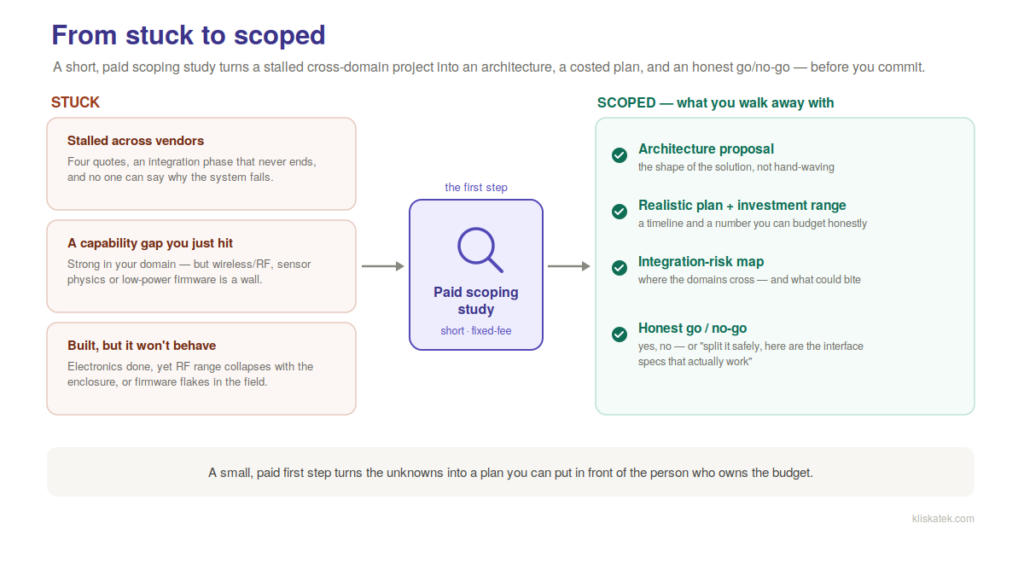
Cross-domain projects tend to stall in one of three ways, and they feel very different from the inside.
The project stalled across vendors. You did the sensible thing: separate RFQs, separate specialists, interfaces defined on paper. Then the integration phase that was supposed to take two weeks entered its third month, every vendor’s piece passes its own tests, the system still doesn’t work, and no one can tell you why.
A capability gap you just hit. You’re strong in your domain. But this project needs wireless/RF, or ultra-low-power firmware, or an understanding of the sensor physics that your team simply doesn’t have — and hiring a whole department to cover one project makes no sense.
You built it, and it won’t behave. The electronics are done, but the RF range drops the moment the enclosure goes on. Or the firmware is flawless on the bench and flaky in the field. The pieces are right; the system is wrong.
The common thread: you don’t need to hire “a vendor” yet. You need to know what you’re actually dealing with — and what it will take — before you commit a budget to it.
Why “just start the project” is the expensive option
The instinct when you’re stuck is to scope the whole thing and go. But a cross-domain project’s real unknowns live in the seams between disciplines, and pricing a project around unknowns forces a bad choice: pad the quote heavily to cover the risk, and you overpay for work that may not be needed — or price it lean, and absorb the overruns and change orders when the seams bite. Committing to a full build before the unknowns are mapped is the expensive path wearing the costume of decisiveness.
A scoping study exists to price the unknowns down first.
What a scoping study actually is
It’s a short, fixed-fee engagement. Not free consulting, not a sales call with a slide deck at the end. We take your system-level problem, analyse where the domains actually cross, and hand back four concrete things:
- An architecture proposal — the shape of a workable solution, not hand-waving.
- A realistic plan with a timeline and an investment range — so you can budget honestly rather than guess.
- An integration-risk map — where the disciplines couple, and what’s most likely to bite.
- An honest assessment — can this be solved, and should you proceed?
The output is a document you can put in front of whoever owns the budget. That’s the whole point: it converts “we’re stuck on something technical we can’t quite name” into “here’s the architecture, here’s the number, here’s the risk, here’s the recommendation.”
The honest part: “no” is a valid result
Here’s the deliverable most vendors won’t offer, because it doesn’t serve their funnel: the recommendation might be don’t do this, or you can safely split this after all — and here are the interface specs that will actually hold.
A scoping study that can only ever conclude “hire us for the big project” isn’t a diagnosis; it’s a sales process with an invoice attached. A real one can end with you walking away holding a plan and no further need for us. We think that’s exactly what makes the assessment worth paying for — you’re buying a decision you can trust, not a pitch.
Why it’s paid
Two reasons, both honest.
First, it delivers real value on its own. You leave with an architecture and a costed plan whether or not you ever sign a project with us. That’s a deliverable, and deliverables aren’t free.
Second, paying filters for seriousness. It separates the teams solving a real problem from the ones collecting free opinions to shop around — and it means the time goes to clients who intend to act. A scoping study is a small fraction of a full project’s cost, and it’s the cheapest insurance you’ll ever buy on the project that follows.
From scoped to decided
Once you’re scoped, the decision in front of you changes shape entirely. It’s no longer the scary, unanswerable “do I trust this vendor with my whole system?” It’s a normal, almost boring, good decision: here’s the architecture, here’s the investment range, here’s the risk, here’s the go/no-go. Proceed with us, proceed with the plan and your own team, or don’t proceed — all three beat staying stuck, and all three start with the same small, paid step.
Is your cross-domain project stuck — stalled across vendors, blocked on a capability you don’t have, or built but misbehaving? A scoping study is the lowest-risk way to find out what it actually takes before you commit. You’ll get an architecture, a costed plan, and an honest recommendation — even if that recommendation is “don’t.” Start with a paid scoping study →
Next week: One Sensing Core, Three Protocols: Reusing the Same Capability Across SenseID / BLE / NFC.