
Last week we published a post about the hidden cost of splitting a cross-domain project. Today we shift to a different kind of honesty: helping you figure out whether battery-free sensing is actually what you need.
Because sometimes it isn’t.
Battery-free sensing is an extraordinary technology for the right applications. A sensor that harvests energy from an RF field or an NFC phone, takes a measurement, and transmits the data — with zero batteries, zero maintenance, and a potentially unlimited lifetime — solves problems that no other technology can solve. We’ve spent 17 years building this capability, and we believe in it deeply.
But we also believe in not selling people something they don’t need. Battery-free sensing adds complexity to a project: energy harvesting, antenna design, power budgeting, reader infrastructure. That complexity is justified when the alternative — cables or batteries — is impossible, dangerous, or prohibitively expensive. It’s not justified when a battery-powered sensor or a wired installation would work just fine.
This post gives you a practical filter to make that determination.
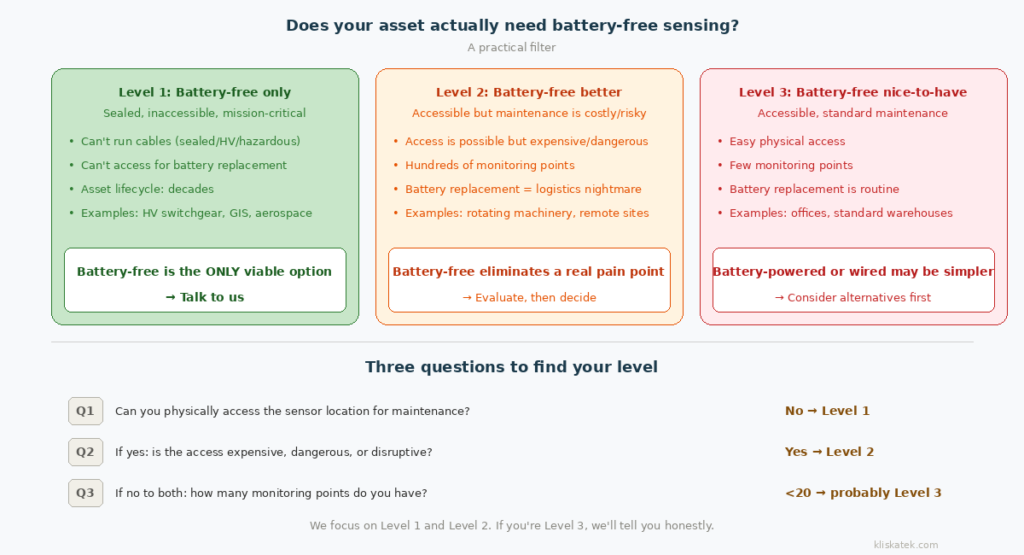
1) The three levels
Not all monitoring problems are equal. We’ve found it useful to classify assets into three levels based on how accessible they are and what the consequences of that accessibility (or lack of it) mean for your monitoring strategy.
Level 1: Battery-free is the only viable option.
Your asset is sealed, inaccessible, or operating in an environment where physical access for maintenance is impossible or unacceptable. You cannot run cables into the monitored location. You cannot access the sensor to replace a battery. The asset has a lifecycle measured in decades, and any monitoring solution needs to last as long as the asset itself without intervention.
Real examples: high voltage switchgear operating at tens of kilovolts where opening the enclosure requires a planned shutdown. Gas-insulated equipment (GIS) where the compartment is sealed and pressurised. Aerospace components embedded inside structures during manufacturing. Rotating machinery where the sensor is on a spinning element that cables can’t reach.
For these assets, the question isn’t “should I use battery-free?” — it’s “battery-free is the only option, and the question is whether the technology can deliver the measurement I need at the range and accuracy I require.”
If your asset is Level 1, we should talk.
Level 2: Battery-free is better, but not the only option.
Your asset is physically accessible, but accessing it for maintenance is expensive, dangerous, time-consuming, or disruptive. You can reach the sensor — but every time you do, it costs you something meaningful.
Real examples: sensors distributed across hundreds of monitoring points in a large facility, where replacing 200 coin cell batteries per year requires a dedicated technician and a logistics operation. Sensors in hazardous areas where every maintenance visit requires safety permits, PPE, and a confined space procedure. Sensors on remote infrastructure (pipelines, substations, bridges) where every visit means a truck roll and a field crew.
For these assets, battery-free eliminates a real operational pain point. The technology works. The economics make sense. But it’s not the only option — a battery-powered sensor with a 5-year cell life might also be acceptable if the number of monitoring points is small enough and the access procedure is manageable.
The decision here is economic, not binary. Compare the total cost of battery-free (higher upfront sensor cost, reader infrastructure) against the total cost of battery-powered (lower upfront cost, ongoing battery replacement and access costs over the lifecycle). The answer depends on your specific numbers.
Level 3: Battery-free is nice-to-have, but probably not worth the complexity.
Your asset is easily accessible. Physical access for maintenance is routine, inexpensive, and non-disruptive. You have a small number of monitoring points. Battery replacement is a minor item on the maintenance schedule, not a logistical challenge.
Real examples: temperature monitoring in an office building. Humidity sensing in a standard warehouse with easy access to all locations. A small number of monitoring points in a facility where maintenance staff visit regularly anyway.
For these assets, battery-free adds engineering complexity (energy harvesting, reader infrastructure, power budgeting) without eliminating a significant pain point. A battery-powered sensor, a wired installation, or even manual readings may be simpler, cheaper, and perfectly adequate.
If your asset is Level 3, we’ll tell you honestly. We’d rather direct you to the right solution — even if it’s not ours — than sell you technology you don’t need and create a disappointed customer.
2) Three questions to find your level
If you’re not sure which level your asset falls into, these three questions will get you there:
Question 1: Can you physically access the sensor location for maintenance?
If the answer is genuinely no — the location is sealed, pressurised, at lethal voltage, encased in concrete, or physically unreachable — you’re Level 1. Battery-free is likely your only wireless option. The remaining question is whether the technology can meet your measurement requirements (range, accuracy, environmental conditions).
Question 2: If you can access it — is the access expensive, dangerous, or disruptive?
If yes — the access requires planned shutdowns, safety permits, specialised equipment, truck rolls, or significant coordination — you’re Level 2. Battery-free eliminates that access burden for the sensor’s entire lifetime. Run the TCO comparison: what does battery replacement cost you per point per year, multiplied by the number of points and the deployment lifetime?
Question 3: If access is easy — how many monitoring points do you have?
If the answer is fewer than 20 and the access is straightforward, you’re likely Level 3. The battery-free advantage (zero maintenance) doesn’t offset the added engineering complexity for a small deployment in an easily accessible environment. Consider battery-powered wireless sensors or wired installations first.
3) The grey zones
Not every asset fits neatly into one level. Here are the common grey zones:
“Access is possible but the asset operates 24/7 and any downtime costs €10K/hour.” This is effectively Level 1 — the theoretical accessibility doesn’t matter if the operational cost of accessing makes it impractical.
“We have 500 monitoring points but each one is easy to reach.” This is Level 2 territory — not because of access difficulty, but because the logistics of replacing 500 batteries on a rolling schedule is a management burden that scales with the number of points.
“The asset is accessible now, but we’re designing a next-generation product where it won’t be.” Think like Level 1 for the product design, even if the current prototype is on your bench. The deployment environment is what matters, not the lab environment.
“We’re monitoring a moving asset (vehicles, containers, pallets).” This depends heavily on the movement pattern. If the asset passes through a fixed point regularly (dock door, checkpoint), battery-free sensing at that touchpoint works well. If you need continuous monitoring during transit with no fixed touchpoints, battery-powered is likely the better fit for the transit portion.
4) Why we tell you when you don’t need us
This might seem counterintuitive for a company that builds battery-free sensors. Why would we tell a potential customer to look elsewhere?
Two reasons.
First, a customer who buys technology they don’t need becomes a disappointed customer. They’ll invest time and money, the project will feel over-engineered, and the outcome won’t justify the effort. That’s bad for them and bad for our reputation.
Second, when we tell someone honestly “you’re Level 3, consider a battery-powered solution” — and they do, and it works — they remember us as the company that gave them honest advice instead of pushing a sale. When they encounter a Level 1 problem later (or their colleague does), they come back. Trust is a longer game than a single transaction.
5) What happens if you’re Level 1 or 2
If you’ve worked through the filter and your asset is Level 1 or Level 2, here’s the path:
For Level 1 (battery-free only): The question is no longer “should I use battery-free?” but “can this team deliver what I need?” The answer depends on your specific measurement requirements (what magnitude, what accuracy, what range, what environmental conditions). Start by contacting us with a description of your asset, your monitoring needs, and the access constraints. We’ll tell you whether it’s feasible and what a scoping engagement would look like.
For Level 2 (battery-free better): The question is economic. We can help you build the TCO comparison — battery-free vs battery-powered over your deployment lifecycle. Start with our evaluation kits (50 € per board) to validate that the technology works in your environment. If it does, we’ll discuss whether a custom solution makes sense for your scale.
For both levels: the cross-domain engineering challenge is real. Battery-free sensing requires antenna design, RF energy management, ultra-low-power firmware, and sensor signal conditioning to work together as a system. That’s what we do — and it’s why the filter matters. We’d rather focus our engineering effort on projects where battery-free is genuinely the right answer.
Not sure which level you are? Ask us. We’ll give you an honest answer — even if that answer is “you don’t need us.”
Next week: “Why We Build Battery-Free Sensors: The Hardest Proof of Owning the Whole RF/Firmware/Software Stack” — how the most extreme product we build proves a broader engineering capability.