
Most posts about battery-free sensing open with the sensor. NFC maintenance rounds open somewhere else: with the walk that somebody is already doing.
In most plants someone already walks a route. They open a panel, read a gauge, look at a filter and sign a sheet. That round is scheduled, staffed and paid for, and it is not going away. NFC maintenance rounds do not replace the walk. They change what the walk produces.
We covered the SenseNFC line itself in the evaluation guide: the physics, the board, the two-centimetre range. This post is the decision that comes after. Is your round one of the rounds worth instrumenting, and what actually changes on the day it is?
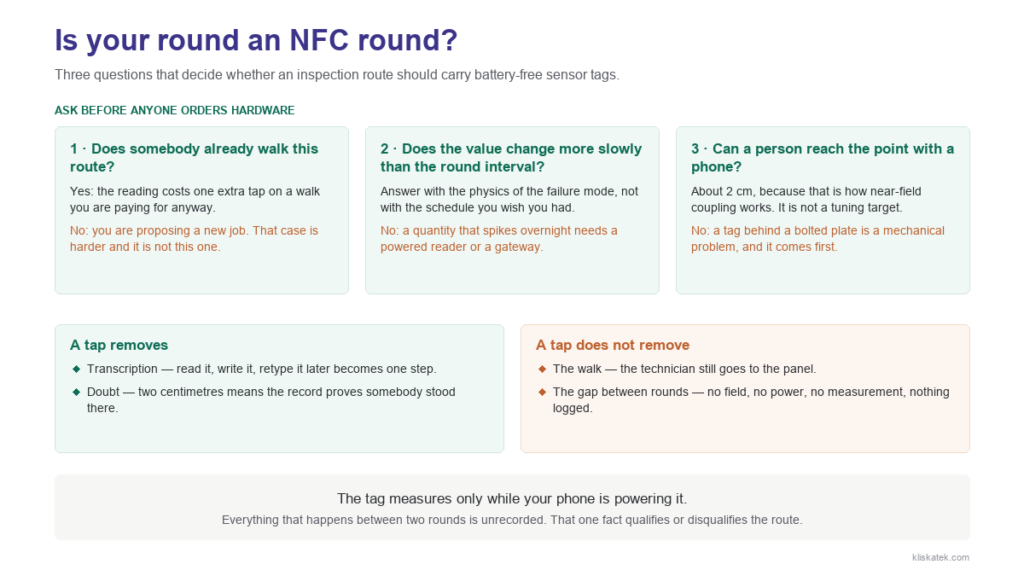
What an NFC maintenance round removes, and what it does not
It does not remove the walk. The technician still goes to the panel. Anyone selling you a labour saving here is selling you the wrong thing.
It removes two other things, and both are worth more than they look.
The first is transcription. Today a value gets read off a gauge, written on a sheet, and typed into a system hours later. Every hop costs time and loses fidelity. A tap collapses the three steps into one.
The second is doubt. Near-field coupling works over roughly two centimetres. Nobody taps a tag from the corridor, and nobody taps it from the van. The record is therefore evidence that a person stood at that point, at that time.
That second one is the argument that survives contact with an auditor. It is rarely “we measured 41 °C”. It is “we can show who measured it, where, and when”.
The measurement only exists while you are tapping
Here is the limitation, stated as hard as we can state it.
The tag has no battery. It harvests energy from the field your phone generates. No field means no power, and no power means no measurement. Between two taps the tag is simply off.
So the tag does not log. It does not remember the night shift. A monthly round gives you twelve readings a year, and twelve readings a year is not a trend.
If the failure you are chasing develops between rounds, this is the wrong tool. No amount of app work will fix that, because the problem is physics rather than software. You need a powered reader or a gateway instead — that is what UHF RFID and Bluetooth are for.
The good news is that plenty of what people monitor drifts slowly. Humidity ingress in a cabinet, ambient conditions in a room, the slow trends that show up over weeks: a monthly or weekly reading tracks those honestly.
The three questions that qualify NFC maintenance rounds
Ask these before anyone orders hardware. They take ten minutes and they are more diagnostic than a datasheet.
1. Does somebody already walk this route? If yes, the marginal cost of the reading is a tap, and the business case is easy. If no, you are proposing a new job for somebody. That case can still be made, but it is a different and much harder one.
2. Does the value change more slowly than your round interval? Answer this with the physics of the failure mode, not with the inspection schedule you wish you had. A quantity that spikes in an afternoon will not be caught by a Tuesday-morning round.
3. Can a person reach the point with a phone? Two centimetres is not a guideline we could relax with a better antenna. It is how near-field coupling works, and the NFC Forum specifications define the operating volume it produces. A tag behind a bolted plate is not a tappable tag.
Three yeses and you have a good candidate. A no on question two means you need a different technology. A no on question three is a mechanical problem, and it has to be solved before any of this matters.
Where you put the tag decides the route
This is the consequence people meet late. Once the tags are mounted, the route is fixed by them. Placement is a decision you make once and then live with for years.
The mounting surface matters as much as the position. Metal near an antenna detunes it, so the distance to metal, the panel material and the fixing method all belong in the same conversation. Test the placement on the real panel, not on a bench.
And an externally mounted tag measures external conditions. If the value you care about lives inside sealed equipment, you are not in the round problem any more. You are in the design-in problem, and we wrote the guidelines for that last week.
What the round looks like in practice
The technician carries the phone they already have. Our free SenseNFC app decodes the tag and shows humidity and temperature on screen. A tap takes about a second. Move away, come back, tap again, and you get a fresh harvest and a fresh measurement.
One board covers the family today: the EVAL-SNFC-RHAT, relative humidity and temperature, ±2 % RH and ±0.2 °C. That temperature figure is better than a lot of battery-powered industrial sensors. Other magnitudes are a conversation rather than a catalogue number, so tell us what you need to measure.
One caveat we would rather you heard from us. Our app is an Android app. An iPhone will read the tag in standard NDEF mode, but the technician sees raw data instead of parsed values. If your crews carry iPhones, raise it in week one, because it changes what a pilot has to include.
The part nobody scopes: getting the reading into your system
The tap is the easy half.
On the round itself the phone is the reader, and that is the whole point. Away from the round you have two other ways in. KL-OSIRIS, our free evaluation software, reads the same tags through a supported NFC reader and logs to CSV, exactly as it already does for SenseID and SenseBLE. And if you want a different reader, or the readings inside your own application, we publish the libraries and you build against them.
What none of that decides is where the record lives. Which system owns it? Does the phone write to that system directly, or does a file land somewhere for somebody to pick up? And who notices when a point on the route comes back empty?
Answer those three before the pilot rather than after it. That is where this either becomes useful or becomes a second system everybody quietly ignores. We do that work, and we would rather say now that it is work.
Piloting NFC maintenance rounds: one route, three cycles
Pick one route rather than one sensor. A single instrumented point proves the tag works, which is something you already know from the evaluation guide.
Instrument every point on that route, including the boring ones. Run it for three full round cycles. Then measure two numbers: how long the round takes compared with before, and how many points came back with no reading at all.
The second number is the one that matters. The value of this is not a more accurate reading. It is a complete record, produced by the same walk you were paying for anyway.
If your round passes the three questions, the cheapest first step costs nothing: the SenseNFC app is free on Google Play. The tag is the EVAL-SNFC-RHAT at 50 €, and one board is enough to walk a route and see what comes back. For the part where the readings have to reach your maintenance system, tell us what your round looks like → A short paid scoping study is the honest way to find out whether your route is a candidate, and what the integration really costs.
Next week: when splitting a project is the right call — and what holds the seams together.