
In gas-insulated switchgear, the insulation isn’t something you can see. It’s gas — usually SF6, increasingly one of its replacements — held under pressure inside a sealed metal enclosure. The equipment works because that gas stays dense enough to hold off a fault. Let the density drift down through a slow leak, or let moisture creep in, and you are quietly losing the one thing standing between normal operation and an internal flashover.
The catch is the same one that makes high-voltage monitoring hard in general, only sharper: the parameter you most need to watch lives inside a sealed, pressurised compartment you are specifically not supposed to open.
The gas is the asset
Most people picture switchgear insulation as the solid parts — the bushings, the spacers. In gas-insulated equipment, the working insulation is the gas itself, and its dielectric strength is a function of density. That is why GIS has always been built around a density monitor rather than a simple pressure gauge: pressure rises and falls with temperature, but density is what actually determines whether the gas can still do its job, so it has to be measured in a temperature-compensated way.
Two things erode that job quietly. The first is a leak — a fitting, a seal or a weld that lets gas escape slowly enough that nobody notices until an alarm trips or a fault occurs. The second is moisture. Water vapour inside the compartment lowers the dielectric strength on its own, and under the heat of an internal arc it reacts with SF6 to form corrosive byproducts that attack insulators and metalwork from the inside. So the two measurements that tell you whether a gas compartment is healthy are density — is there enough gas, and is it still tight? — and humidity — is the inside staying dry, or quietly corroding?
None of this disappears with the move to SF6-free gases. Clean-air and fluoronitrile-based alternatives still rely on density for their dielectric strength, and several bring their own moisture sensitivities. The gas changes; the need to know its state does not.
Why now: the regulation changed the maths
For years, gas monitoring in GIS was a reliability choice — worth doing, easy to defer. The EU’s revised F-gas Regulation has quietly turned it into something closer to a compliance lever.
The regulation is best known for phasing SF6 out of new switchgear: medium-voltage up to 24 kV since the start of 2026, with the high-voltage bands following between 2028 and 2032. But buried in the same rules is a detail that matters more for monitoring than the bans do. The tightened obligation to check sealed equipment for leaks comes with an exemption for gear that carries automatic pressure or density monitoring with an alert. In plain terms, continuous density monitoring can take a recurring, manual inspection burden off the operator’s plate. That is a rare thing — a monitoring investment that regulation actively rewards rather than merely implies.
And there is a timing gift hidden in the phase-out itself. Every manufacturer redesigning a product to run on an SF6-free gas is rebuilding the inside of that enclosure anyway. Designing gas monitoring in during that redesign costs a fraction of retrofitting it into a sealed product later.
Why the obvious sensors don’t fit a sealed gas compartment
The instinct is to drop a pressure and humidity sensor inside and wire it out. In a gas-insulated compartment, that wire is the problem. Every penetration through the gas-tight, pressure-rated boundary is a potential leak path and a dielectric weak point — the opposite of what the enclosure exists to provide. Adding sensor cabling means adding sealed feedthroughs, and each one is a liability the design team will push back on.
A battery dodges the wire but creates a worse problem. This is sealed equipment specified for decades of service; a cell you can never reach to replace is a maintenance failure waiting to happen, inside the last place you want to open.
So the requirement lands in the same precise spot it did for busbar monitoring, only with a pressure boundary in the way: measure density and humidity directly inside the compartment, continuously, with no battery to maintain and nothing extra crossing the gas-tight boundary.
What battery-free changes — and the part that is genuinely hard
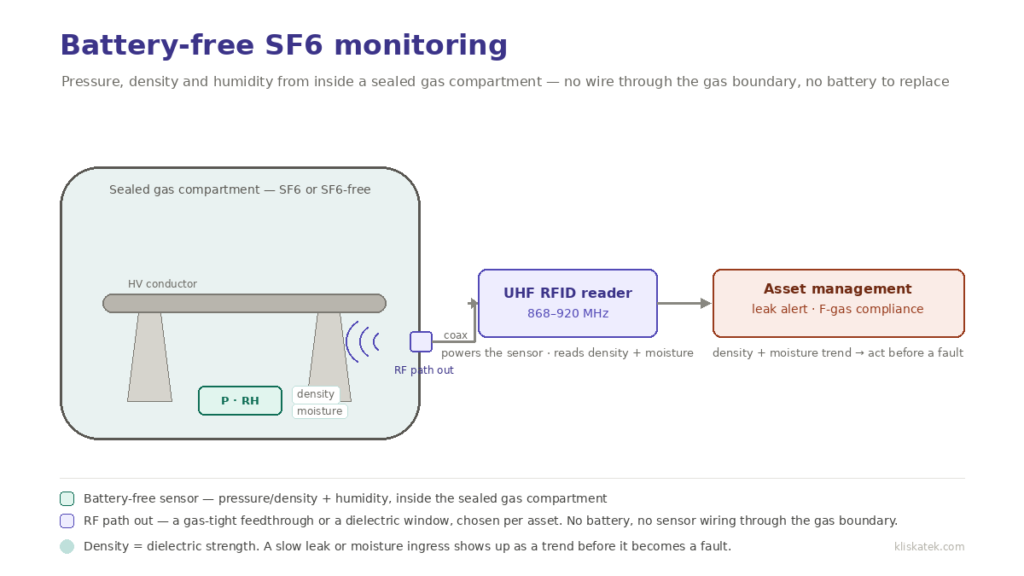
The principle is straightforward. A battery-free sensor inside the compartment harvests the energy it needs from an external RF field, measures the gas state at the source, and sends it back — no cell to fail, and no power or signal wiring run through the seal for the sensor itself.
The hard part — and I want to be clear that this is an open design question, not something anyone hands you off a shelf — is getting the RF in and back out. A sealed metal compartment is a Faraday cage. Powering a tag through it and reading it back is not a matter of placing an antenna and walking away; it needs a deliberate path, and broadly there are two candidate approaches, each with a real trade-off:
- A gas-tight RF feedthrough — an antenna inside the compartment, coupled through a sealed bulkhead to a reader outside. It keeps the antenna close to the sensor, but it adds a penetration to a pressure boundary whose whole purpose is to have as few penetrations as possible.
- A dielectric window — a deliberately non-metallic section of the enclosure that the field can pass through, with the reader entirely outside. It adds no electrical penetration, but it constrains the mechanical and dielectric design of the enclosure itself.
Neither is an off-the-shelf answer, and we are not pretending to have one. Which approach fits depends on the equipment, the gas, the pressure rating and how the enclosure is built — it is a design decision the equipment owner makes, not a part you order. In the conversations we have had so far, the dielectric-window route tends to come up more often than the feedthrough, but the trade-offs are far from settled.
What these approaches share is that the problem sits across RF, mechanical sealing and high-voltage design at once — exactly the kind of thing that has no clean owner when you split it between an RF house, a mechanical supplier and the switchgear team. That is where we fit: not with a finished GIS sensor on a shelf, but as the team that can hold those domains together and help you turn your chosen approach into something that survives, sealed, for the life of the asset. That whole-system role is the point.
Choosing how to read it
The sensing core is the same one we use everywhere; the choice is how the data comes back. For continuous, fixed monitoring of a gas compartment — which is what density and moisture warrant — a UHF-powered link makes sense, whether the data returns by RFID backscatter (SenseID) or over BLE to a gateway (SenseBLE). The two share the same energy-harvesting front end and the same range, so the decision is about the reader infrastructure you already run, not capability; we pull that apart in One Sensor, Three Protocols. Tap-to-read NFC has a role for a technician confirming a reading at the cabinet, but its few-centimetre range makes it a spot check, not the continuous watch a sealed gas volume really needs.
Building the case your stakeholders will sign
If you make the equipment, the strongest moment is the redesign you are already doing for SF6-free compliance: monitoring designed in during manufacturing is cheaper, cleaner, and becomes a feature your utility customers can use to lighten their own inspection obligations. If you operate the equipment, the numbers are about avoided pain — the recurring cost of manual leak checks you may be able to shed, the catastrophic internal failure you prevent by catching a leak or a moisture ingress while it is still a trend, and the shift from calendar-based maintenance to acting only when a compartment actually drifts.
And the same caution applies as for any of this work: an evaluation that proves the measurement on the bench is the cheap first step, not the finished system. For a sealed, pressurised, certified gas compartment, the distance from one to the other — the RF path, the qualification, the certification — is precisely the part worth scoping before you commit.
Designing or operating gas-insulated equipment? If you are weighing battery-free density and moisture monitoring — for a new SF6-free platform or an existing GIS fleet — a feasibility study is the quickest way to find out what it would take: which RF approach fits your equipment, through to how the data reaches your compliance and maintenance systems. The decision stays yours; we help you get there. Request a GIS feasibility study →
Next week: condition-based maintenance vs periodic inspection — the business case for utilities.