
A busbar joint rarely fails all at once. It starts with a bolt that has loosened half a turn, or a thin film of oxide forming where two conductors meet. Resistance creeps up. The joint runs a few degrees warmer than its neighbours. Months later — sometimes years — those few degrees have become a hot spot hot enough to char insulation, and the failure mode at the end of that curve is an arc flash inside an energised cabinet.
The frustrating part is that the early warning is sitting right there, on the joint, the whole time. The hard part is reading it without opening the door.
This post is about why that reading is harder than it looks, why battery-free sensing is one of the few honest answers in this environment, and — just as importantly — where the real engineering difficulty lies once you accept that a tag on a busbar can work.
Why the obvious solutions don’t fit a switchgear cabinet
Most thermal faults in switchgear appear at connections: a busbar bolted to another busbar, a busbar landing on a cable lug, a contact in a breaker. A poor connection — under-torqued, contaminated, or corroded — creates a point of resistance, and resistance under current generates heat. Find the temperature at those points and you can act before the joint runs away.
The trouble is that the three obvious ways to measure temperature all break down inside an energised compartment:
Wired sensors mean running a conductor across the insulation boundary. In a high-voltage environment that wire is a potential arc path, and it compromises the very insulation that keeps the cabinet safe. It is not a small inconvenience — it is a reason the maintenance team will refuse the installation.
Battery-powered wireless sensors remove the wire but introduce a battery inside the cabinet. Beyond the safety questions of putting a chemical cell next to live conductors, there is a lifecycle mismatch that managers feel immediately: switchgear is specified for decades of service, and a battery is not. A sensor you have to revisit to replace the cell is a sensor that quietly becomes the maintenance problem it was supposed to solve.
Thermal cameras and periodic inspection are the status quo, and they have a blind spot built in. Infrared needs line of sight, which usually means opening an access panel on fully energised equipment — exactly the dangerous act everyone is trying to avoid. And it is a snapshot. Most installed switchgear is inspected on one-to-three-year intervals, which means a joint can begin to degrade the week after an inspection and go unseen until the next one.
So the requirement is unusual but precise: measure temperature directly at the connection, continuously, with no wire crossing the insulation boundary and no battery to maintain. That set of constraints is what makes battery-free RF sensing the natural fit here, rather than a novelty.
What “battery-free” actually means at the joint
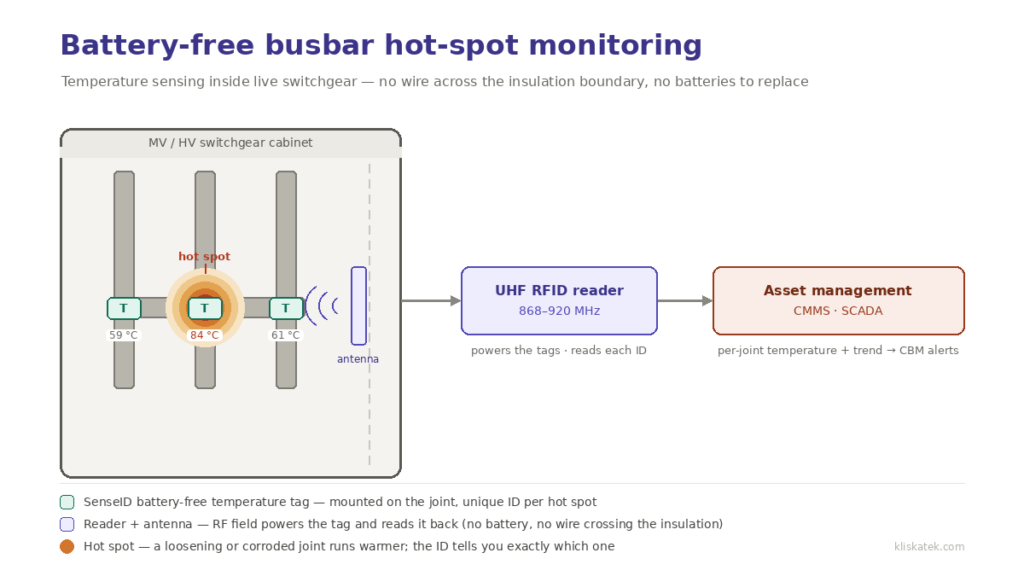
A battery-free sensor tag carries no energy of its own. It harvests the energy it needs from the radio-frequency field of a nearby reader, wakes up, takes a measurement, sends it back, and goes dormant again. In a UHF RFID configuration (the SenseID family, working in the 868–920 MHz band), the same reader that powers the tag also collects the data, and that band sits comfortably alongside switchgear operation without EMC issues.
In practice this means a small sensor tag mounted directly on the hot spot — a busbar connection, a cable lug, a contact assembly — with a contact temperature probe reading the metal itself. There is no cell to fail and no conductor crossing the insulation boundary. The reader antenna sits inside the cabinet, mounted flat against the wall so its cable can exit while respecting the required insulation clearances. A single antenna reads several tags at once, and one reader can drive several antennas — antenna multiplexing — to cover a fully populated cabinet, or a row of adjacent ones.
Two properties matter more than the absence of a battery:
First, identity. Every tag answers with a unique ID, so you are not told “something in this panel is hot” — you are told which joint. Maintenance can be dispatched to a specific connection instead of de-energising a whole section to hunt for the fault.
Second, continuity. A passive tag costs nothing to read again, so the system can poll around the clock. Instead of a thermal snapshot every couple of years, the asset owner gets a live thermal picture and a trend line for every monitored joint — which is the raw material condition-based maintenance actually runs on.
The part that is genuinely hard
Here is the honest bit, and it is the bit that separates a demo from a deployment.
Making a battery-free temperature tag read correctly on a bench is, by now, a solved problem. The catalogue of available tags is real. If the question were only “can a passive tag measure temperature,” there would be nothing left to write about.
The question that actually decides whether a switchgear monitoring system works is a system question, and it spans several domains at once:
- RF coverage inside a metal enclosure. The antenna lives inside the cabinet, against the wall — you are not pushing RF through metal from outside — so the work is reliable coupling and coverage in a space full of conductors and reflections. Every monitored joint has to receive enough field to power up and be read, every time, with each tag’s unique ID keeping it distinct from its neighbours. Antenna placement under tight clearance constraints, field strength at each tag, and how many antennas one reader has to multiplex for full coverage are the real variables — not whether a tag reads on a bench.
- Surviving the asset’s life. The sensor has to keep working in the thermal and mechanical conditions at the joint for as long as the switchgear is in service — a horizon measured in decades, not warranty periods.
- Feeding the system the operator already runs. A temperature reading is only useful when it lands in the asset-management, CMMS or SCADA platform where alarms and maintenance decisions already live. The integration is part of the product, not an afterthought.
None of these is a component you buy. Together they are a system you own — across RF, power management, firmware, mechanical integration and data. That ownership is the difference between “a tag that works” and “a thermal monitoring system a utility will trust on its network.” It is also, frankly, where most of these projects stall when they are split across vendors who each hold one slice.
Choosing the protocol for the way you operate
One point worth clearing up, because it is widely misunderstood: SenseID and SenseBLE are the same sensor with the same power source. Both harvest energy from the same UHF RF field (868–920 MHz), carry the same sensing core, and reach the same distance — operational range is set by how far the tag can harvest power, not by the data link. What differs is only how the reading comes back, and therefore what hardware reads it. Both support continuous monitoring of fixed assets. We pull this apart in One Sensor, Three Protocols, and the reader-cost physics in The Economics of Battery-Free.
So for switchgear the choice is about infrastructure and reader-side cost, not capability:
| For your switchgear, if you… | Use | Why |
|---|---|---|
| Already run UHF RFID readers, or want deterministic, reader-controlled reads | SenseID | Data returns by EPC C1G2 backscatter; the reader you may already have both powers and reads the tags |
| Are building from scratch or watching reader-side cost | SenseBLE | Same UHF power, but the data comes back over BLE to a commodity gateway — cheaper receive side, with no change to accuracy or range |
| Want a technician to tap a phone on a maintenance round | SenseNFC | The phone powers and reads the tag — but NFC is near-field (a few centimetres), so this is spot-checks, not continuous monitoring |
For a permanently energised cabinet you want watched around the clock, SenseID or SenseBLE both do the job — pick the one that matches the readers and IoT stack you already run. SenseNFC is the complement, not the continuous option: it removes all fixed hardware for a technician walking a route, at the cost of having to be within a few centimetres of each tag. Most real deployments combine them. And while temperature is the headline magnitude here, the same platform extends to humidity (condensation in enclosures) or pressure (sealed and gas-insulated compartments) when the asset calls for it.
Building the case your own stakeholders will sign off on
If you are evaluating this, the technology working is table stakes. What gets a project funded is the case you can make to the people who hold the budget and the risk. Four numbers tend to carry that conversation:
The cost and danger of inspecting the way you do now. Outage windows to de-energise, technicians opening panels on live equipment, the recurring labour of a one-to-three-year cycle. Continuous monitoring replaces a dangerous periodic task with a passive one.
The cost of an unplanned failure. Replacement equipment and the lead time to get it, the downtime, the safety exposure of an arc-flash event, and the regulatory and insurance consequences that follow. A single avoided failure usually dwarfs the cost of monitoring.
The shift from calendar-based to condition-based maintenance. Acting on a joint when its trend line drifts, not when the calendar says so — fewer needless interventions, and none of the failures that used to slip between scheduled inspections.
For an equipment manufacturer, the product angle. Switchgear that ships with embedded thermal monitoring is a differentiated product, an ongoing data relationship with the customer, and a feature competitors without the sensing capability cannot easily match. Designing the sensor in during manufacturing — rather than retrofitting it later — is both cheaper and cleaner, and it is a decision a product manager owns.
If you can put your own figures against those four points, you have a business case. If you cannot yet, that is usually the most useful place to start a conversation.
From a working tag to a production system
There is a gap that catches a lot of teams off guard: the distance between an evaluation kit that proves the measurement on your desk and a system you can install in a fielded switchgear platform. Certification, embedding the sensor during manufacturing, reader infrastructure, the IEC 62271 context, and a lifecycle that has to match the asset — none of that is visible when you are watching a number update on a screen for the first time, and all of it determines whether the project ships.
That gap — what it really takes to go from eval kit to production solution — is the subject of the next edition of our newsletter, No Batteries Attached. If you want the field notes rather than the brochure version, it is worth subscribing.
Working on thermal monitoring for a switchgear platform? If you are weighing battery-free monitoring for a specific cabinet or product line, a feasibility study is the fastest way to find out what it would actually take. We would look at the energy budget inside your enclosure, antenna coverage for your joint layout, the right protocol for how you operate, and how the data reaches the system you already run — and you would come away knowing whether it is worth building, before you commit to building it. Request a switchgear feasibility study →
Next week: SF6 monitoring without batteries — pressure and humidity in gas-insulated equipment.