
If you’ve managed a project that needed hardware, firmware, software and wireless communication to work together as a system, you’ve probably faced this situation: no single vendor can do it all.
Hardware houses design boards and enclosures. Firmware developers write embedded code. Software teams build applications and dashboards. RF engineers handle antennas and wireless protocols. Each one is excellent at their discipline. None of them owns the system.
So you split the project. You write separate RFQs, hire separate vendors, define interfaces between them, and manage the integration yourself. It looks clean on paper. The quotes arrive. The timelines seem reasonable. Each vendor knows their piece.
And then the project starts.
1) The integration gap
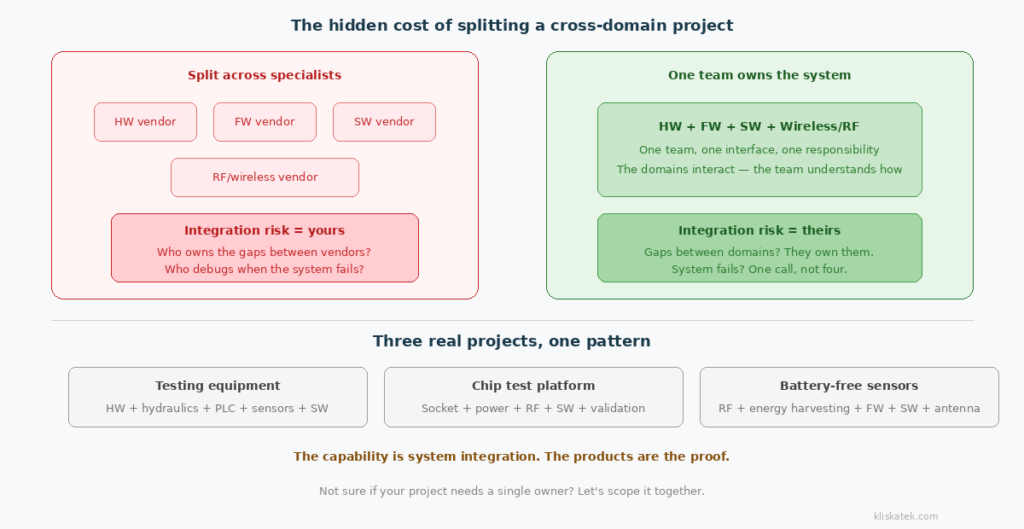
The problem is not that the vendors are bad at their jobs. They’re usually very good. The problem is what happens at the boundaries — the spaces between disciplines where nobody has clear ownership.
A hardware design assumes certain signal timing. The firmware developer doesn’t know about that assumption because it wasn’t in the spec — it was in the head of the hardware engineer. The software expects data at a certain rate, but the firmware delivers it at a different rate because the hardware has a constraint the software team never heard about. The RF layer needs antenna clearance that the mechanical design doesn’t provide because the housing was designed before the antenna specs were final.
Each of these issues is individually small. Together, they can derail a project for months. And the debugging is the worst part: when the system fails, every vendor tests their piece in isolation, confirms it works, and points at the interface. “Our board passes all tests.” “Our firmware runs correctly on the eval kit.” “Our software works with the test data.” The system doesn’t work. Everybody is right. Nobody is responsible.
2) The cost nobody quotes
When you receive four separate quotes for the four pieces of your project, the total looks like the project cost. It’s not. The hidden costs don’t appear in any quote:
Integration engineering. Someone has to make the pieces work together. That someone is usually you — the client. You become the systems engineer by default, managing interfaces you may not fully understand. If you have a strong internal engineering team, this is manageable. If you don’t, you’re learning systems engineering on your most critical project.
Communication overhead. Four vendors means four sets of meetings, four sets of status updates, four different issue tracking systems, four different ideas of what “done” means. The coordination cost scales quadratically, not linearly — vendor A needs to align with vendors B, C, and D; vendor B needs to align with A, C, and D; and so on.
Debugging across boundaries. When something doesn’t work, identifying whether the problem is in the hardware, the firmware, the software, or the wireless layer requires understanding all four. The vendor who finds the root cause is rarely the one whose discipline it falls in — it’s usually an interaction between two layers that neither vendor saw coming.
Iteration delays. Every change in one layer potentially affects the others. A firmware change might require a board spin. A software update might need firmware support. An antenna redesign might change the housing. When these dependencies cross vendor boundaries, every iteration requires negotiation, re-quoting, and re-scheduling.
3) Three projects, one pattern
We’ve seen this pattern from both sides — as the team called in to fix it, and as the team that took ownership from the start. Three examples, anonymised:
A manufacturer of testing equipment needed software for machines that test automotive components. They asked for “a programmer.” But what they really needed was someone who understood the machine — hydraulics, PLC, sensors, mechanical patterns — and could write software that made sense in that context. The previous approach had been to hire a software contractor. The contractor wrote technically correct code, but they didn’t understand what the machine was doing physically. Starting over with a team that understood the system — not just the software layer — solved the real problem behind the request.
A semiconductor company designing a new RFID chip needed a complete test platform: custom test sockets, power delivery and measurement, RF interfaces, stimulus generation, and validation software. They had their chip expertise. What they needed was the system around the chip — and that system crossed hardware, firmware, RF, and software. Splitting it would have meant four vendors and the chip company doing integration. Instead, one team designed the entire platform. The result: a working test system that matched the chip’s specs because the same people who designed the socket also wrote the software that drove it.
Battery-free wireless sensors — our own products. A sensor that harvests energy from an RF field, powers a measurement, and transmits the result wirelessly requires antenna design, RF energy harvesting circuits, ultra-low-power firmware, sensor signal conditioning, and software for the reader side. These domains interact at every level: the antenna affects the energy budget, the energy budget constrains the firmware duty cycle, the duty cycle determines the data rate, the data rate shapes the software architecture. Splitting this across specialists would create exactly the integration gaps described above. We own the system because the system can’t be split.
4) The alternative: one team, one system
The alternative to splitting is finding a team that can own the full system — hardware, firmware, software, and wireless/RF — under one roof.
This doesn’t mean one person does everything. It means one team, with specialists in each domain, works together with shared context. The hardware engineer sits next to the firmware developer. The antenna designer talks to the software architect. When a decision in one layer affects another, the conversation happens in real time, not across vendor boundaries.
The result is not just faster development — it’s a fundamentally different kind of accountability. When the system doesn’t work, there’s no finger-pointing. The same team owns the problem and fixes it, because they understand all the layers and how they interact.
5) How to recognise a cross-domain project
Not every project needs this approach. If your project is purely software, hire a software team. If it’s a board design with well-defined specs, a hardware house will do fine. The approach described here is specifically for projects where the disciplines interact — where decisions in one layer affect the others, and the system behaviour is more than the sum of its parts.
Signs that your project is cross-domain:
The spec keeps changing across layers. You started with a hardware spec, but the firmware requirements changed the board design, and the software requirements changed the firmware, and now the hardware spec is on version 4. This isn’t poor planning — it’s the natural behaviour of a system where the layers are coupled.
You’re spending more time coordinating vendors than doing engineering. If your project manager is translating between a hardware house and a software team because they don’t speak the same language, that’s a cross-domain signal.
The integration phase keeps growing. The plan said “2 weeks for integration.” It’s month 3 and you’re still finding interface issues. The pieces work individually; the system doesn’t.
Nobody can tell you why the system doesn’t work. Each vendor has tested their piece and it passes. The system fails. Nobody knows where to look because nobody understands the whole picture.
6) What we do
At Kliskatek, system integration across hardware, firmware, software and wireless/RF is our core capability. It’s what we’ve done for 17 years, across applications as diverse as battery-free wireless sensors, automotive test equipment, semiconductor chip validation platforms, and wireless product development.
The rarest layer in our stack is wireless/RF, energy harvesting, and ultra-low-power design. That’s where the deepest expertise lives. But the value we deliver is broader: the ability to own the complete system when the disciplines need to work together, so our clients don’t carry the integration risk themselves.
Our products — the SenseID, SenseBLE, and SenseNFC battery-free sensor families — are the hardest expression of this capability. If we can make a sensor that harvests energy from an RF field and transmits data wirelessly with zero batteries, we can design your cross-domain system.
7) Starting with a scoping conversation
If you’re not sure whether your project needs a single system owner or can be safely split across specialists, the best starting point is a conversation. We offer paid scoping sessions that de-risk the project before it starts: we analyse the domain crossings, identify the integration risks, and recommend an architecture — whether that means working with us or splitting it (with clear interface specs that actually work).
The scoping is paid because it delivers real value — and because it filters for projects where the client is serious about solving the problem, not just exploring options.
Have a project that crosses hardware, firmware, software and wireless? Contact us and tell us about it. We’ll tell you honestly whether it needs a single owner or can be safely split.
Next week: “Does Your Sealed, Inaccessible Asset Actually Need Battery-Free? A Practical Filter” — a decision framework for knowing when battery-free sensing is the right answer, and when it isn’t.