
Battery-free sensor lifetime is the question a high voltage project reaches about ten minutes after everyone agrees that a battery is impossible. The asset is specified for forty years. The enclosure gets sealed at the factory and nobody opens it on a whim. So how long does the thing you are about to put inside it actually last?
In June we published the argument that gets battery-free sensing into that enclosure in the first place. The compartment is sealed, the conductors are lethal, the service life runs to decades, and a coin cell in there is a deferred problem rather than a solution. We still stand behind that post. Last week we worked through what the energy budget actually buys you in a single session. This post is the other axis. Not how often the device can measure, but how long it is still there to measure at all.
It is also the easy half. Taking the cell out removes the first thing that would have failed. It does not promote your sensor to the lifetime of the asset. It promotes the next weakest item in the assembly, and most teams have never had to think about what that item is, because the battery always got there first.
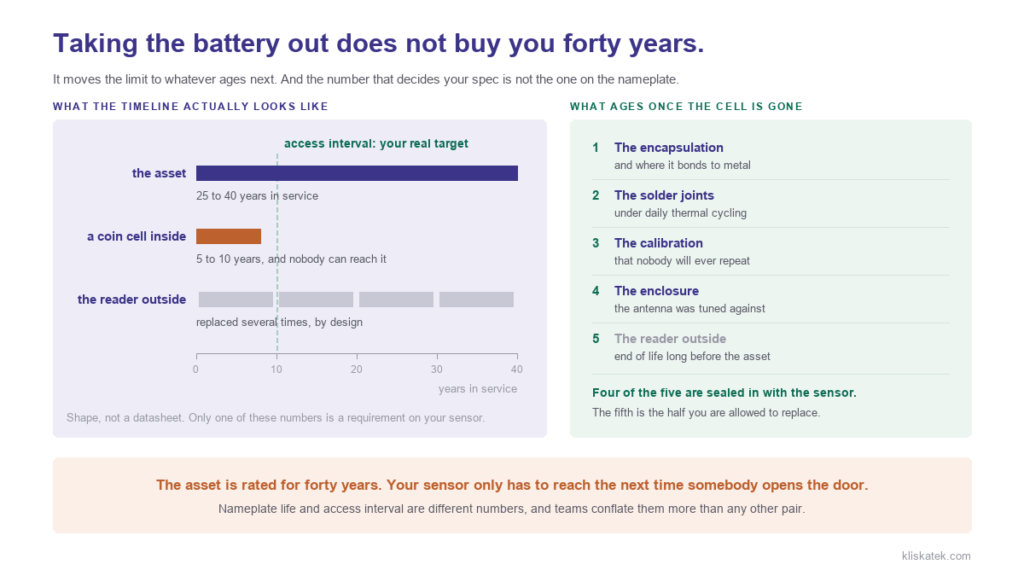
Nobody certifies a battery-free sensor lifetime of forty years
Start with where the number comes from, because it is not a test result. Forty years is a service expectation. The asset owner plans around it and the procurement department writes it down. A whole industry has organised itself around equipment that stays in place for a very long time.
The qualification underneath that expectation works differently. High voltage switchgear earns its approval through type tests and endurance classes, and those classes count operations and test sequences rather than calendar years. The IEC 62271 series is built that way on purpose. No manufacturer ran a circuit breaker for forty years before selling the first one. The industry built confidence out of standardised tests, decades of accumulated service experience and conservative design margins.
That matters to you for two reasons. Write “forty year lifetime” on a sensor datasheet and you are making a claim nobody can test. The product manager across the table will ask what it rests on. The honest version turns out to be more useful anyway. Name the mechanisms that end the sensor’s life, then say what evidence you hold for each one.
What actually ages once the cell is gone
Five mechanisms, in the order we see them bite.
The encapsulation, not the electronics. Potting keeps moisture and vibration away from the die and the interconnect. It is also a slab of polymer bonded to metal and to plastic, and those three materials expand at different rates. Thermal cycling works that interface for years. When it finally opens, it opens a moisture path, and moisture is what kills the part. Note where the sensor sits in a busbar application: on the hot spot, by design. That is the worst thermal duty in the cabinet.
The interconnect. Solder and conductive adhesive joints fatigue under the same cycling. A tag on a joint that runs well above ambient at load and falls back every night accumulates a cycle count that deserves a number in the spec.
Calibration you will never repeat. A contact temperature probe drifts. In a normal product you would recalibrate it during service. Inside a compartment nobody opens, you never will. So the drift has to be designed out, or bounded by the sensing element you chose. The alternative is to measure in a way that does not depend on absolute accuracy at all.
The RF environment, not the antenna. You tune the antenna against the enclosure it lives in. Enclosures change. Somebody adds a cable duct, swaps a panel, or racks a new unit alongside. Your tag is exactly as you left it and your link budget is not.
The read infrastructure. The least durable thing in the whole system usually sits outside the enclosure. Reader models go end of life, gateways get replaced, operating systems move on, and occasionally the company that made your reader does too.
The half that is designed to be replaced
Look at that list again and something useful appears. Four of the five mechanisms live inside the sealed volume, where nobody can reach them. The fifth lives outside, where a technician reaches it during ordinary work.
That split is the real architectural advantage of battery-free sensing in a sealed asset, and it deserves a sharper description than “no batteries”. The tag holds no state between reads, keeps no clock, and accepts no firmware update once it is potted. Those sound like limitations. They are the reason you can leave it alone for decades. Every decision that might change belongs on the reader side, where changing it costs a site visit rather than an outage.
The same logic applies to what you record. The measurement history outlives the device that produced it, and it also outlives the software that first stored it. Pick identifiers and a record format you would still be comfortable reading in twenty years. Keep the meaning of a reading in the record itself, not in the reader that happened to collect it.
Evidence a battery-free sensor lifetime claim can rest on
You cannot test forty years, so you test mechanisms. High temperature storage, thermal cycling, damp heat, and mechanical shock and vibration where the mounting justifies it. Elevated temperature buys you an Arrhenius extrapolation, which is a projection with stated assumptions rather than a promise.
Two honest limits belong in that conversation. Accelerated ageing validates the mechanisms you thought of, and says nothing about the one you missed. The failures that surface after twenty years are usually exactly the ones nobody modelled. And the evidence has to sit at assembly level. A component rated for a thousand hours at 125 °C tells you very little about a potted assembly bolted to a busbar.
So a battery-free sensor lifetime you can actually defend has a shape rather than a number. These are the mechanisms, this is the test evidence, these are the service conditions it covers, and this is what happens when one of them ends.
The number that really constrains you is the access interval
Here is the reframe that changes most of the specifications we see.
An asset built for forty years is not necessarily an asset nobody touches for forty years. Some compartments are sealed for the full service life and never opened. Others come apart on a planned overhaul every eight or twelve years. Somebody already has that panel open, with the equipment de-energised.
If your asset falls in the second group, the sensor does not need to reach forty years. It needs to reach the next access with margin, and to be quick to swap while the door is open anyway. That is a different product, a different qualification effort and a different price.
Teams conflate the nameplate life of the asset with the access interval of the enclosure. It is the most common mistake we meet in this area. The two numbers are unrelated, and only one of them is a requirement on your sensor. Establish which one you are facing before anybody specifies anything, because the answer decides how hard the rest of the project has to be.
Five decisions a long life requirement actually changes
- Specify the temperature at the mounting point, not the ambient of the cabinet. Every ageing mechanism on this page is driven by the temperature the part sees, and the part sees the joint.
- Prefer measurements that degrade gracefully. A trend, or a differential against a second tag, survives drift far better than an absolute threshold with two degrees of margin.
- Make failure legible. A tag that stops answering tells the operator something. A tag that answers with a plausible wrong number is worse than no tag at all. Push the likely failure mode towards silence.
- Choose the replaceability boundary on purpose. Decide which parts belong to the “replace at overhaul” set and which parts have to survive alone. Leaving that to chance is how a sensor ends up permanently potted for no reason.
- Write the requirement in mechanisms and evidence. “The sensor shall survive the service life of the equipment” is not something an engineer can test or a supplier can price. A list of conditions, cycles and required test evidence is both.
What this looks like from the OEM side
If you build the equipment rather than operate it, the lifetime question lands on your desk in a particular form. Your customer expects the monitoring to last as long as the product you sold them. Your warranty ends long before that. And the sensor is now a line in your bill of materials rather than an accessory somebody bolts on later.
The good news is that designing the sensor in during manufacturing puts battery-free sensor lifetime under your control. All five mechanisms become yours at once. Mounting temperature, cycle count, encapsulation, antenna environment and the read interface stop being someone else’s assumptions. That is a real advantage, and it is one of the few places where doing the harder thing early makes the later work smaller.
Specifying monitoring for an asset that has to outlive several generations of everything around it? Three facts start the useful conversation: what the asset is, what temperature the mounting point really reaches, and how often the enclosure is opened. Send us those and we will tell you what lifetime claim the design can honestly carry. Tell us what you need to measure →
Next week: beyond temperature, and what else a few microwatts can actually measure.