
Custom battery-free sensors get asked the same question in every first call, and it is rarely about temperature. Somebody needs a pressure, a weight, a pH or a display on an asset where a battery is not welcome. Almost everything published about battery-free sensing, ours included, uses temperature as the example. That is not because temperature is all there is. It is because temperature is the cheapest measurement in the catalogue, and cheap is what battery-free rewards.
Last week we worked through how long the device lasts once the cell is gone. The week before that we covered what your power budget allows in a single session. This post is the third axis. Not how long, not how often, but what.
Why temperature became the default
A digital temperature sensor asks almost nothing of the system around it. It needs no excitation current and it settles in milliseconds. It hands you a number over a two wire bus, already calibrated at the factory. In our own worked example of a 150 µJ session, the sensor accounted for about 80 µJ. Most of that went into powering the part, not into wrestling with the signal.
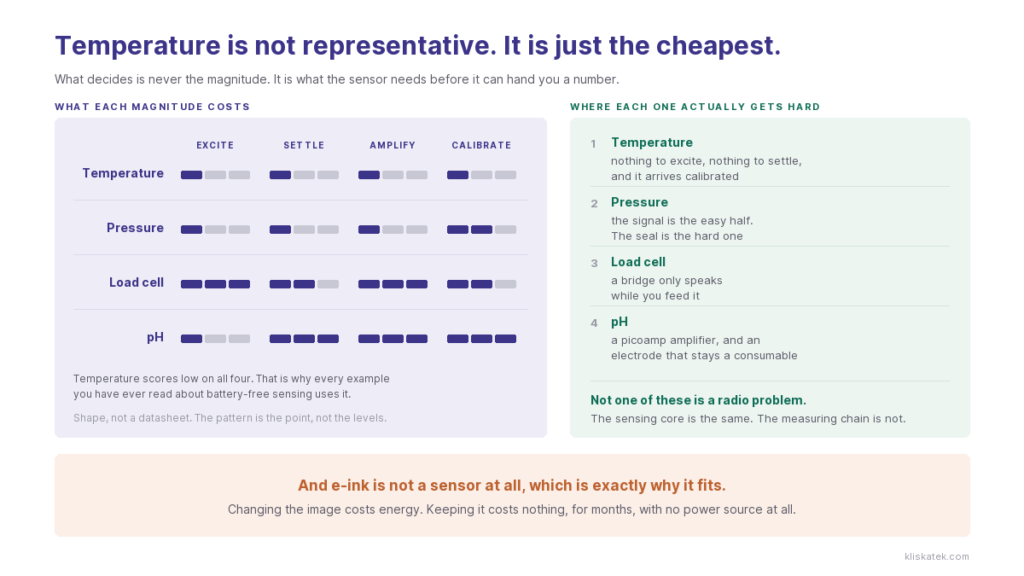
That combination is unusual. Change the magnitude and you normally lose at least one of those four properties, sometimes all four. So the useful question is not which magnitudes we support. It is what each magnitude costs before it becomes a number.
What a measurement costs custom battery-free sensors
Four costs, and only the first one is obvious.
Excitation. Some sensors are passive elements that need to be driven. A strain gauge bridge does nothing until you put a voltage across it. Then it draws that current for as long as you convert. The reading is not free the way a digital part’s reading is free.
Settling time. The device is awake for a few milliseconds. Some sensing elements need longer than that to reach a stable value. Then you pay in time rather than in current, and time under a harvested field is the scarcest thing you have.
Analogue conditioning. A raw sensor output often measures in millivolts or microamps. Getting it to a converter means amplification. Amplifiers bring their own power draw, their own settling behaviour and their own offset and drift. This is where most of the engineering actually goes.
Calibration and reference. Somebody has to turn counts into engineering units, and something has to stay stable enough for that conversion to remain true. On an asset nobody opens, you get one chance.
Score a magnitude against those four and you can predict the difficulty of custom battery-free sensors before anyone builds anything. Temperature scores low on all four. That is the whole story of why it became the example.
Pressure sits closest to temperature
Pressure is the easy neighbour. Modern piezoresistive and capacitive elements arrive as integrated digital parts. The bridge, the amplifier and the compensation all sit inside the package. From the tag’s point of view, reading one looks a lot like reading a temperature sensor.
The complications are mechanical rather than electrical. The part needs a port to the medium and the port needs a seal. That seal then has to survive whatever the asset does, for as long as it does it. We covered this in the gas insulated case, where pressure and humidity together tell you about seal integrity. The sensing was the straightforward half of that project.
Load cells: the excitation problem in its purest form
Weight is where the four costs start to bite. A load cell is a resistive bridge, and a bridge is a divider that only speaks while you feed it. Excite it, wait for the mechanical and electrical transients to settle, then amplify a few millivolts of imbalance. Convert, and only then shut it down. Every one of those steps costs microjoules that a digital sensor never spends.
None of that puts weight out of reach for custom battery-free sensors. It makes it a design exercise with real trade-offs. That is why a weight reading on a battery-free tag takes seconds rather than milliseconds. We described the warehouse version of this in weight, ID and environment on the same tag.
One thing worth knowing before anyone writes a specification. Legal metrology for load cells lives in OIML R 60. Its accuracy classes assume a measuring chain that stays powered and stable. A tag that wakes up, measures once and dies is a different animal. If the number has to be legally defensible, say so on day one, because it changes the architecture rather than the firmware.
pH is where custom battery-free sensors get genuinely hard
pH is the one we are most careful about, and the reason is not energy.
A glass electrode is a voltage source with a source impedance in the hundreds of megohms. Reading it takes an amplifier that draws input current in picoamps. That amplifier then has to settle against an enormous source resistance. Doing all of it in a few milliseconds, on harvested energy and with no continuous bias, is a hard analogue problem rather than a power one.
Then there is the part nobody enjoys hearing. The electrode itself is a consumable. Reference junctions foul and the glass ages. Calibration then drifts on a schedule that chemistry sets, not your maintenance plan. Battery-free removes the battery from the maintenance calendar. It does not remove the electrode. Say the reason you want a battery-free pH sensor is to stop visiting the asset. The electrode will still make you visit it. We would rather say that in the first call than in the third month.
Solid state pH elements change this picture and we watch them closely. They also carry their own drift and calibration story, so the honest answer today stays conditional.
E-ink is not a sensor, and that is exactly why it fits
E-ink keeps appearing in these conversations, and it is the odd one out. It is an output rather than an input. It is also the only display technology that behaves the way a battery-free system needs. Changing the image costs energy. Keeping it costs nothing at all.
That bistability is the whole reason it belongs here. A tag can harvest field from a reader or a phone and redraw a label. It then holds that label for months with no power source whatsoever. Anyone walking past reads the current value with their eyes, no reader required. Think price labels, work order status, calibration due dates or asset state on a shelf. That is a very different proposition from a screen that has to stay alive.
The constraint is the update, not the retention. A full screen refresh is a real energy event and it takes seconds. So the design question becomes how much of the image actually changes, and how long the field lasts.
What custom battery-free sensors cannot do
The part of this series that earns the most trust is where we disqualify things. So here is the current line, and it is where custom battery-free sensors stop being the right answer.
Anything that needs continuous excitation over a long window is a poor fit. Vibration is the clearest example. Sampling acceleration at the moment of interrogation gives you trending, tilt and shock. We said as much in the SenseID evaluation guide. It does not give you a frequency spectrum. If your diagnosis depends on an FFT, you want a powered device, and we will say so.
Electrochemical gas sensors with a heater fall into the same bucket. The heater is a continuous load rather than a burst. Anything needing minutes of settling has the same problem seen from the other side. And any accuracy claim resting on periodic recalibration deserves a conversation about who performs it, before anyone commits to a form factor.
What to send us
The sensing core is the same across our families. So the interesting part of a custom project is never the radio. It is the four costs above, and the mechanics around them.
If you are weighing a magnitude beyond temperature, three things let us answer properly. What you need to measure, with the range and the accuracy you actually need rather than the one that sounds safe. Where the sensing element has to sit, and what surrounds it. And what the reading feeds, because a threshold crossing and a trend line have very different energy budgets.
Send us those three. We will tell you whether it fits, what it would take, or that a powered device suits you better. Talk to our engineering team.
Next week: what happens to the reading after it leaves the tag, and why the work order decides the project rather than the sensor.