
Most battery-free projects meet their first real constraint in a spec review. Somebody writes “one reading every ten seconds”, and the number sounds modest. It is not a modest number. It is the whole design.
A battery-free sensor sampling rate is not a setting. It is the output of an arithmetic problem with three inputs, and one of them is usually outside your control. This post is that arithmetic, and what to do when it does not give you the answer the spec wants. If you want the anatomy underneath it, we wrote that up in Inside a Battery-Free Sensor. This one is about the number you have to defend in a meeting.
What actually sets a battery-free sensor sampling rate
Three inputs, in the order that matters.
Energy per session. Wake up, power the sensor, let it settle, convert, do something with the number, transmit, go back to sleep. That is one session, and it has a cost in microjoules. In our own worked example, a typical session came to roughly 150 µJ: 80 µJ for the sensor, 20 µJ for compute, 5 µJ for the transmit logic and about 45 µJ of overhead.
Energy available per unit of time. This is the input people forget, and it is the one you often do not own. It is set by how much field reaches the device, which depends on the reader, the distance, the enclosure and what the asset is made of.
Storage. The capacitor does not create energy. It buys you the right to spend energy faster than it arrives, for a short while. It sets the size of the burst, not the rate.
Rate comes from the second input. Burst size comes from the third. Confusing the two is the most common mistake we see in a first design review.
Three regimes, and only one is about the capacitor
Before doing any arithmetic, work out which of these you are in. The answer changes what the question even means.
Reader-powered, on demand. UHF RFID with an interrogator present. The reader decides when the device lives. Your sampling rate is a property of the installation, not of the tag: how many portals, how long the dwell, how often something passes. A tag that could technically measure ten times a second is irrelevant if the field arrives twice a day.
Tap to measure. NFC. A human sets the rate by walking up with a phone. The right question is not sampling rate at all, it is whether anyone will actually walk that route, which we argued in NFC maintenance rounds.
Harvest then send. Ambient energy, no reader waiting. Here the arithmetic below is the whole story, and here the honest answers are usually slower than the spec.
Only the third regime is really about the capacitor. In the first two, the infrastructure sets the rate and the storage just has to survive one session.
The arithmetic, with our own numbers
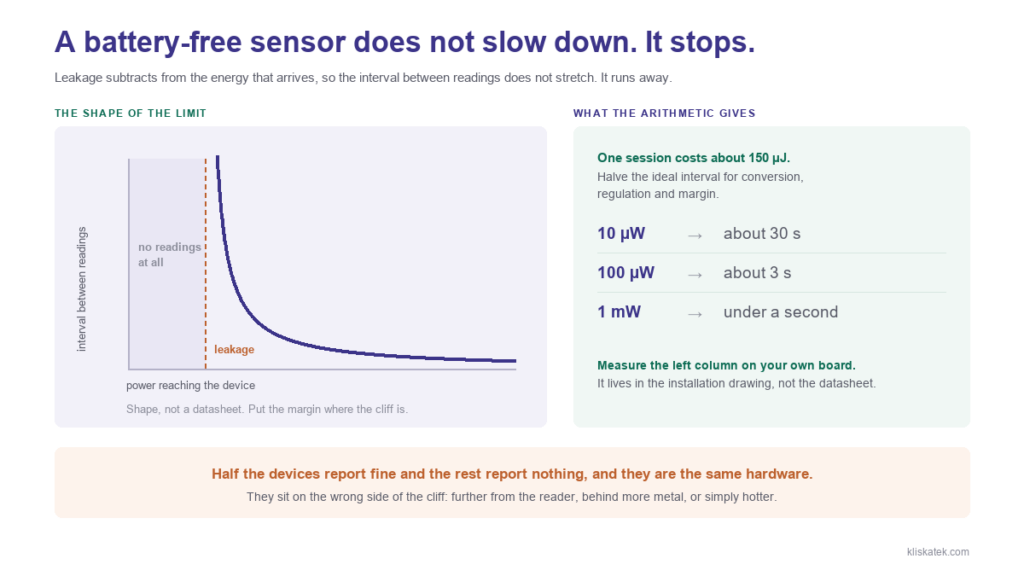
Take the 150 µJ session above. Divide it by the power actually reaching the device and you get the interval between readings. Then halve the result, because conversion, regulation and margin are not free. Roughly half is a fair first assumption, and your board will tell you the real one.
| Power available at the device | Ideal interval | Realistic first estimate |
|---|---|---|
| 10 µW | 15 s | ~30 s |
| 100 µW | 1.5 s | ~3 s |
| 1 mW | 0.15 s | under a second |
Two warnings about this table. It is arithmetic, not a datasheet, and the left column is the number you have to measure rather than assume. And every value in it assumes the field is there continuously, which in a real installation it rarely is.
Now the part that surprises people, and the reason this post exists.
Below a threshold you do not get slower readings, you get none
Leakage runs whether or not you are measuring. The storage element loses charge on its own, and so does the rest of the circuit. So the energy that accumulates is not what arrives. It is what arrives minus what leaks.
That turns the interval into a division by a difference, and a division by a difference behaves badly. Cut the incoming power in half and the interval does not double. As the harvested power approaches the leakage, the interval runs away to infinity. The device stops working entirely.
This is why a battery-free deployment tends to fail in a way that confuses everyone on site. Half the devices report fine and the rest report nothing at all, and they are the same hardware. They are not broken. They sit on the wrong side of a cliff, because they are further from the reader, or behind more metal, or simply hotter, since leakage rises sharply with temperature.
A battery-powered sensor degrades gracefully. This kind does not. Plan for the cliff, and put your margin where the cliff is rather than where the average is.
The capacitor you bought is not the capacitor you have
The storage number in your budget is optimistic, often by a lot. A ceramic capacitor loses effective capacitance under DC bias, loses more with age, and loses more again at temperature. Those effects multiply. A published worked example takes a nominal 10 µF part down to about 2.9 µF once bias, ageing, temperature and AC conditions are applied together.
Supercapacitors solve the size problem and bring their own: leakage that gets worse at high temperature, and reduced life at low temperature. That matters more than usual here, because leakage is exactly the term that produces the cliff above.
So the practical rule is dull and it holds. Derate the storage hard, then measure the energy per session on your own board with your own enclosure, and treat the datasheet capacitance as a starting point for a purchase order rather than an input to a power budget.
Four levers when the spec asks for more than the budget allows
In order of how much they usually buy you.
Cut the energy per session. Usually the biggest win, and usually in the sensor rather than the radio. Settling time is the quiet cost: many sensors spend most of their energy waiting to become accurate. A different part, or a shorter settle with a correction, can move the total more than any firmware tuning.
Cut what you send, not how often you send. Transmitting a threshold crossing costs a fraction of transmitting a waveform. Decide on the device what is worth saying.
Buy more field time. Add a reader, move it closer, change the antenna, change where the device sits. This is the lever that works best and gets considered last, because it lives in the installation budget rather than the product budget. It is also the one that turns an impossible spec into a routine one.
Relax the rate. Ask what decision the reading actually feeds. A measurement that triggers a maintenance visit does not need a ten second interval, because nobody can act on it that fast. Specs often carry a sampling rate copied from a wired instrument, where sampling was free.
When the honest answer is a battery
Sometimes the budget does not close, and the answer is that this application is not a battery-free application. If you need continuous high rate sampling with no reader nearby and no ambient energy, no amount of design will fix it, and we would rather say so at the spec stage than discover it together at the pilot.
Our filter is unchanged from what battery-free really means: the technology earns its place where the asset is sealed, inaccessible or long-lived enough that changing a battery is the real problem. It is a maintenance answer before it is a measurement answer.
What to write in the spec instead of a number
Replace “one reading every ten seconds” with five lines that can actually be engineered against.
- The decision the reading feeds, and how fast anyone can act on it.
- The energy per session measured on your board, not estimated from datasheets.
- The power available at the device in the worst position of the installation, not the average.
- The temperature range, because leakage and capacitance both move with it and both move the wrong way.
- What counts as acceptable silence: a device that misses readings occasionally, or one that must never miss.
That last line is the one that changes designs. It is also the one nobody writes down.
Have a sampling rate in a specification and no idea whether it is achievable? Send us the number, the asset and the temperature range, and we will tell you which of the three regimes you are in and where the cliff sits. Tell us what you need to measure →
Next week: why a sensor that has to last forty years changes the question, and what that means for high-voltage assets.