
Battery-free BLE tracking is one of the most attractive ideas in this field, and one of the easiest to get wrong. A tag with no battery that lasts as long as the thing it is stuck to. Any nearby phone or gateway can hear it. Last week we used aviation to show the questions a sealed, mission-critical asset has to answer. This week is about a promise that sounds simpler and is harder to keep: telling you where something is.
We write this for the product manager or founder weighing that idea, before anybody commits to hardware. The arithmetic most people do for it is correct. It is just not the arithmetic that decides whether the product works.
Why battery-free BLE tracking is such an attractive idea
The pitch writes itself. A small tag harvests radio energy from its surroundings, stores a little, and sends a short Bluetooth advertisement when it has enough. There is no battery to replace and nothing to charge. Bluetooth receivers are everywhere, so the infrastructure seems to exist already.
Then someone runs the numbers. They estimate how much radio energy surrounds the asset on average, compare it with the cost of one advertisement, and get an interval. Perhaps one message an hour. For tracking that sounds like plenty, because nobody needs to know where a pallet is every second.
That calculation is usually done carefully, and we have no quarrel with it. We worked through the same kind of arithmetic for sensor sampling rates, and it holds. The problem is what the average hides.
Ambient energy is a distribution, not a number
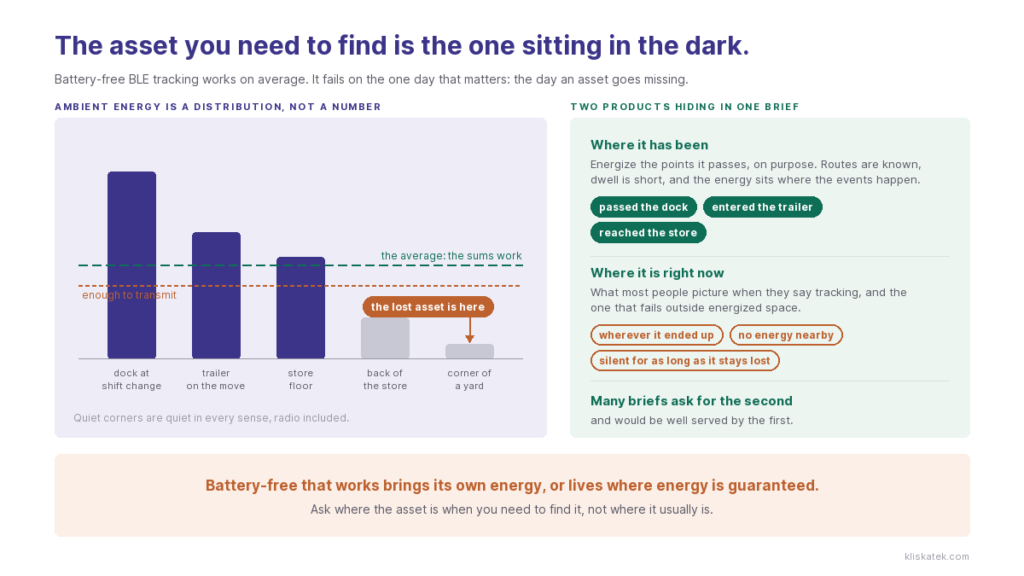
The radio energy around an asset is not a property of the asset. It belongs to the place and to the moment. A loading dock at shift change is busy with readers, phones, radios and gateways. The same dock at three in the morning is quiet. A container on a truck passes through energy and out of it again. A cage at the back of a store may sit in one spot that never sees much at all.
So the honest description is not a single figure. It is a distribution: how much energy, where, and when, across the life of the asset. The average of that distribution is real. For tracking it is also close to useless, and the next section is why.
The asset you need to find is the one sitting in the dark
Think about when a tracking product earns its money. Not while the asset is where it should be, moving through the places it always moves through. You already know where it is then. It earns its money on the day the asset goes missing.
And a missing asset has a typical shape. It has stopped moving, somewhere nobody walks past. A returnable pallet left in the corner of a customer’s yard. A tool forgotten in the back of a van. A spare parts cage pushed to the far end of a store. Places with little traffic have little radio activity, and those are exactly the places where a harvesting tag cannot collect enough to speak.
That is the correlation nobody puts in the spreadsheet. The failure is not a tag that transmits less often than planned. It is a tag that goes silent at the moment you need it, and stays silent for as long as the asset stays lost. The average says one message an hour. The lost asset says none.
From the sensor side, we described the same physics as a cliff rather than a slope. Below a threshold you do not get slower readings, you get none. In tracking, the cliff and the lost asset tend to be in the same place.
Why battery-free BLE tracking that works brings its own energy
This is not an argument against battery-free BLE. It is an argument about where the energy comes from, and the systems that work are open about it.
Wiliot is the obvious example, and its own documentation is worth reading closely. It quotes the energizing range of its tags from a bridge to the tag: up to 40 metres in the sub-1 GHz band, under optimal conditions. It also describes its network infrastructure as the part that energizes the tags. Its FAQ is just as direct: with no energy nearby to harvest from, a tag does not transmit. That is not a flaw in the design. It is the design. The energy is part of the deployment, not something the tag hopes to find.
Our own battery-free BLE sensors work on the same principle. SenseBLE harvests from a dedicated UHF source and reports over Bluetooth. Splitting power and data across two bands is what usually keeps it cheaper than a reader per zone. It is the point we made earlier this year when we compared reader-powered RF with light and vibration. If you need energy at a specific moment, you have to bring it.
So the rule is short. Battery-free that works either brings its own energy or lives where energy is guaranteed. “Ambient” on its own is not a plan.
What battery-free BLE tracking is genuinely good at
None of this makes the technology less useful. It makes the question sharper, because most tracking briefs hide two different products.
The first is knowing where an asset has been. It passed the dock, it entered the trailer, it reached the store. Each of those points can be energized on purpose, and a harvesting tag is very good at announcing itself on the way past. Routes are known, dwell times are short, and the infrastructure sits exactly where the events happen.
The second is knowing where an asset is right now, wherever that turns out to be. That is what most people picture when they say tracking. It is also the one that fails outside energized space, for the reason above.
Many projects ask for the second and would be well served by the first. Separating them early changes the architecture, the budget and the conversation with whoever signs the business case. It is the most useful ten minutes in the whole scoping exercise.
Where the “no battery” requirement comes from
One more question belongs before any design work, because it changes which problem you are solving.
Sometimes “no battery” is an engineering requirement. The asset is sealed, it lives too long, or nobody will ever replace a cell. Sometimes it is not engineering at all. Transport and waste rules have their own requirements for anything that contains a cell. Some teams want to keep their product out of a category, not out of a maintenance schedule. Those are different requirements, and they belong to different people in your organisation.
So find out which one you have. If it is engineering, the energy question above is your whole project. If it is classification, it is a question for your compliance team first, and their answer may widen your options or narrow them.
And the honest part. Solving the classification does not solve the physics. A tag that satisfies every rule still has to find energy in the corner where the asset got lost.
Three questions before you build anything
If you are weighing battery-free BLE tracking, these three make a first conversation useful.
Where is the asset at the moment you most need to find it? Not where it usually is, but where it ends up when it goes missing.
Do you need to know where it is now, or where it has been? Be honest about which one the business case really needs.
What already emits energy near that spot, and who controls it? If the answer is nothing, or somebody else’s equipment, you have your answer about ambient.
Send us those three and we will tell you whether your idea needs its own energy and where that energy would have to live. We will also tell you whether a battery-free design is still the right one. Sometimes it is not, and that is far cheaper to learn on a call than in a pilot. Talk to our engineering team.
Next week: when the asset keeps moving, and a tag only gets a moment in the field to wake up and report.