
Aerospace battery-free sensors are this category with every constraint turned up at once. Last week we wrote about what a reading has to carry before a maintenance system can act on it. We closed by promising a look at assets that are sealed, inaccessible and mission-critical all together. Aircraft interiors are all three, which makes them a useful place to look even if you will never go near an aircraft.
This post is for the person whose asset has just matched that description. In June we published a filter that tells you whether you need battery-free at all. This one is about what you get asked once you pass it.
Why aerospace battery-free sensors are the category example
You do not have to work in aviation for this to be about you. Sealed compartments, decades of service life and a reason not to open things are common across heavy industry. What aviation adds is a schedule. Somebody will ask you for evidence early, in writing, before you have built anything.
That is why it makes a good mirror. In most sectors the constraints of this category surface slowly, over the first deployment and the first field failure. In aviation they all arrive in the first month, from people whose job is to ask. You get to see the whole shape of the category without waiting ten years for it.
Our June filter sorts assets by how hard they are to reach, and that part still holds. Level 1 is where cables and batteries are not available to you. Access is either impossible, or it costs so much that it may as well be. What the filter does not tell you is what happens next.
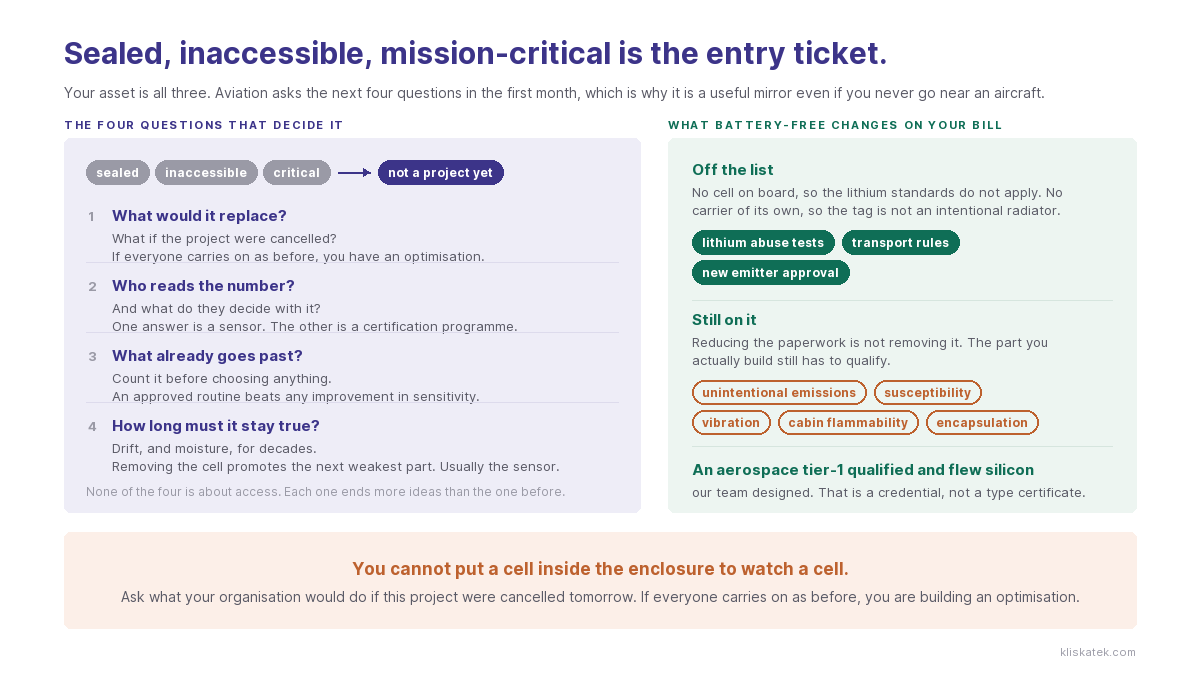
Four questions decide it, and none of them is about access. They tend to arrive in this order, and each one ends more ideas than the one before.
What would the measurement replace?
The first question you will be asked, in one form or another, is what changes if this measurement exists.
If your device already works with a battery in it and you propose taking the battery out, you are offering an optimisation. Optimisations get cancelled, and usually for ordinary reasons. A design changes upstream, a new component turns out to be good enough, a programme reprioritises. Nobody was against your part. The requirement behind it was never load-bearing.
Compare that with a measurement that does not exist today. Either nothing can be powered where you need it, or storing energy in that location is itself the thing nobody will approve. That requirement does not evaporate when somebody redraws a schematic.
The cleanest example we know is checking the state of charge of an emergency battery. You cannot put a cell inside the enclosure to watch a cell. Doing that reproduces the problem you set out to solve, so the requirement survives any redesign upstream. Whether the measurement is feasible is a separate question, and the answer depends on what you actually need to know about the cell. That part is not a one-line answer, and it is worth asking about early.
There is a cheap way to find out which kind you have, and it works before any of this reaches an engineer. Ask what your organisation would do if the project were cancelled tomorrow. If the answer is that everyone carries on as before, you have an optimisation. Better to know that now than in month nine.
Who reads the number, and what do they decide with it?
The second question sets the size of the programme, and the same physical measurement can land on either side of it.
A reading a technician takes on the ground during a scheduled inspection is maintenance data. A reading that a system on board consumes, acts on or reports is airworthiness data, and it brings the certification apparatus with it.
Take one temperature inside one sealed assembly. Read by a technician on a walk-round who writes a job card, it is the first kind. Read by an aircraft system that changes what it does, or shows the value to a crew, it is the second. The sensor can be identical. What moved is who uses the number and what they are allowed to decide with it.
So put that sentence on the first page of your specification, in your own words. Do it before anybody draws a block diagram. Most of the scope arguments we have watched in this area were really this question, discovered late and argued about sideways.
What already goes past your asset?
The third question is about everything except your device, which is why product teams reach it last.
A battery-free sensor needs something to power and interrogate it. If that something already exists and is already approved for the environment, you are adding a passive part to an accepted routine. If it does not, you are proposing to introduce a new emitter into a certified space. That cost will dwarf everything else on your list.
Handheld RFID inspection is already routine in several aircraft maintenance flows. For an idea in this category, that single fact is worth more than any improvement in sensitivity a supplier can offer you. So count what already walks, drives or flies past your asset before you choose a technology. The answer often decides the technology for you, and it is the cheapest piece of homework in the whole project.
How long does the reading have to stay true?
The fourth question is the one that catches people who have done everything else right.
Taking the cell out removes the first thing that would have failed. It does not promote your sensor to the lifetime of the asset. It promotes whatever is now the weakest item in the assembly, and in a sealed location that is usually the sensing element itself. Two mechanisms decide most cases. A contact measurement drifts, and inside something nobody opens you will never recalibrate it. And moisture works on the encapsulation for as long as the asset is in service, which in this category means decades.
Anything closed up at build time is where this bites hardest, and the good ideas are the ones that deserve an honest answer. Powering a tag inside a sealed assembly is a solvable problem. Getting a sensing element that still means the same thing thirty years later is the hard one. No access, no recalibration, and no way to tell drift from a real trend.
Before you accept a number for this, read what a forty-year requirement actually demands. The short version: the service life of the asset and the interval at which somebody opens it are different numbers. Only one of them is a requirement on your sensor. Establishing which one you face changes the price of the project more than any other decision here.
What aerospace battery-free sensors take off your bill
Now the part that works in your favour, and it is bigger than most people expect.
Removing the battery removes a body of regulation, not just a maintenance task. Lithium cells on board bring their own standards for abuse, overcharge, short circuit and thermal propagation. The transport and handling rules follow them. A sensor with no cell is outside all of it.
Removing the transmitter does something similar. A passive tag backscatters the field a reader sends. It does not generate a carrier of its own, so it is not an intentional radiator. The equipment that is one belongs to somebody else, who has already dealt with its conformity.
Put those together and the marginal cost of adding your sensor is a fraction of what an active device would cost you. That argument travels to any certified environment, and it is usually stronger than the maintenance saving you were planning to lead with.
What aerospace battery-free sensors still have to survive
The honest half, because none of that exempts the part you actually build.
Not being an intentional radiator does not exempt you from unintentional emissions or from susceptibility testing. Environmental qualification still applies, and RTCA DO-160 is the document that defines it: vibration, temperature, altitude, fluids, flammability and the rest. Cabin interior materials carry their own requirement, and 14 CFR 25.853 is the version most people meet first.
That last one catches sensor suppliers more often than any RF issue. A potting compound that survives a factory floor may not be acceptable inside a cabin, and finding out late is expensive. We wrote about embedding sensors during manufacturing from the RF side. Here the material choice is the harder constraint, and it is worth asking any supplier about it early.
One test you can apply to whoever you are talking to. An aerospace tier-1 qualified and flew silicon our team designed. That is a credential, and it is not a type certificate. Anyone who lets you confuse the two is telling you something useful about how the rest of the project will go.
What this looks like outside aerospace
The four questions do not need an aircraft.
Gas-insulated switchgear behaves the same way. The compartment is sealed and pressurised, so monitoring inside it without a battery is the only version that exists. And the reading is for maintenance rather than for protection. Encapsulated machinery, potted assemblies and anything closed up at build time sit in the same place.
In every one of them the useful question is not whether you can reach the sensor. It is what the measurement replaces, who reads it, what already goes past, and how long it has to stay true. Aviation just charges you for the answers sooner.
Four questions to send us
If your asset matched the description at the top, these four make a first conversation useful.
What would the measurement replace, and what happens if the project is cancelled? Who or what reads the number, and does any control or safety function depend on it? What already passes near the asset that could power a tag, whether that is a handheld reader, a gateway or a phone? And how long does the reading have to stay trustworthy with nobody touching it?
Send us those four and we will tell you which one is your binding constraint. Sometimes the answer is that the project is smaller than you feared. Sometimes it is that you are describing a certification programme rather than a sensor. Either way it is cheaper to know now. Talk to our engineering team.
Next week: why the ambient energy in a tracking application is never there at the moment you actually need it.