
The prototype to production step is where good projects go quiet. The board works. The firmware does what the demo promised. Somebody senior has watched it light up, and the question changes overnight: when can we have five hundred?
Last week we looked at what decides whether a moving asset gets read. A line that speeds up quietly breaks a system that worked all year. This is the same idea one step earlier, before anything has been installed anywhere.
That sounds like a question about scale. It is not. We write this for the person who has to answer it. Usually a product lead or a CTO with a working prototype, a committee asking for a date, and a supplier list that somebody picked for speed rather than for volume.
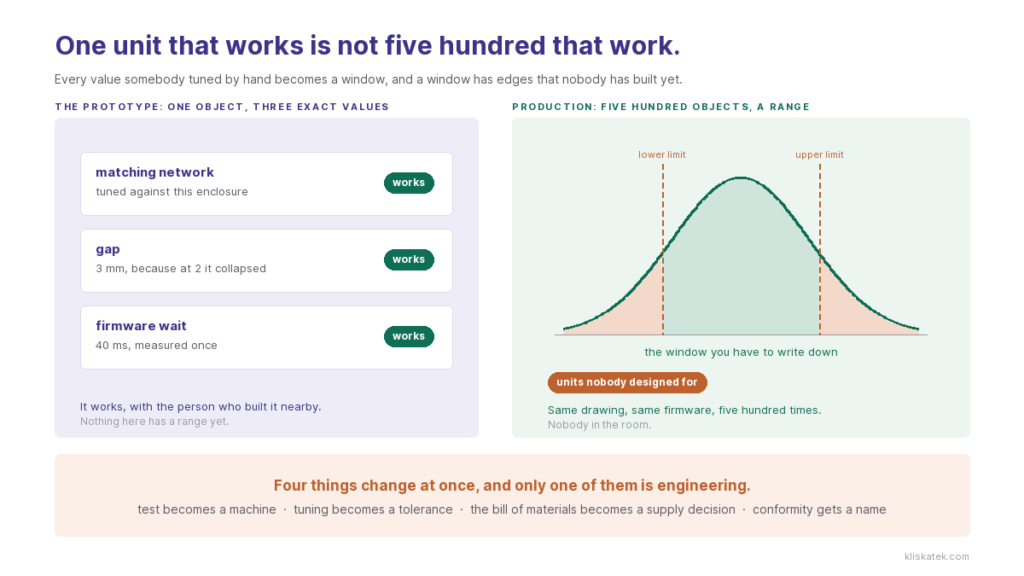
Prototype to production is a change of object, not a change of scale
A prototype is one object that works, usually with the person who built it somewhere nearby. Production is five hundred objects that all have to work, with nobody nearby at all.
Everything that was a value in the prototype becomes a range in production. A tuning becomes a window. A gap becomes a tolerance. A cure time becomes a process step with a worst case. A gain becomes a distribution across a reel of parts.
There is an honest test for where you are. Take any number that makes your prototype work and ask what happens at the edges of its range. If the answer is that you have only built one, you have found the work.
The second question follows from the first. How many of the five hundred have to work the first time? Ninety per cent sounds reassuring until you price fifty reworks. The people who do that rework are the same people who should be building the next batch.
Test stops being something you do and becomes something you build
In the lab, test is an activity. You measure until it looks right, and you are the instrument.
In production, test is a machine. It needs a fixture, a repeatable geometry, a criterion, a log and somebody who maintains it when it drifts. Building that machine is a project of its own, and it is the one most plans leave out. We have built a few of them, and wrote up what it takes when the bench has to decide whether a part is good.
That machine also needs an owner. Fixtures wear, contacts oxidise and cables get stood on, and a tester that has drifted quietly starts rejecting good units or, worse, passing bad ones. Who calibrates it, against what reference, and how often belongs in the plan, not in the first bad week of production.
It also forces a decision that teams like to postpone: what happens to a unit that passes narrowly. A pass or fail buzzer hides the drift that would have warned you that the process moved. We wrote the RF version of this, including why an end of line read should record margin instead of a verdict, in Embedding Sensors During Manufacturing.
Tuning becomes a tolerance, or it becomes a secret
Anything adjusted by hand in the prototype has to turn into a number with a window around it.
A matching network tuned against one enclosure, a trimmer turned until the reading looked right, a firmware setting that somebody changed on a Friday. None of that is wrong in a prototype. But you have to write all of it down, measure it and put bounds around it before anybody can repeat it five hundred times.
If the only place a tuning lives is in the head of the person who built the first one, you do not have a product yet. You have a demonstration with a dependency.
The bill of materials becomes a supply decision
Somebody chose the part that made the prototype work because it sat in a drawer, or because it arrived in two days.
At five hundred units the questions change. Lead time, minimum order, lifecycle, and whether a second source exists for the one component you cannot swap without tuning everything again. A component heading for obsolescence is not a purchasing problem. It is a redesign with a date on it.
Minimum order quantities deserve their own line in that conversation. The first purchase order usually commits you to more units of something than the pilot needs. So the part you choose this month is the part you live with for two years, whether or not the design still wants it.
This is also where open standards earn their keep. If a part speaks something widely implemented, like the UHF air interface protocol, another part that speaks the same thing can take its place. A clever part that speaks only its own language is a dependency you will meet again.
Conformity gets a name on it
Somewhere between the prototype and the five hundredth unit, somebody signs.
Whoever places the product on the market is the one who declares that it complies. Not the supplier who designed the electronics, and not the contract manufacturer who assembled it. That sentence moves budgets and calendars, and it is usually read properly for the first time far too late. We will come back to it in a post of its own.
Where prototype to production projects actually break
Rarely in the engineering. Almost always in the handover.
The team that built the prototype is not the team that builds five hundred of them. Files travel well between those two teams. Decisions do not. Why that component, why that gap, why that firmware setting, what the first team tried and rejected, which number is critical and which one just happened to be there.
The examples are always mundane, which is why nobody writes them down. The capacitor is that value because the next one up did not fit under the lid. The gap is three millimetres because at two the reading collapsed on the day it rained. The firmware waits forty milliseconds because somebody measured the worst case once, on a Tuesday, and never wrote the measurement down.
A prototype hands over well when the reasons travel with it. When they do not, the second team rediscovers them one at a time, and every rediscovery costs a revision and a month. It is the same seam we described in the hidden cost of splitting a project between suppliers. Here time separates the two halves, rather than a contract.
What a prototype to production plan has to answer
Five questions, and they are cheap to ask now and expensive to ask later.
- Which numbers did somebody tune by hand, which ones did you measure, and which still have no window?
- What will the line test, with what fixture, and what does it do with a unit that only just passes?
- Which component has no second source, and what would replacing it cost you in re-tuning?
- Who signs the conformity, and have they seen the product yet?
- Which decisions live only in somebody’s head, and what happens when that person moves to another project?
If three or more of those are open while somebody is already quoting tooling, you are not late yet. You are close.
Where we would start
Before anyone orders tooling or a reel of anything, the useful first step is small, paid and quick: take the prototype apart on paper and turn it into a plan. Which numbers are tuned, what the line will have to test, which parts are a dependency, and which decisions have no owner. That is what a paid scoping study is for, and it takes weeks rather than months.
Send us three things and we will tell you where the first break is likely to be. What the prototype is, how many units you expect in the first year, and what somebody tuned by hand to make it work. Talk to our engineering team.
Next week: why watching a backup battery is harder than it sounds, and why those checks are still done by hand.