
Every utility already maintains its high-voltage assets. The real question was never whether to maintain them — it was when. For decades the honest answer was “on a schedule,” because for a sealed switchgear cabinet or a pressurised gas compartment you couldn’t see inside, a fixed inspection interval was the best available proxy for the asset’s actual state. You inspected often enough to hope you’d catch trouble, and you lived with the cost.
Battery-free sensing removes that constraint. And the moment you can read an asset’s condition directly, “when to act” stops being a technical limitation and becomes a financial decision. This post is about that decision — what periodic inspection actually costs, what condition-based maintenance (CBM) changes, and the honest way to put numbers on it for the people who sign off. We’ve covered the how already, in busbar hot-spot monitoring and SF6 density and moisture in GIS. This is the layer above the sensor.
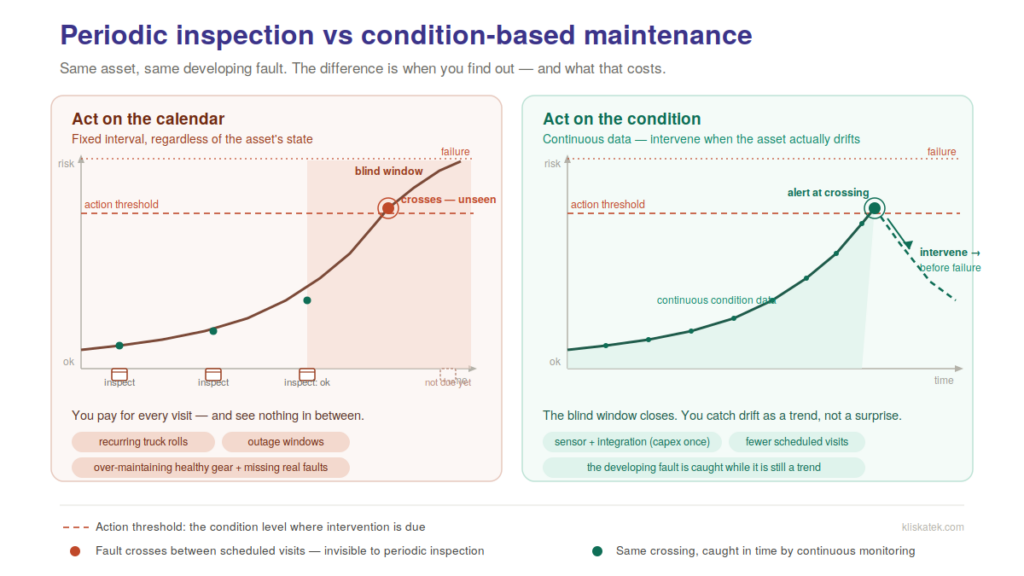
Two ways to decide when to act
Periodic inspection is time-based. You check every asset every N months or years, regardless of its state — a thermal-camera round on switchgear, a manual leak check on a gas compartment, a scheduled outage to open a panel and look. Condition-based maintenance is state-based. You monitor the parameter that signals degradation and you act when it crosses a threshold.
The subtle point most business cases skip is this: a fixed inspection interval is itself a bet about condition. When you inspect every two years, you’re implicitly claiming an asset can’t degrade dangerously in less than two years. Sometimes that bet is fine. Sometimes it isn’t, and you don’t find out which until something fails. CBM replaces the bet with the measurement.
What periodic inspection actually costs
There are two kinds of cost here, and the second is the one that’s usually left off the spreadsheet.
The visible cost is recurring and predictable: crew time and travel to each site, the outage window when gear has to be de-energised to be inspected safely, and — for gas-insulated equipment — the manual leak-check obligation the F-gas rules impose, the very burden that continuous density monitoring can lighten. These costs are real, and they repeat forever.
The invisible cost is the interval itself. Any fixed schedule makes two errors it cannot avoid at the same time. Inspect too often and you over-maintain — spending crew hours and outages on assets that were perfectly healthy. Inspect too rarely and you under-detect — a joint that begins loosening, or a seal that begins weeping, the week after an inspection has months to develop before anyone looks again. And between any two visits, the asset is unmonitored by definition. That gap is the blind window in the diagram above, and it’s where the failures that actually matter tend to happen.
What condition-based maintenance changes
CBM doesn’t remove cost; it changes its shape. You pay a capital cost once — the sensor, plus the work to get its data into your CMMS or SCADA — and in return three things move. Scheduled interventions get fewer and lighter, because you stop servicing assets that don’t need it. The blind window closes, because the asset is watched continuously rather than sampled. And you catch drift as a trend: a loosening joint or a slow leak is a data point long before it’s an event.
Be clear-eyed about the other side of the ledger. CBM carries costs periodic inspection doesn’t: the sensors and their integration, the discipline to tune thresholds so you’re managing real signals and not chasing false alarms, and — for sealed HV assets specifically — the genuine engineering of getting a signal in and out of a Faraday cage with no battery and no wire through the seal. That last part is not a solved, off-the-shelf thing, and we say so plainly in the busbar and SF6 posts. CBM is not free monitoring. It’s a different — and, for the right assets, a better — cost curve.
Where the numbers actually come from
A business case a finance owner will sign is not a vendor’s ROI claim. It’s your own five numbers. Answer these before anyone opens a spreadsheet:
- How often, and at what fully-loaded cost, do you inspect this asset class today? Crew, travel, the outage, and the paperwork — not just the hour on site.
- What does one unplanned failure of this asset actually cost you? Not only the replacement: the outage, the penalties, the emergency response, the safety exposure.
- How many assets or measurement points are in scope? CBM economics live and die on count. The integration cost is close to fixed, so the per-asset case gets stronger the more assets you have.
- What is continuous condition worth over a periodic snapshot, for this asset? For a low-consequence, easily-inspected one, not much. For a sealed, mission-critical one, potentially everything.
- Who owns this budget, and who do they have to convince? The case has to be written for that person, in their language — which is rarely RF.
Put your own figures in and the comparison is simple to state: on one side, the recurring inspection cost forever, plus the expected cost of the failures the interval misses. On the other, the one-time CBM cost plus a smaller recurring cost, minus the failures you now catch early. Every number in that comparison is yours to supply. Anyone who hands you a generic “utilities save X%” is selling, not analysing.
The asymmetry most business cases miss
Here’s the trap. The easy line to quantify — inspection hours saved — is usually the smaller half of the value. The larger half is the tail: the single internal flashover, the gas compartment that quietly loses dielectric strength, the failure you avoid by catching a trend in time. But tail risk is exactly the thing that’s hard to put a defensible number on — so it’s the thing that gets discounted in the room, and good CBM cases stall on it.
The practical move is to not lean on the catastrophe. Build the case so the inspection-saving and compliance-relief lines stand on their own, and treat the avoided failure as upside you’ve argued but not banked. A case that survives without the scary number is a case that gets approved.
When periodic inspection is still the right answer
CBM is not always the answer, and pretending otherwise costs you credibility. If an asset is accessible, cheap to inspect, low-consequence and few in number, a ladder and a checklist win — put your sensing budget where it earns more. (We wrote a whole practical filter for exactly this call.)
CBM earns its place where the opposite holds: the asset is sealed or inaccessible, its failure is expensive or dangerous, and you have enough of them for the integration to amortise. High-voltage switchgear, GIS and transformers sit squarely in that corner — which is why this is where the business case is strongest, not weakest.
Two readers, two cases
If you make the equipment, condition-based readiness is a feature, not a cost. Designed in during the SF6-free redesign you’re already doing, monitoring becomes something your utility customers can use to lighten their inspection and compliance load. You’re selling better maintenance economics, not just a switchgear.
If you operate the equipment, the case is avoided pain: the recurring inspection you can shed, the compliance burden you can lighten, and the shift from maintaining on the calendar to maintaining on the truth. Same capability underneath — two different buyers, two different spreadsheets.
Weighing condition-based monitoring for an HV asset class? The honest first step isn’t a purchase order — it’s the real numbers for your equipment. A paid scoping study answers what CBM would actually take: which parameter, which RF approach through your enclosure, and how the data reaches your maintenance and compliance systems — the inputs your business case needs and that nobody can guess for you. The decision stays yours; we help you cost it properly. Request a scoping study →
Next week: From Stuck to Scoped: How a Paid Scoping Study De-Risks a Cross-Domain Project.