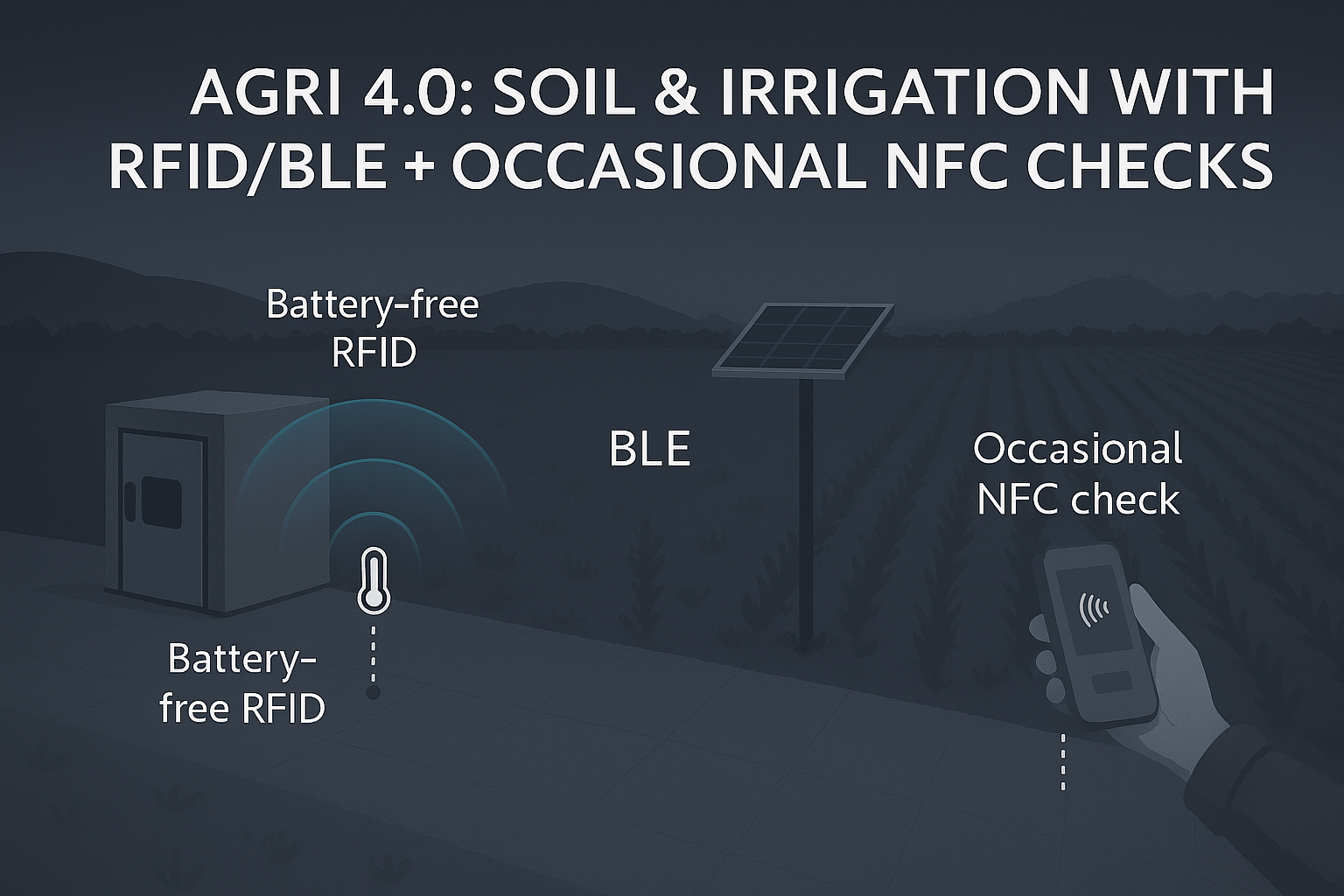
Hybrid Agri 4.0 playbook: battery‑free RFID at touchpoints, BLE for row‑level trends, and NFC spot checks—with cells, message contracts, and acceptance tests.

Hybrid Agri 4.0 playbook: battery‑free RFID at touchpoints, BLE for row‑level trends, and NFC spot checks—with cells, message contracts, and acceptance tests.
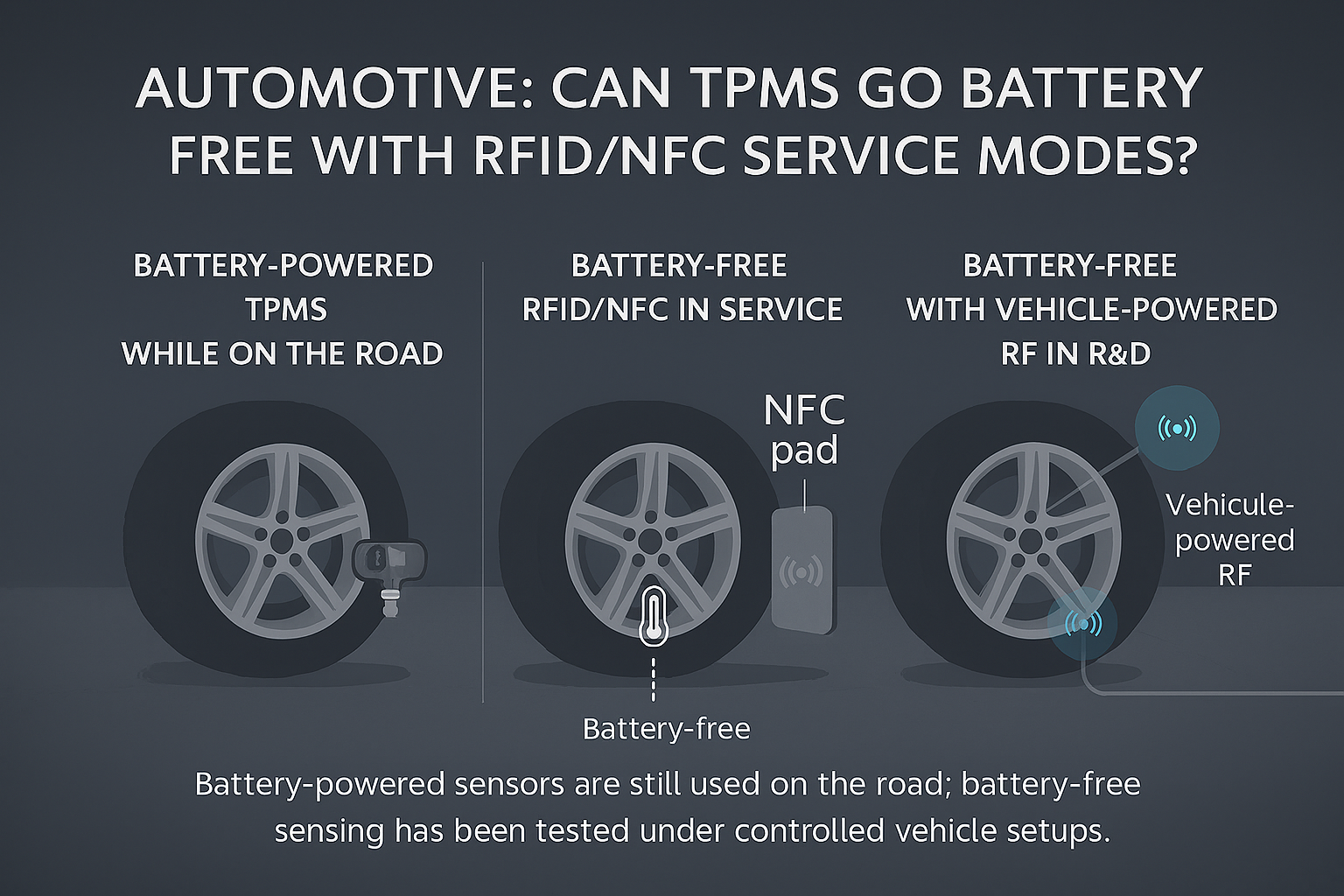
Battery‑free works for tire ID and service‑time sensing; in‑motion TPMS stays powered. We also outline RF‑powered, battery‑free feasibility and what it takes.
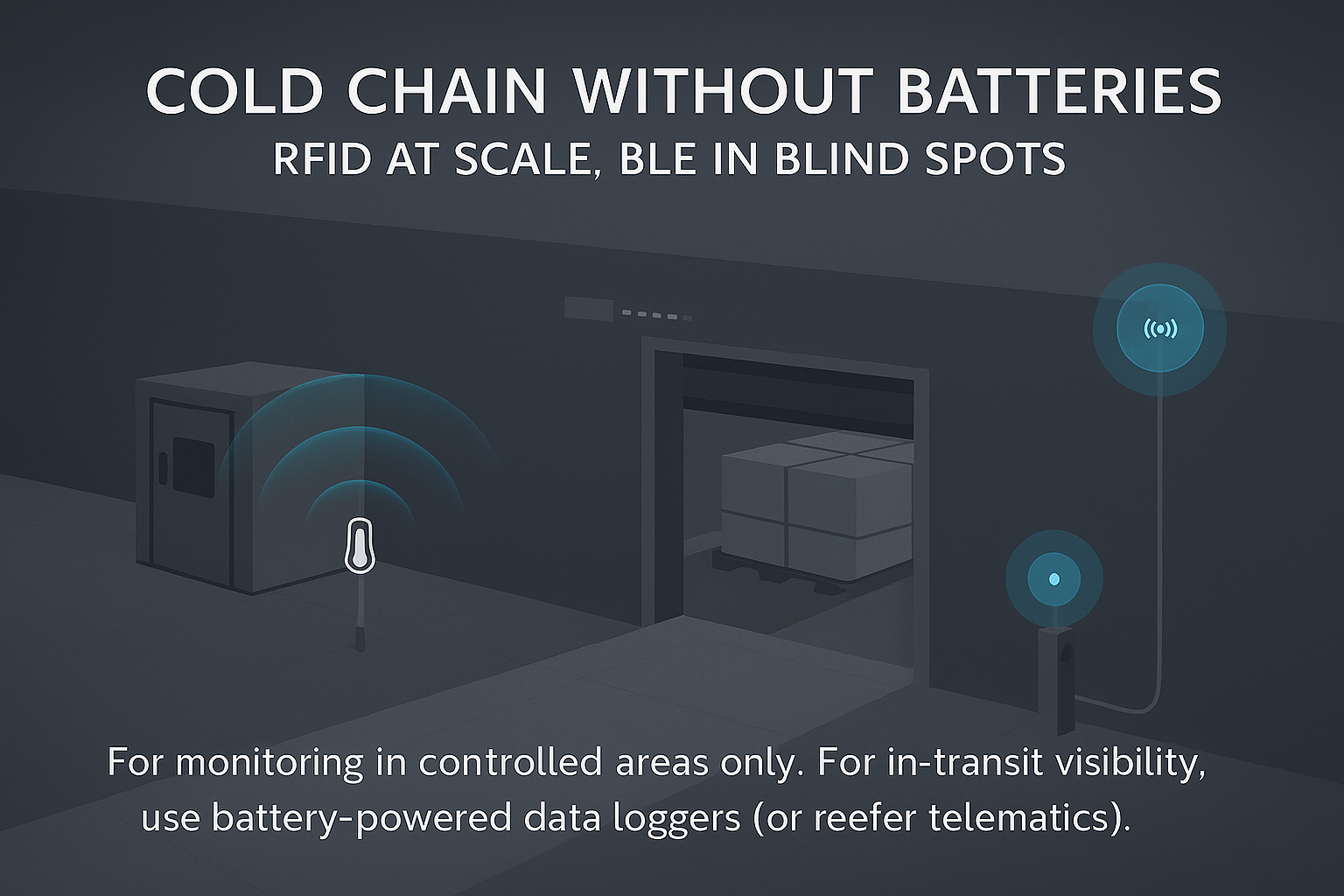
Battery‑free cold‑chain at sites using UHF RFID and touchpoint BLE—rooms, docks, portals. For in‑transit visibility, use battery‑powered data loggers.
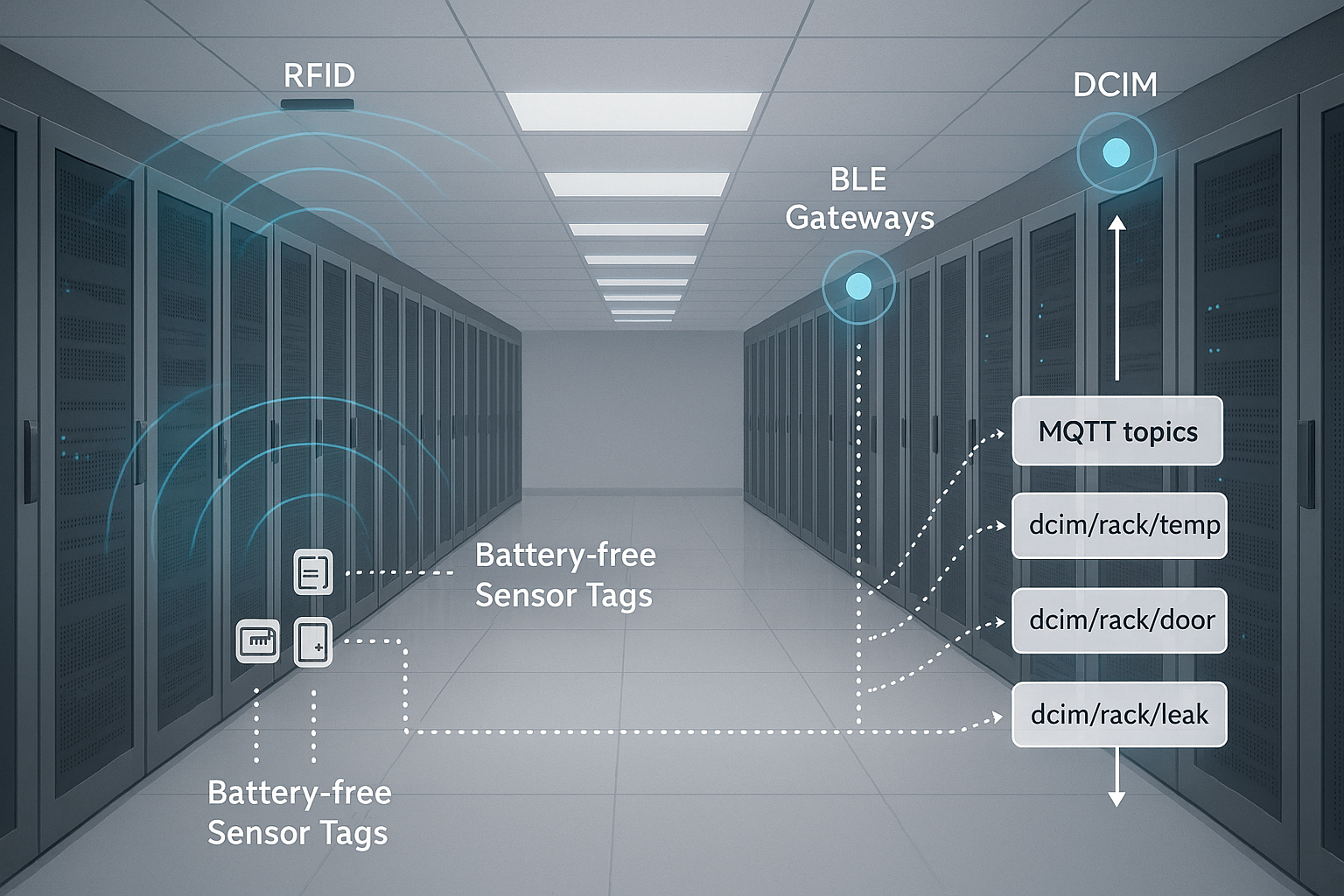
Reinvent DCIM with battery‑free RFID sensors and BLE gateways—cut OPEX, simplify deployments, and stream clean, privacy‑safe data into DCIM/CMMS.
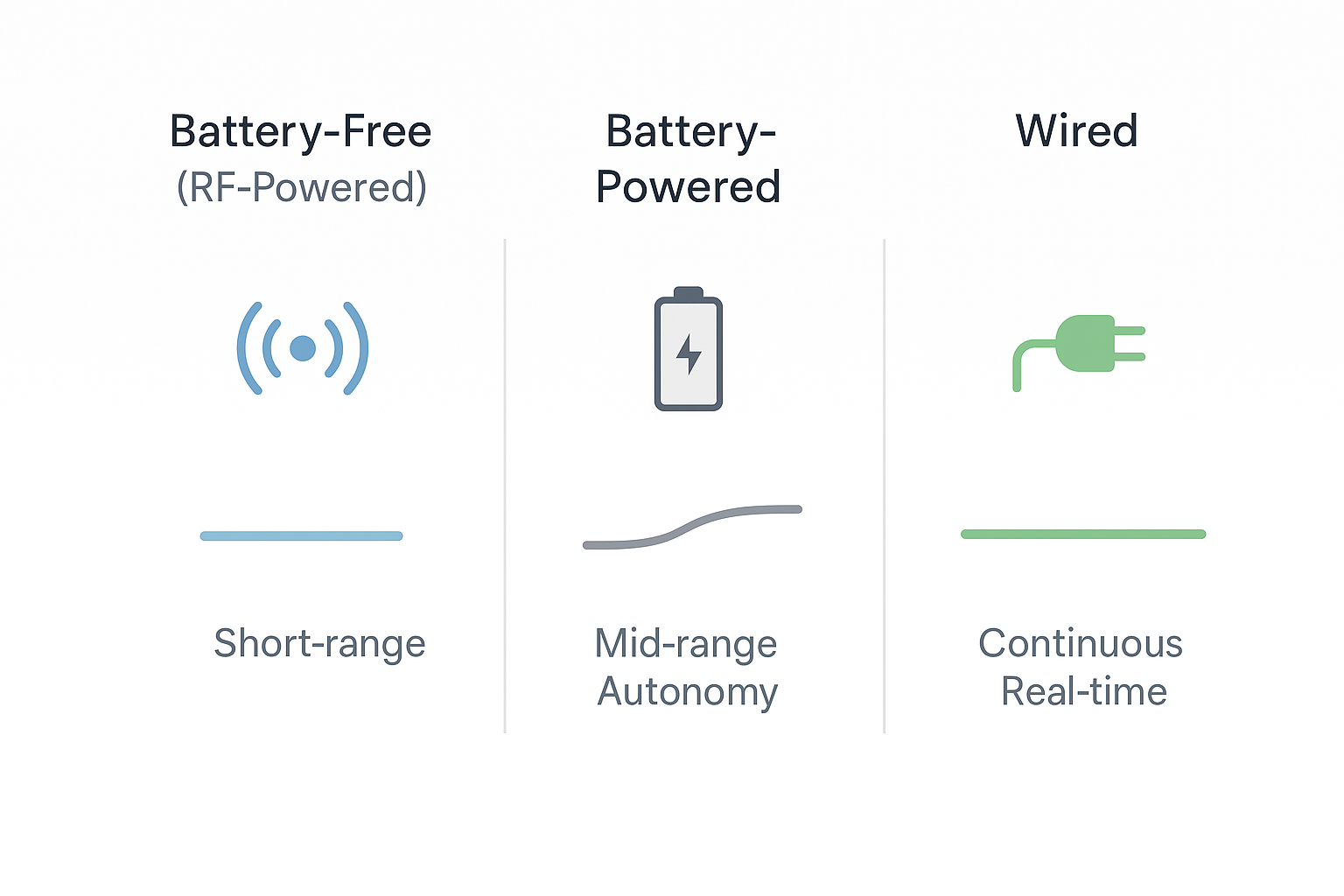
Zero‑maintenance sensing is transforming industrial IoT—but it isn’t a single technology. It’s a strategy built around choosing the right architecture for the environment: battery‑free when a reader can reach the sensor, battery‑powered when autonomous updates are needed, and wired when continuous real‑time data is essential. With battery‑free sensing now scaling rapidly—from USD 73.2M in 2025 to a projected USD 512.8M by 2035—industries are adopting long‑life, low‑touch monitoring across data centers, logistics, and civil infrastructure. The real shift isn’t eliminating batteries everywhere; it’s eliminating unnecessary maintenance while keeping sensing reliable, sustainable, and scalable.

Visibility Is the First Step to Automation Switches are everywhere—light controls, safety interlocks, mechanical locks in warehouses. Yet in many industrial environments, we still rely on manual checks to know whether a switch is open or closed. At Kliskatek, we believe automation begins with visibility. That’s why we’re introducing battery-free RFID switch monitors—a simple, scalable … Read more

Water Is Precious. Let’s Treat It That Way. As climate change accelerates and global food demand rises, water is becoming one of the most critical—and strained—resources in agriculture. Traditional irrigation systems, even automated ones, often lack the intelligence to adapt to real-time soil conditions. The result? Overwatering, inefficiency, and unnecessary waste. At Kliskatek, we believe … Read more

RFID Sensor Tags ≠ Standard ID Tags RFID systems are everywhere—from inventory tracking to access control. But when you move from ID-only tags to sensor-enabled tags, the game changes. At Kliskatek, we specialize in batteryless RFID sensor tags that harvest energy from the reader’s RF field. These tags don’t just identify—they sense. And that means … Read more

Energy Efficiency Starts with Visibility Data centers are the backbone of digital infrastructure—but they’re also among the most energy-intensive facilities on the planet. As workloads grow, operators face mounting pressure to reduce energy consumption, lower cooling costs, and improve sustainability without compromising uptime. One of the most effective strategies? Thermal monitoring. Yet traditional solutions often … Read more
Do you have a specific question or need more information about our products, services, or expertise? We're just an email or phone call away. Feel free to reach out, and we'll ensure your queries are addressed promptly.
If you prefer a face-to-face conversation, our physical location is open and welcoming to visitors. Come meet us in person, and let's discuss how we can work together to drive innovation and excellence.
Polígono Akarregi 10
Oficina 112
20120, Hernani
Interested in a career with Kliskatek? We're always on the lookout for exceptional talent. You may be a perfect fit to join our dynamic team.
Kliskatek is all about innovation .We are a global solution development company that focuses on wireless sensing, energy harvesting and low power electronics. Our products help customers efficiently manage processes and assets.
© Copyright 2023-2025 Kliskatek S.L. All rights reserved.