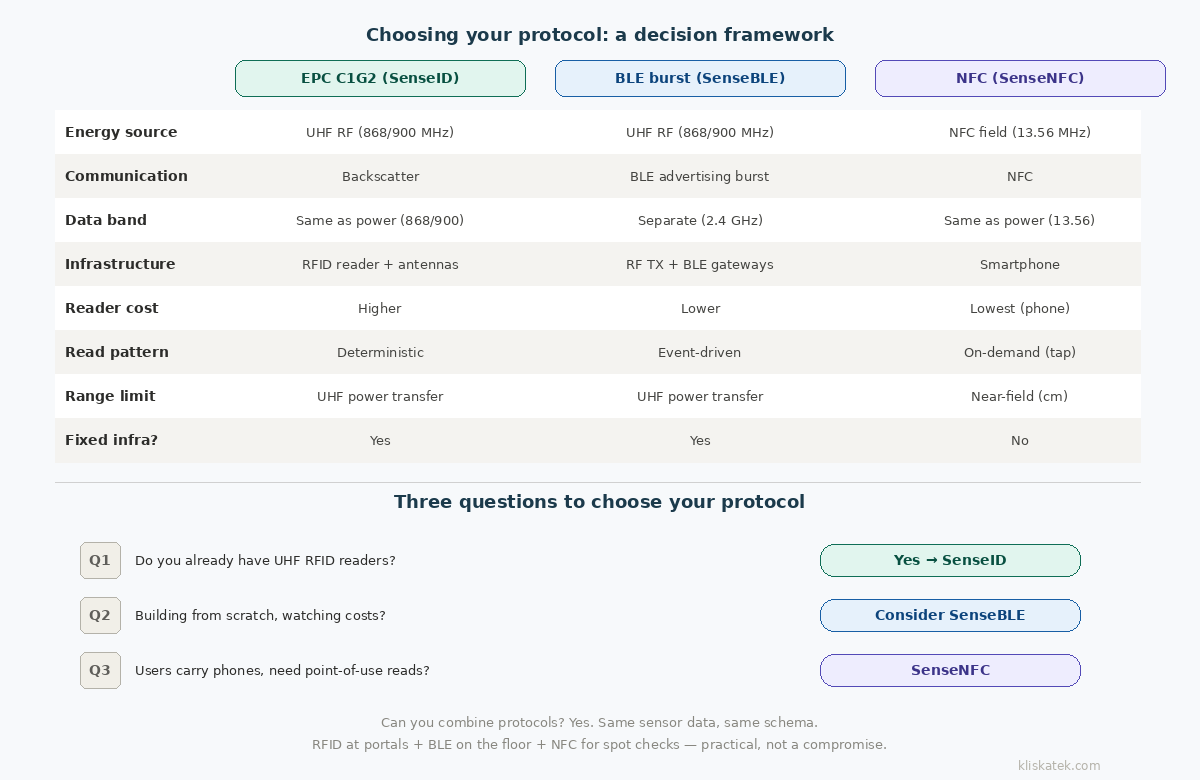
How to choose between EPC C1G2, BLE and NFC for battery-free sensor deployments. A practical framework based on infrastructure, cost structure and use case — not technology hype.

How to choose between EPC C1G2, BLE and NFC for battery-free sensor deployments. A practical framework based on infrastructure, cost structure and use case — not technology hype.
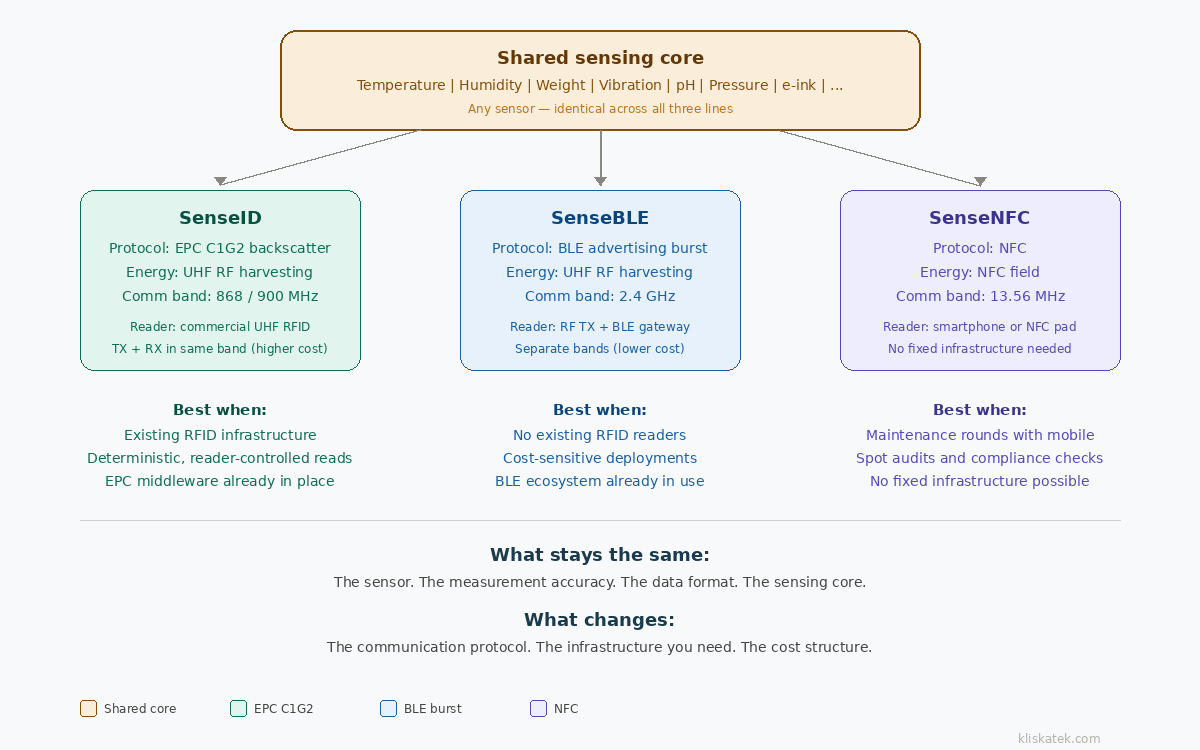
SenseID, SenseBLE and SenseNFC use the same battery-free sensors. The difference is the communication protocol and the infrastructure you need. Here’s how to choose.
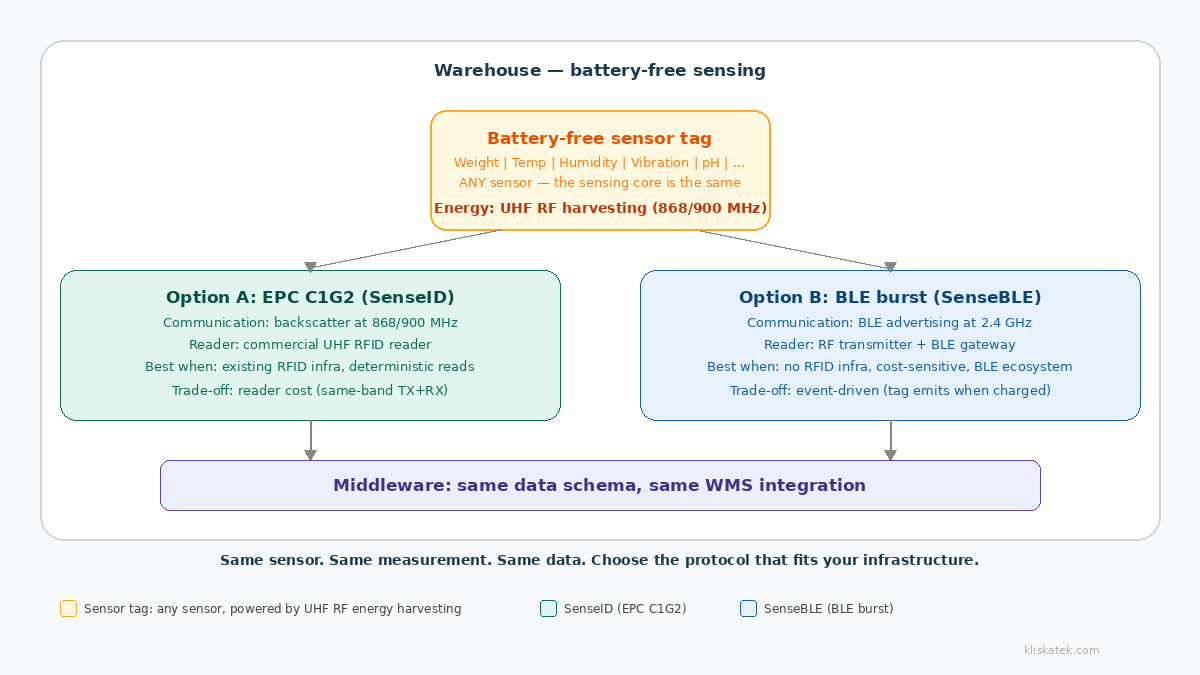
Battery‑free sensors for warehouse weight, ID and environmental monitoring. Choose EPC C1G2 (SenseID) or BLE (SenseBLE) based on your infrastructure — the sensors are the same.
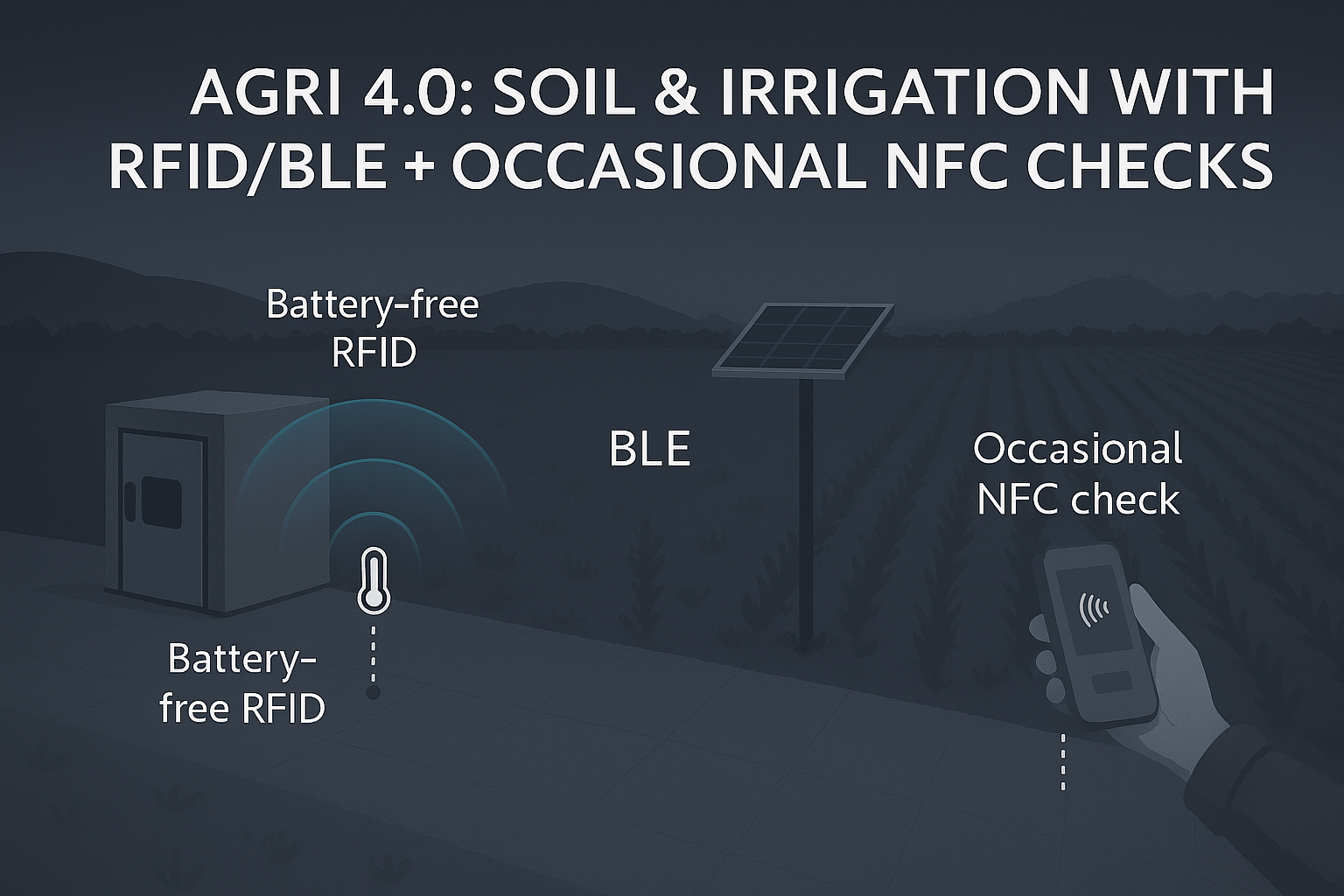
Hybrid Agri 4.0 playbook: battery‑free RFID at touchpoints, BLE for row‑level trends, and NFC spot checks—with cells, message contracts, and acceptance tests.
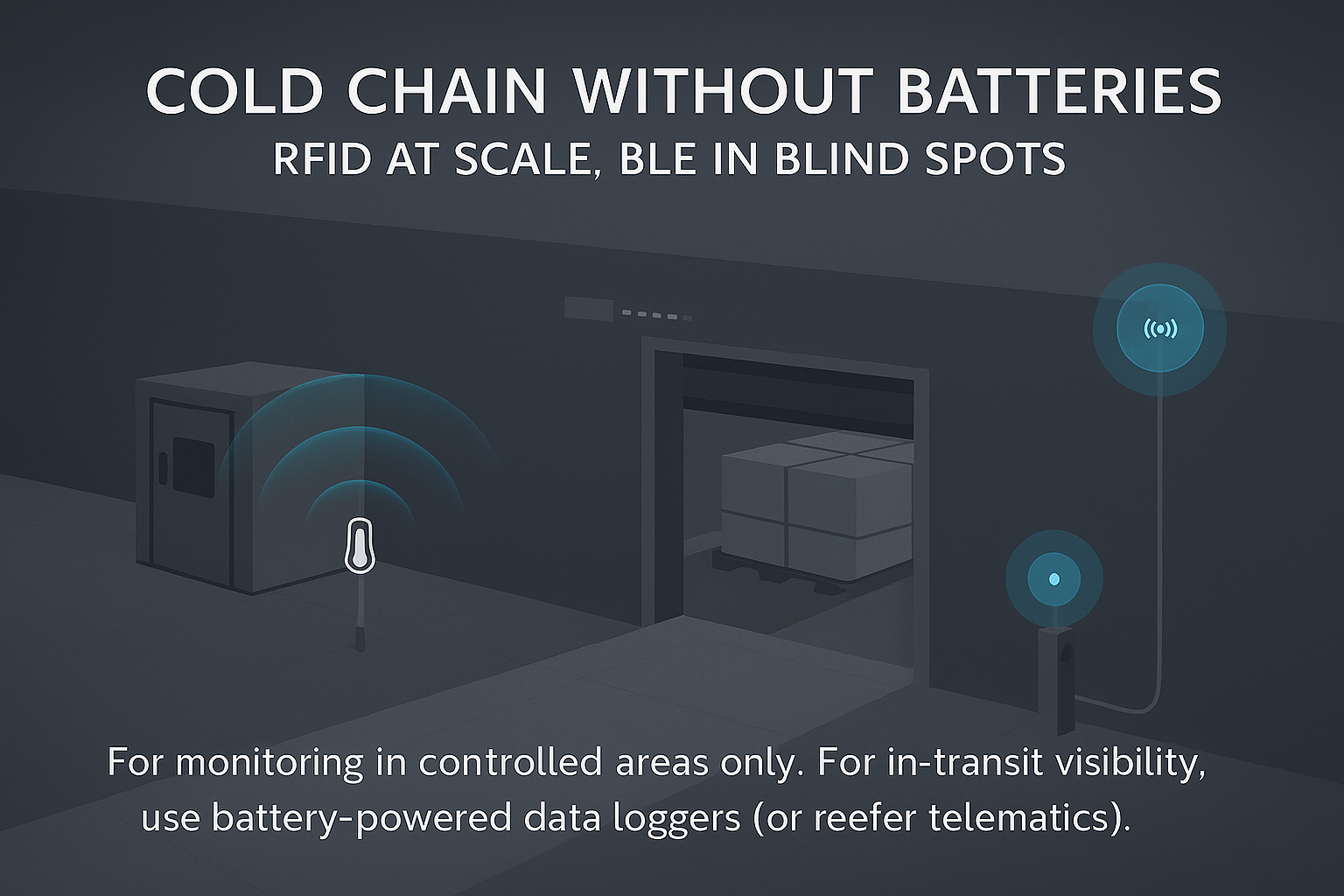
Battery‑free cold‑chain at sites using UHF RFID and touchpoint BLE—rooms, docks, portals. For in‑transit visibility, use battery‑powered data loggers.
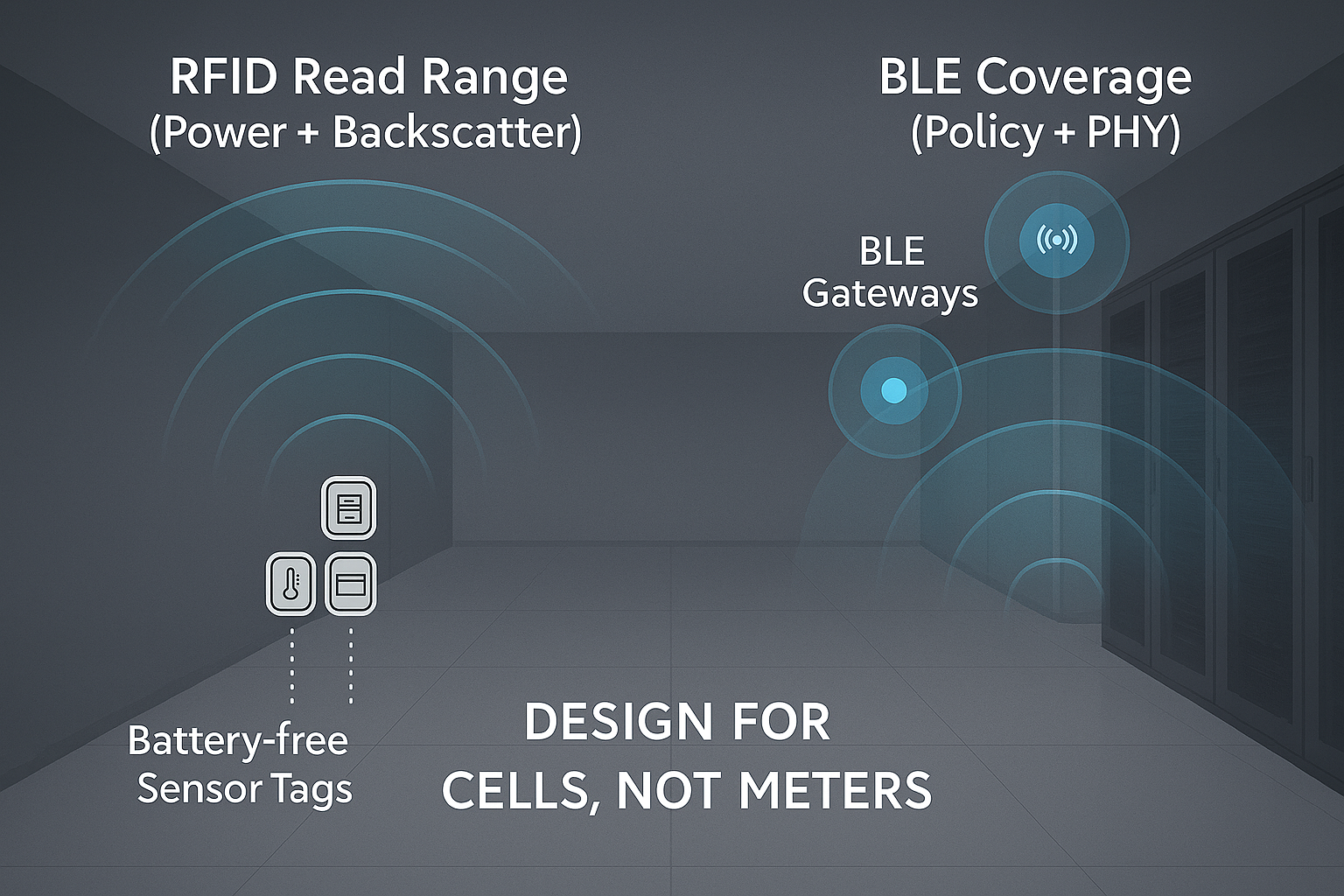
RFID “read range” and BLE “coverage” aren’t the same. Learn how to translate spec‑sheet claims into real deployments—and when hybrid RFID+BLE wins.
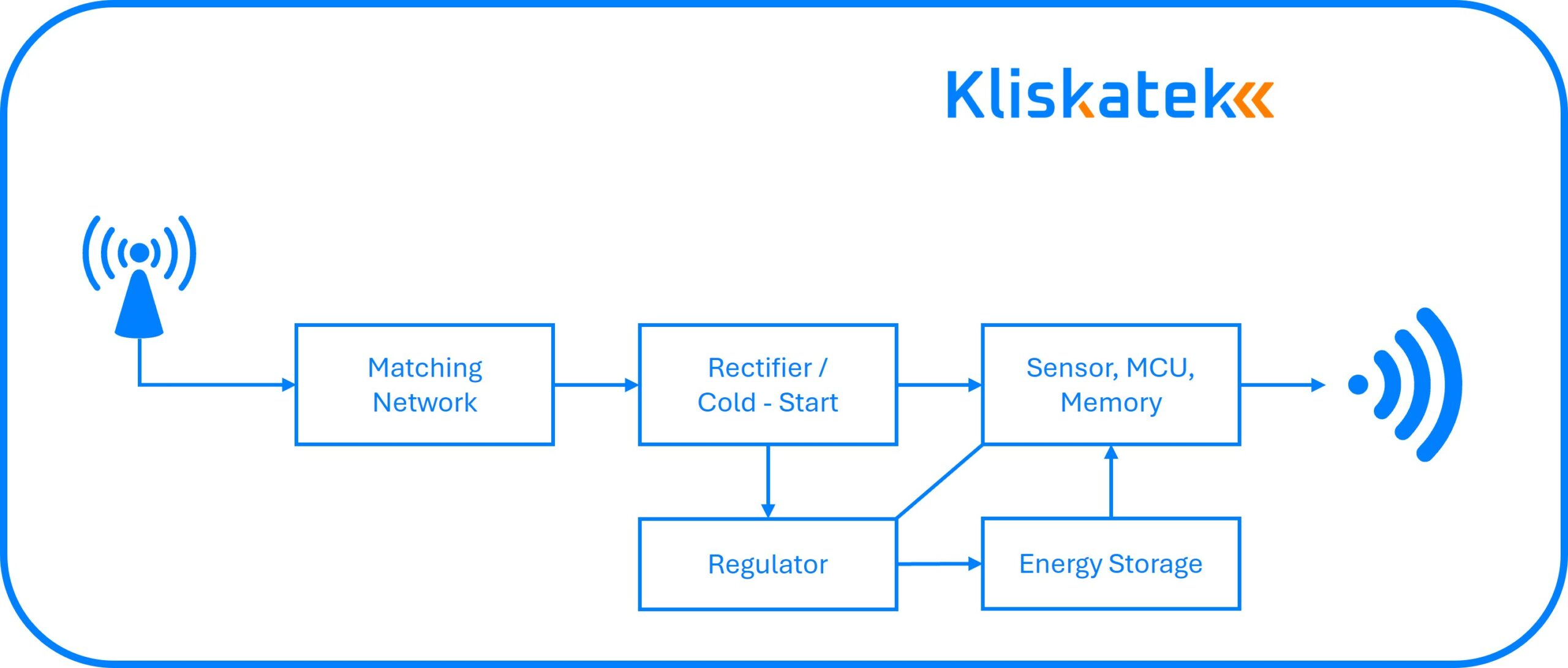
Battery‑free sensor design: power path, storage sizing, and duty‑cycling—plus UHF RFID, BLE burst, and NFC tap‑to‑measure patterns that actually work.
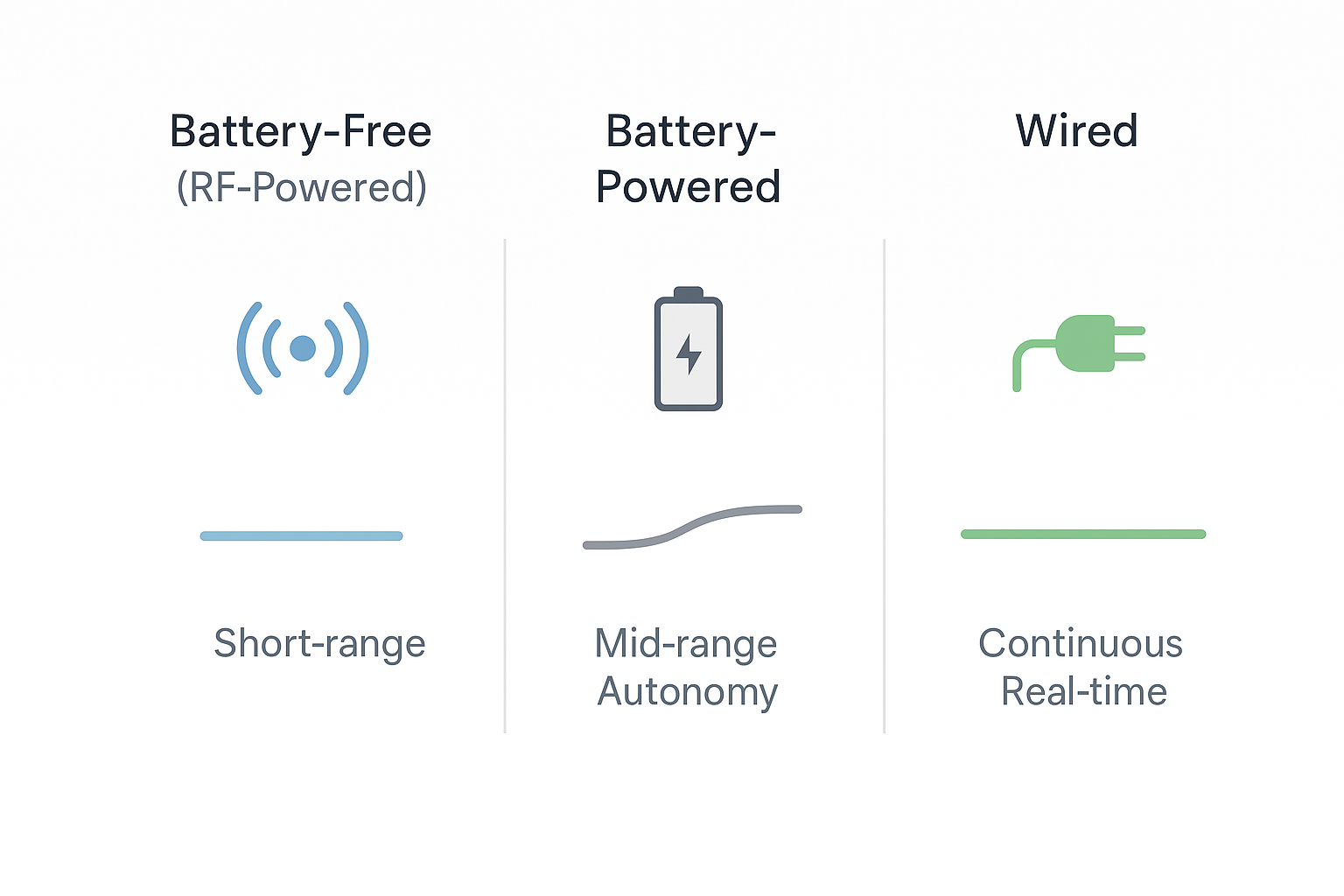
Zero‑maintenance sensing is transforming industrial IoT—but it isn’t a single technology. It’s a strategy built around choosing the right architecture for the environment: battery‑free when a reader can reach the sensor, battery‑powered when autonomous updates are needed, and wired when continuous real‑time data is essential. With battery‑free sensing now scaling rapidly—from USD 73.2M in 2025 to a projected USD 512.8M by 2035—industries are adopting long‑life, low‑touch monitoring across data centers, logistics, and civil infrastructure. The real shift isn’t eliminating batteries everywhere; it’s eliminating unnecessary maintenance while keeping sensing reliable, sustainable, and scalable.
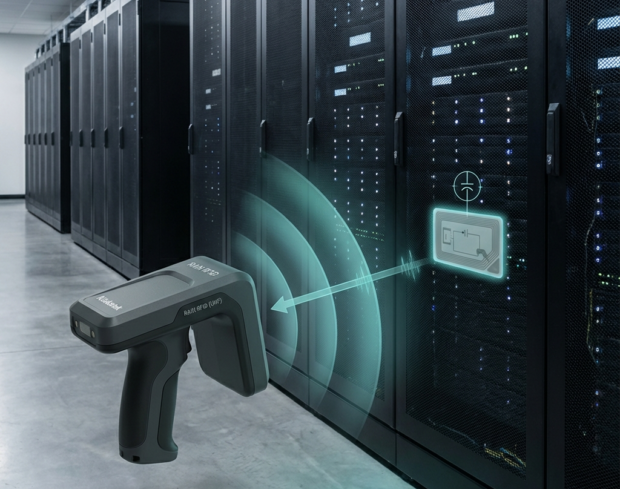
“Battery‑free” doesn’t mean “no energy.” It means sensors harvest energy on demand (often from sub‑1 GHz RF) and buffer it (e.g., in capacitors/supercapacitors) to take a measurement and backscatter the data. That subtle difference is what makes deployments practical, compliant, and maintenance‑free.
Do you have a specific question or need more information about our products, services, or expertise? We're just an email or phone call away. Feel free to reach out, and we'll ensure your queries are addressed promptly.
If you prefer a face-to-face conversation, our physical location is open and welcoming to visitors. Come meet us in person, and let's discuss how we can work together to drive innovation and excellence.
Polígono Akarregi 10
Oficina 112
20120, Hernani
Interested in a career with Kliskatek? We're always on the lookout for exceptional talent. You may be a perfect fit to join our dynamic team.
Kliskatek is all about innovation .We are a global solution development company that focuses on wireless sensing, energy harvesting and low power electronics. Our products help customers efficiently manage processes and assets.
© Copyright 2023-2025 Kliskatek S.L. All rights reserved.