
Backup battery monitoring has a contradiction at the centre of it, and everything else follows from there. Last week we looked at what changes between a prototype and five hundred units. This week the subject is narrower: the asset you want to watch is itself a store of energy.
We write this for whoever owns equipment that has to work when everything else has stopped. Emergency lighting, fire panels, telecom cabinets, switchgear rooms, the uninterruptible supply in a plant room.
The contradiction at the centre of backup battery monitoring
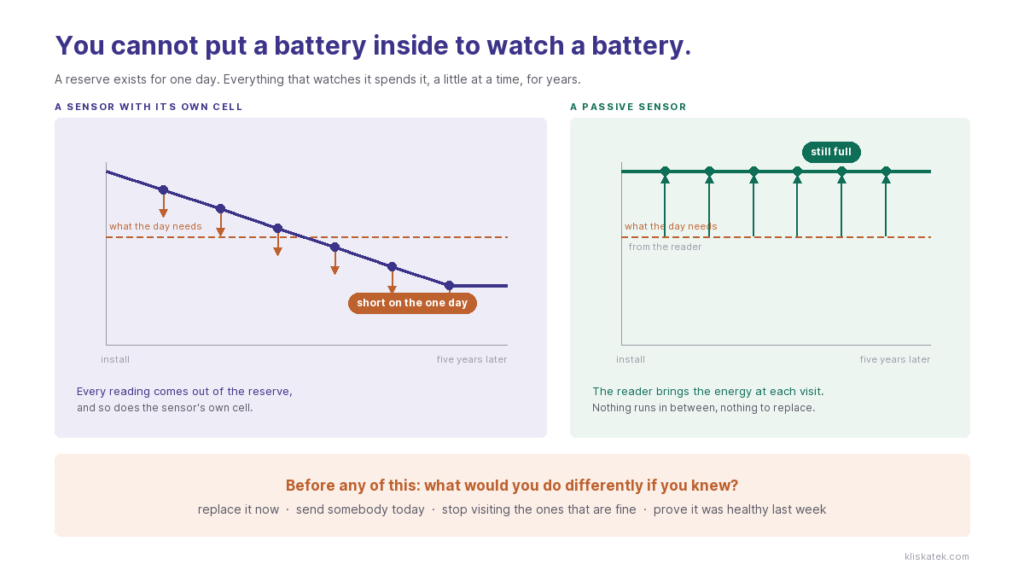
The job of a backup battery is to be full on the one day that everything else fails. The only way to be certain it is full is to use some of it, and using it is the thing you are trying to avoid.
That is why these batteries get checked on a calendar rather than continuously. Somebody walks to the cabinet, presses a button, reads a display or runs a discharge test, and writes it down. The check is real, and it is expensive in the most ordinary way: it costs a visit.
A sensor that draws from the same reserve does not escape the contradiction. It just makes it permanent and small, instead of occasional and large.
The three fixes everybody tries first
Give the sensor its own battery. Now the cabinet has two batteries, and the small one ages faster than the big one. In ten years that is a maintenance round you created in order to avoid a maintenance round. We wrote about what long-lived assets actually demand from a sensor in what a forty-year asset demands.
Wire it. Technically clean, and often impossible. You are rewiring an installed base, in a cabinet somebody signed off, with a door that has to close and a layout nobody wants to touch.
Leave it to the round. This is what most places do, and it works until the round slips. The reading exists, but it is monthly at best, and nobody knows what happened between two visits.
There is a fourth answer that nobody writes down, and it is the most common of all. The cabinet gets a sticker with a date on it, somebody signs the sticker, and the battery is assumed to be fine until the next date. That is not negligence. It is what you do when checking properly costs a van.
What a passive sensor actually changes
A passive sensor carries no energy of its own. The reader brings the energy, the sensor wakes up, measures and answers, and then there is nothing left running.
Two consequences matter here. The measurement costs the backup battery nothing, which removes the contradiction. And there is no second battery to replace, which removes the maintenance you were trying to avoid.
There is a third, quieter one. A passive tag has nothing that runs, so there is nothing to fail silently in the five years between the day it goes in and the day somebody needs it. A powered sensor in a cabinet is one more thing that can be dead when you arrive, and you will not know until you are standing in front of it.
That is a narrow advantage and it is worth saying plainly. It does not make the measurement easy, and it does not tell you what you can measure.
What backup battery monitoring can tell you, and what we will not pretend
The useful question is not what a sensor can measure. It is what the reading would change.
A battery in a cabinet can be asked several different things. Is it there and connected. Is it holding what it should. Is it running hotter than its neighbours. Has it been through an event that nobody logged.
Those are different measurements with different costs. Which of them you can get without touching the terminals depends on the chemistry, on the access you have, and on how the thing was installed.
We are not going to publish a table that pretends otherwise. Working out which readings are reachable in a specific cabinet is a short piece of engineering, not a paragraph in a blog post. The same question in a sealed aerospace assembly and in a telecom cabinet on a roof has two different answers, and the difference is rarely the sensor.
The decision test, before any of this
Name the decision the reading would change, in one sentence.
Replace this battery now rather than at the next cycle. Send somebody today instead of next month. Stop sending anybody to the cabinets that report fine. Prove, after an outage, that the reserve was healthy the week before.
If no sentence like that exists, you do not have a monitoring project. You have a chart, and charts quietly stop being read. We wrote about the step that makes a reading into an action in from sensor to work order.
The sentence also tells you how often the reading has to arrive, which is the number that sets the whole design. “Replace it before it fails” and “prove it was healthy last week” sound similar in a meeting. One of them is a monthly tap on a technician’s round, and the other is infrastructure.
Where the check already exists
In most of these installations nobody has to be convinced that the battery matters. Stationary battery installations come with maintenance and inspection requirements of their own, set out in standards such as IEC 62485-2. In many buildings the periodic test of the emergency system is a legal duty rather than a preference.
That changes the business case, and it changes it in your favour. You are rarely arguing for a new activity. You are arguing about the cost of one that already happens.
So the numbers are easier to defend than in most monitoring projects. What does a visit cost. How many cabinets get visited, and how many of those visits find nothing. What would it be worth to send somebody only where something is wrong.
It is the same shape as the case we set out in periodic inspection versus condition-based maintenance. The same warning applies too: build the case on the visits you save, not on the outage you imagine.
When backup battery monitoring is the wrong project
If you need to know within seconds that the reserve has gone, this is not it. That is a wired alarm, and it should be.
If you need laboratory state of health on every cell, this is not it either. And if the batteries are accessible, few, and already visited every month for other reasons, the honest answer is that the round is cheap. Keep it.
The case gets interesting when the cabinets are many, scattered or awkward to reach, and when the visit costs more than the battery. That is also when nobody can tell you, today, how many of those cabinets are actually fine. The reason to start is usually that question, not the technology.
Where to start
Tell us three things: what the battery backs up, who visits it today and how often, and what you would do differently if you knew its state between visits. We will tell you whether a reading changes any of that, and which part of it is hard.
If it looks worth testing, the next step is small. A feasibility study on your own cabinets, or an evaluation kit to see what a passive reading looks like on your own bench. Talk to our engineering team.
Next week: who signs the declaration of conformity when the radio inside your product was designed by somebody else.