
RFID read point design decides more about your data than the tag does. Last week we looked at why the ambient energy is never there when you need it, with an asset that had stopped moving in a quiet corner. This week the asset does not stop at all. It rides a conveyor, hangs from an overhead line, or goes through a door on a forklift. The tag gets one moment inside the field to wake up, take a reading and answer.
We write this for whoever has to make that point work. The engineer who owns the line. The operations manager who signed for the project. The product manager whose device has to be read at a customer’s door. The physics of that moment we have written before. This post is about everything you decide around it.
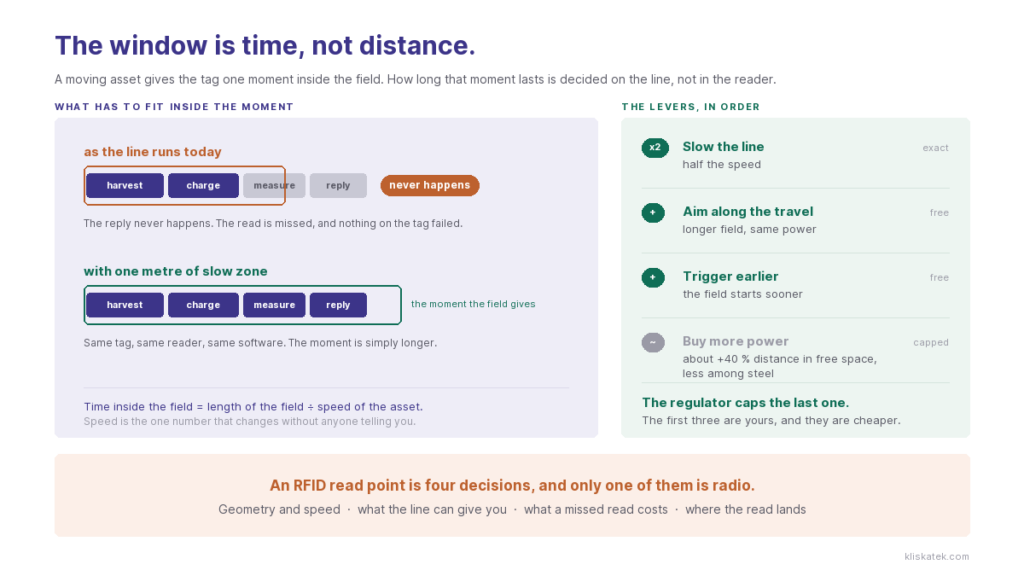
The window is time, not distance
A tag with no battery has to harvest energy, charge, measure and reply inside the window the field gives it. That window is not the reader’s range. It is how long the asset stays inside the field. That is the length of the field divided by the speed of the asset, and an RFID read point exists to make it long enough.
We wrote the physics of it in Inside a Battery-Free Sensor. The reader’s dwell time acts as the pre-charge. If the reader rushes past, the pre-charge window collapses. We also wrote why the range figure on a datasheet answers a different question, in Decoding Range Specs. Here we take both as read and start from the consequence.
The consequence is uncomfortable. If the line runs a third faster after a good quarter, the window shrinks by a quarter. Nothing about the tag, the reader or the software changed. A system that was fine in March starts dropping reads in October, and the first place everyone looks is the equipment.
Why the reader is rarely the lever
The first instinct is to buy more power. It is a weak lever twice over.
The field does not grow in proportion to the power you put into it. Doubling the transmit power buys something like forty per cent more distance in free space. In a hall full of steel it buys less. And the regulator caps the top end anyway. For this band in Europe those limits live in ETSI EN 302 208, and the reader you already own is probably close to them.
Speed works the other way. Halve it and you get exactly twice the window. Geometry behaves like speed rather than like power. Antennas whose coverage stretches along the direction of travel keep the tag in the field for longer. Antennas that cut across it do not. The difference costs nothing in power and nothing in licences.
So the order of the levers is the opposite of the order most projects try them in. What the line does comes first, where the antennas go comes second, and the reader comes last.
An RFID read point is four decisions, and only one of them is radio
Geometry and speed. Where the asset passes, how fast it passes at the worst moment, in what orientation, and how many pass together. The number that matters is not the average line speed. It is the speed of the shift that is running late.
What the line can give you. A slow zone of one metre, a gate, single file, or a photocell that tells the reader when to start looking. A trigger that starts the field earlier is cheaper than any antenna. It also usually belongs to a team that has never been in the room when the read point is discussed.
What happens when a read is missed. Retry, divert, alarm, manual scan, or nothing at all. A miss rate that nobody acts on is a statistic, not a control. Decide this before you decide the hardware, because it sets how good the read point actually has to be.
Where the read has to land. The record ends up in a WMS, an ERP or a maintenance system, and someone has to own what it means there. We wrote about that last step in From Sensor to Work Order. A read that nobody can act on is not data, it is traffic.
Only the first of the four is radio, and even that one is mostly mechanical.
Who owns the RFID read point
This is the part that decides projects, and it is not technical.
The automation team owns the conveyor. IT owns the system that receives the data. One supplier owns the tags and often a different one owns the reader. The read point sits exactly where all of them meet, and in most organisations nobody owns it.
That is why a reading problem can sit unresolved for months while three teams each confirm, correctly, that their own part works. Every one of them is right. The failure lives in the seam, and the seam has no owner. We told that story from the inside, in a project where splitting the work between specialists was the right call, in this case study.
The practical version of this is short. Some decisions need the line, the radio and the software to move together. Someone has to be able to change all three. Failing that, someone has to be able to get all three into a room on the same morning.
There is a cheap test for it. Ask who can authorise a one metre slow zone on that line. If the answer takes more than two names, the read point has an ownership problem, and no amount of hardware will fix that one.
Five questions before anyone buys hardware
- How many milliseconds is the asset inside the field, at the fastest speed you actually run?
- What can the line give you: a slow zone, a gate, single file, a trigger?
- What does a missed read cost, and who finds out that it happened?
- Which system receives the read, and what does it do with a duplicate?
- Which of those can you change, and whose approval does that take?
If the first two answers are “we do not know” and “nothing”, this is not a hardware project yet. It is a process question wearing a hardware costume, and buying equipment now will fix it by accident at best.
When an RFID read point is the wrong shape
A battery-free tag earns its place when the asset passes a point you control, and the tag has to survive for years with no service. That is a common shape in industry, and it is the shape this whole post assumes.
It is the wrong shape when reads have to happen anywhere, at any time, away from any infrastructure you own. Then the constraint you are paying for is one you do not need. A powered device, or a different architecture, will do the job with less argument. We would rather say that on a call than after a pilot.
What to do with this
Tell us three things: the speed at the worst moment, what the line is allowed to change, and what a missed read costs. We will tell you whether your read point is a hardware problem or a process one. Quite often it is a process one, and the answer is cheaper than the quote you were expecting. If it is worth building properly, a paid scoping study turns it into a plan with numbers in it. Talk to our engineering team.
Next week: what has to change between a prototype that works and a product you can build five hundred of.