
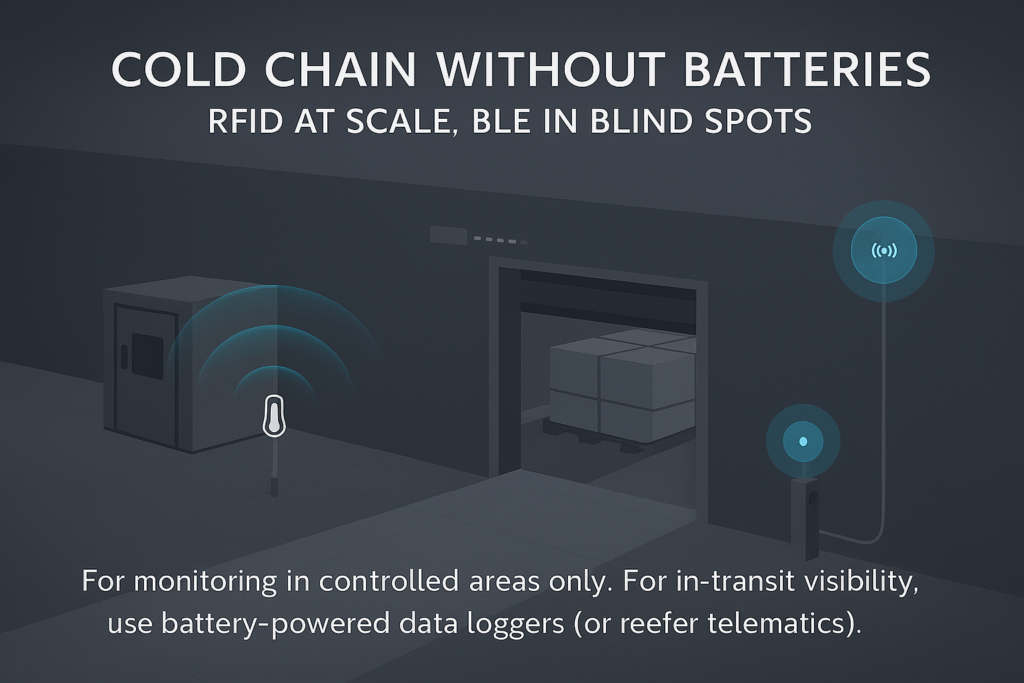
This post covers battery‑free cold‑chain monitoring in controlled areas: cold rooms, portals, docks, staging lanes, handheld sweeps—places you can power a reader or gateway.
It does not claim end‑to‑end, in‑transit visibility without batteries. If you need continuous monitoring during transport, you’ll use battery‑powered data loggers (or powered reefer telematics).
The winning pattern we deploy: Battery‑free UHF RFID (and battery‑free BLE at touchpoints) for ID + snapshots at scale, plus software middleware that turns snapshots into auditable events.
1) Scope (and what this post isn’t)
This is about site‑side coverage—instrumenting the places you control without adding thousands of coin cells:
- Cold rooms & freezers (fixed readers/antennas)
- Dock doors & portals (ingress/egress)
- Staging lanes & audits (handhelds/forklifts)
- Short “blind pockets” inside facilities (battery‑free BLE at touchpoints)
Not in scope for battery‑free: sealed trailers and long, unpowered transit legs. For that, use battery‑powered data loggers or reefer OEM telematics (we integrate those feeds).
2) Why battery‑free works (on site)
- Duty cycle fits the physics. Most cold‑chain decisions don’t need sub‑second data; 1–5 minute cadence catches meaningful thermal events.
- Reader provides the energy. With UHF RFID, the reader field powers the tag → tag samples (T/RH/door/leak) → backscatters a compact TLV → sleeps.
- Scale without rounds. No batteries to swap on pallets, doors, or room checkpoints—OPEX stays low.
Yes, battery‑free BLE exists (at touchpoints). We use battery‑free, energy‑harvesting BLE tags in certain fixtures where a gateway’s field (or a designed harvester) can energize brief BLE‑format bursts right at the controlled point. Think fixed, known locations—not roaming pallets.
3) Reference architecture (site layer)
[Battery‑free UHF RFID Sensor Tags] --(power+read)--> [Portals/Cold-room Readers]
                              │                                  │
                              └─(handheld/forklift sweeps)───────┘
                    [Battery‑free BLE at touchpoints, where applicable]
                                       │
                                       v
                            [Gateway → MQTT/Kafka → Middleware]
- Tags (battery‑free): sample on wake; encode TLV in EPC/User memory (RFID) or short BLE‑format burst (at touchpoints).
- Gateways/readers: parse, calibrate, debounce, and threshold locally; publish compact events and snapshots upstream.
- Middleware: map
epc → asset_id, enrich with location and provenance (reader/antenna, firmware), and route to WMS/QMS/ERP.
4) Message shapes you can drop into your bus
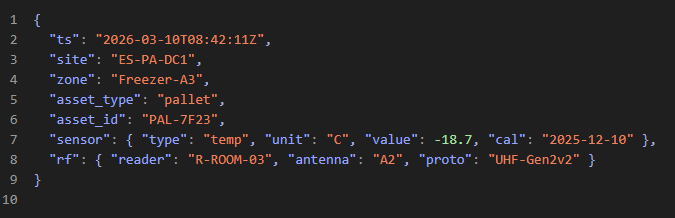
Temperature snapshot (site)
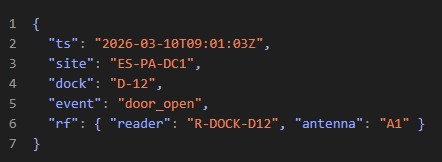
Door event (edge‑debounced)
5) Acceptance tests (site)
- RFID cell SLO: ≥99% of top & bottom pallet tags read within ≤60 s per cell at −20 °C (worst‑case label & orientation).
- Door timing: ≤5 s from physical open to event on the bus (edge‑debounced).
- Privacy by design: rotating identifiers and minimal payloads; TLS end‑to‑end.
6) What happens when the pallet leaves the plant?
If you only need site assurance
- You’re done: pre‑departure snapshot at the dock, arrival snapshot at the next site. Exceptions show up as before/after deltas.
If you need in‑transit visibility (continuous or summarized)
- Use battery‑powered data loggers on pallets or a compartment‑level sensor/telematics feed (powered from the reefer/truck).
- On arrival, upload summaries (min/max/mean, minutes out‑of‑range) or stream continuously via a small BLE→cell gateway.
Rule of thumb: Site coverage = battery‑free. In‑transit coverage = battery‑powered (or powered telematics).
7) Middleware patterns (both worlds)
- Normalize snapshots/events (site) and summaries/time series (transit) into the same topics with a
legattribute (site,transit). - Schema contracts (JSON Schema or Avro) and reject on invalid to keep the bus clean.
- Provenance everywhere (reader/gateway ID, firmware, policy version) for audits.
8) OPEX and compliance outcomes
- Battery‑free where you can → no freezer battery rounds, rapid scale‑out.
- Battery‑powered only where you must → a handful of reusable loggers or a single trailer sensor, not thousands of coin cells.
- Auditable trail: door events + site snapshots + (optional) in‑transit summaries satisfy regulators and customers without drowning ops in data.
9) What we’ll help you pilot
- One cold room + one dock (battery‑free), with acceptance tests baked in.
- Transit option (only if you need it): pick data loggers (pallet‑level) or compartment telemetry; we integrate both.
- Middleware: topics, schemas, and dashboards that separate site and transit legs clearly.
Ready to pilot one dock and one room? We’ll stand it up, measure it, and hand you clean topics in two weeks.
Stay tunned for next week: “End‑to‑End Cold Chain: When Batteries Are the Right Choice”.