
This post covers battery‑free sensing in warehouses: measuring weight, capturing unique IDs and monitoring environmental conditions on pallets and containers — all without batteries on the tag side.
The key idea: the sensor is the same regardless of the communication protocol you choose. Whether you use EPC C1G2 (our SenseID line) or BLE (our SenseBLE line), the load cell, temperature sensor or accelerometer on the tag is identical. What changes is how the data gets from the tag to your system — and that choice depends on your infrastructure and business case, not on what you want to measure.
1) The warehouse data gap
If you manage a warehouse with bulk products, granulates or liquids, you know this problem. Your WMS has a record for every SKU, but the reality on the floor tells a different story.
Workers pick from containers according to shop floor orders, but nobody updates the exact remaining quantity. A container that held 1,000 kg of product yesterday might hold 600 kg today — or 200 kg. You can see the container, but you cannot see inside it. For packaged goods you can count boxes, but for bulk and liquids the only reliable method is weighing.
On top of that, environmental conditions matter. Temperature, humidity, vibration — all affect product quality. But wired sensors are impractical on assets that move, and battery-powered wireless sensors create a maintenance burden that scales with the number of monitoring points.
The data gap is not a software problem. Your WMS is only as good as the data feeding it.
2) What battery‑free sensors bring to the warehouse
A battery‑free sensor tag embedded in a pallet or placed under a container measures on demand — weight, temperature, humidity, or any other magnitude — using energy harvested from an RF field. No batteries to replace, no wires to run.
The process is simple. An RF source energises the tag. The tag wakes up, powers the sensor, takes a measurement, transmits the data along with its unique ID, and goes back to sleep. For a weight measurement, this entire cycle takes under 5 seconds.
What you can measure depends on which sensor is on the tag — not on which communication protocol you use. Load cells for weight. NTC probes for contact temperature. Digital sensors for ambient temperature and humidity. Accelerometers for vibration and orientation. Any sensor that fits within the energy budget of the tag can be integrated.
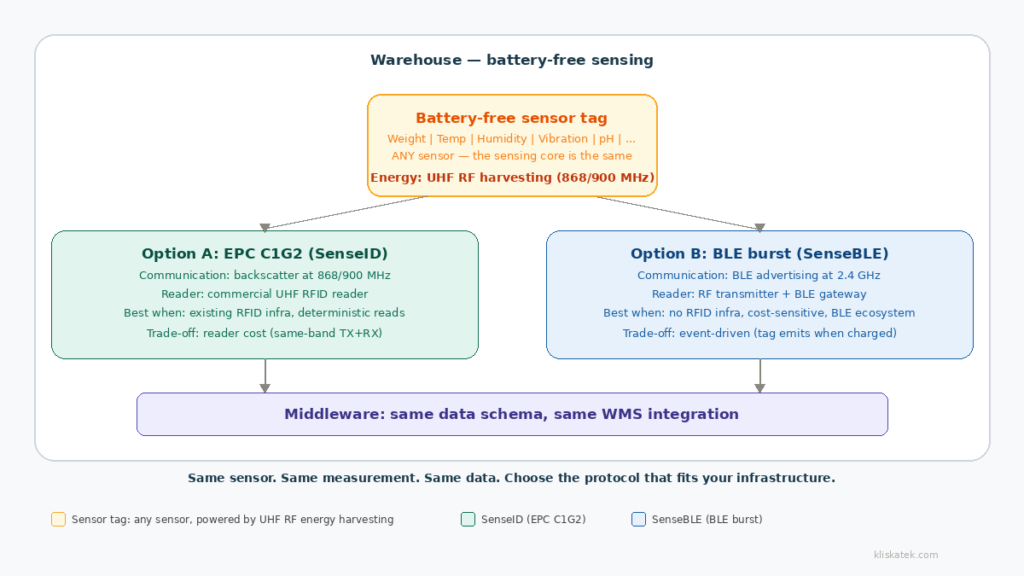
3) Two communication options: same sensor, different infrastructure
This is where the choice gets interesting — and where we see the most confusion in the market.
Option A: EPC C1G2 (SenseID)
The tag harvests energy from a commercial UHF RFID reader and communicates back via EPC C1G2 backscatter. This is the standard RFID protocol: the reader sends power and signal, the tag reflects modulated data back.
When this makes sense: you already have UHF RFID readers deployed for track-and-trace, you need compatibility with existing RFID middleware, or your operations team is familiar with EPC workflows. Adding sensor tags to an existing RFID infrastructure is straightforward — the tags respond to standard EPC C1G2 inventory commands and sensor data is encoded in the EPC or user memory.
The trade-off: RFID readers are relatively expensive. They need to transmit power and listen for backscatter in the same frequency band (868/900 MHz), which requires high-sensitivity receiver circuits. This is mature, proven technology — but the reader cost is meaningful, especially if you are building the infrastructure from scratch.
Option B: BLE burst (SenseBLE)
The tag harvests energy from a UHF RF source — which can be a commercial RFID reader or a simpler, dedicated RF transmitter — and communicates via a BLE advertising burst. Once the tag has accumulated enough energy from the UHF field, it fires a BLE beacon containing the sensor data and its unique ID, then goes back to sleep until the next energy cycle.
When this makes sense: you do not have existing RFID infrastructure, your systems already work with BLE (gateways, smartphones, edge devices), or you are cost-sensitive on the reader side. Transmitting power at 868 MHz and receiving data at 2.4 GHz uses two separate frequency bands, which means simpler and cheaper electronics on the reader/receiver side compared to a full RFID reader.
The trade-off: the read pattern is different. In EPC C1G2, the reader controls exactly when it interrogates each tag (deterministic). In BLE burst, the tag emits when it has enough energy (event-driven). For most warehouse applications, this difference is not critical — but it is worth understanding when designing your data pipeline.
What does not change between the two options: the sensor, the measurement accuracy, the energy harvesting principle (both use UHF RF), and the fact that no batteries are needed on the tag side.
4) Reference architecture
Regardless of which protocol you choose, the data pipeline follows the same pattern:
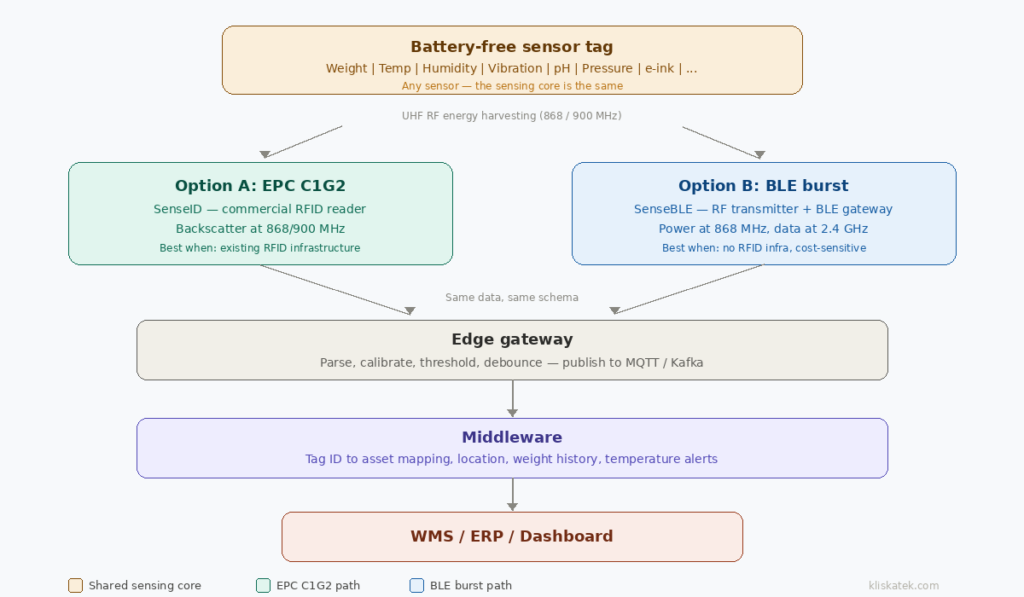
Tags. Battery‑free sensor tags from our SenseID or SenseBLE families. Same physical sensors, different communication ICs. The tag is embedded in the pallet structure, placed under a container, or attached to the asset.
RF source and data receiver. For SenseID: a commercial EPC C1G2 reader at a dock door, on a forklift, or in a handheld. For SenseBLE: an RF transmitter for power plus BLE gateways or any BLE-capable device for data reception.
Middleware. This layer is protocol-agnostic. Whether the upstream data arrives as an EPC C1G2 read event or a BLE advertising packet, it gets normalised into the same schema before hitting your WMS or ERP.
5) Practical message shapes
Weight snapshot (works with either protocol)
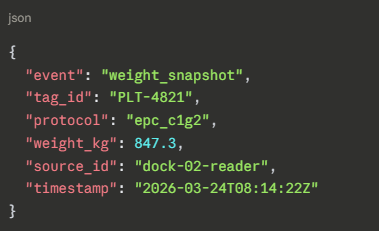
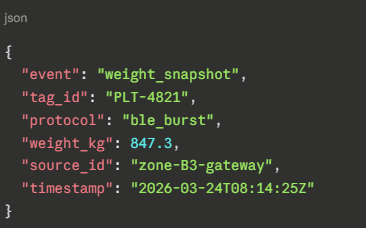
Same data, same schema. The protocol field lets your middleware know where it came from, but downstream systems do not need to care.
6) The weight measurement use case
Battery‑free load cell tags are particularly valuable for warehouse inventory of bulk, granulates and liquids. Here is how it works:
A tag with four load cells is embedded in or placed under a pallet. When an RF source energises the tag, the load cells measure the weight on top, the tag digitises the values and transmits the weight along with its unique ID.
An operator with a handheld reader (or a forklift-mounted reader, or a fixed portal at a dock door) can sweep the warehouse and get an accurate inventory of every container in minutes. No opening lids, no estimating, no paperwork.
For containers where the product has a known density, weight directly translates to volume — which is often what your ERP actually needs.
7) Beyond weight: environmental monitoring and asset tracking
The same energy harvesting platform supports any sensor that fits within the power budget:
Temperature and humidity. Critical for cold chain compliance at fixed sites (cold rooms, staging areas, docks). The sensor tag takes a snapshot every time it is energised — frequency depends on how often the reader or RF source cycles.
Vibration and orientation. Accelerometer tags can detect if a pallet has been dropped, tilted beyond a threshold, or is vibrating abnormally (which might indicate a problem with the storage structure or a nearby machine).
Continuity and tamper detection. A simple continuity check can tell you if a seal has been broken, a wire has snapped, or a container has been opened since the last check.
The point is that the sensing platform is generic. The specific sensors on our evaluation boards (temperature, humidity, accelerometers, magnetometers) are examples of what the technology can do. If your application needs a different sensor — a pH probe, a pressure transducer, a strain gage, an e-ink display — we design custom solutions around the same energy harvesting and communication core.
8) How to decide: EPC C1G2 or BLE?
There is no universally right answer. Here are the real decision factors:
Do you already have UHF RFID readers? If yes, SenseID (EPC C1G2) is the path of least resistance. Your existing readers, antennas and middleware already work. Adding sensor tags is an incremental step.
Are you building from scratch and cost matters? If you have no existing RFID infrastructure, SenseBLE may be more cost-effective. The RF transmitter for power delivery is simpler (it does not need to decode backscatter), and BLE receivers are commodity hardware.
Do your downstream systems already speak BLE? Many modern edge platforms, IoT gateways and mobile apps are built around BLE. If that is your ecosystem, SenseBLE fits naturally.
Do you need deterministic reads? With EPC C1G2, the reader decides when to interrogate each tag. With BLE burst, the tag emits when it has enough energy. For applications where you need to read specific tags in a specific order (think: portal reads at a dock door), EPC C1G2 gives you more control.
Could you use both? Yes. The sensor data is the same. The middleware normalises it. Some deployments use RFID at portals (leveraging existing readers) and BLE in open floor areas (lower infrastructure cost per zone). This is a pragmatic approach, not a compromise.
9) What we will help you pilot
A good starting point: one dock portal or one warehouse zone, with evaluation tags carrying the sensor that matters for your operation — weight, temperature, humidity, or a combination.
We provide the evaluation tags (SenseID or SenseBLE depending on your infrastructure preference), along with KL‑OSIRIS — our free software for reading and logging sensor data — so you can validate measurements before integrating with your WMS.
If your sensor need goes beyond our standard evaluation boards, we design custom solutions: different sensors, different form factors, optimised antennas for your specific environment.
Interested in running a pilot? Contact us and tell us about your warehouse. We will recommend the right protocol and sensor combination for your specific case.
Next week: “One Sensor, Three Protocols: How SenseID, SenseBLE and SenseNFC Share the Same Sensing Core” — the technical story of how a single sensing platform serves three communication standards.