
You don’t need a forest of batteries to monitor fields. Use battery‑free UHF RFID for on‑demand soil/valve snapshots at powered touchpoints, BLE for continuous low‑duty coverage in the rows, and NFC taps for spot checks when humans are on site. This post gives you a field‑proven playbook: cell design, BOM, message contracts, acceptance tests, and a commissioning checklist that real crews can follow.
1) The hybrid that actually deploys
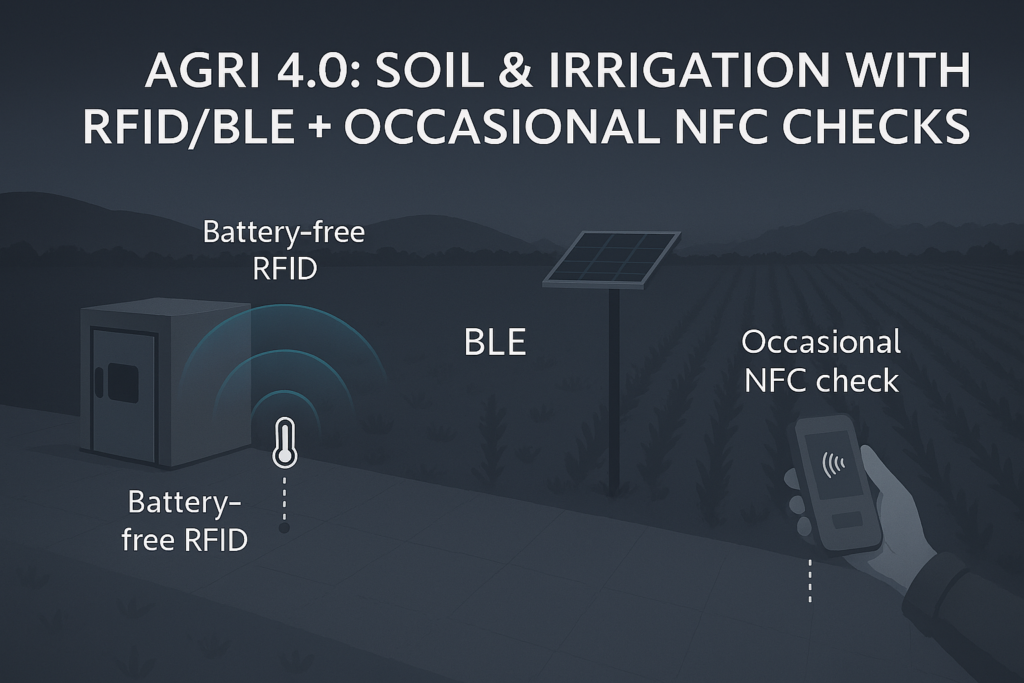
- UHF RFID (battery‑free, on‑demand): At powered touchpoints (pump houses, manifold boxes, headworks, row ends), a reader energizes tags that harvest RF, measure (soil moisture/temperature, valve state, flow pulse), and backscatter a compact payload. Works best as checkpoints and for scheduled audits (e.g., every 15–60 min sweep).
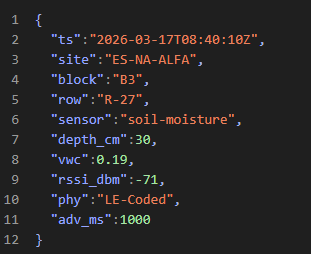
- BLE (continuous context): Solar‑powered BLE gateways along rows (or on poles) run coded PHY for range and robustness; short advertising intervals from battery/energy‑harvesting nodes provide continuous low‑duty trends (e.g., moisture drift, pressure). Gateways publish MQTT/REST upstream.
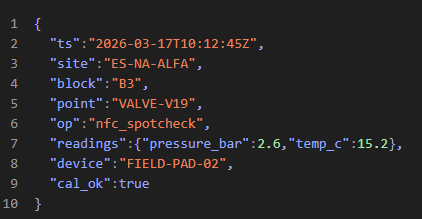
- NFC (occasional checks): A tech taps a buried or enclosure‑mounted tag with a phone/pad; the tag harvests enough energy to take a reading and returns calibrated values—great for cal/spot QA without opening housings.
Rule of thumb: RFID → verify (on‑demand), BLE → watch (continuous), NFC → trust (cal/spot).
2) Cell design (design for cells, not hectares)
A cell is the smallest repeatable coverage bubble with a defined SLO. Tile cells across the block and overlap slightly to avoid holes.
RFID cell SLO (touchpoint):
≥99% of enrolled tags at the manifold/headworks respond within ≤60 s per sweep under production settings (session, data rate, dwell) with worst‑case tag orientation.
BLE cell SLO (row coverage):
P(detect within 10 s) ≥95% for nodes advertising every 1 s (coded PHY, –4 dBm), with people and equipment present.
3) A deployment playbook your crew can follow
Step 0 — Scoping (1–2 days)
- Map irrigation topology: pumps → mains → sub‑mains → valves → laterals.
- Decide cadence: where do you need continuous vs scheduled visibility?
- Pick sensors:
- Soil moisture: dielectric/capacitance probes at 2–3 depths (e.g., 10/30/60 cm).
- Temperature (soil & air) for evapotranspiration context.
- Valve/flow: reed/Hall pulse + limit switch.
- Privacy & data policy: rotating IDs, minimal payloads, TLS.
Step 1 — Bill of materials (per 40–60 ha “block”)
- RFID: 1–2 UHF readers (PoE), 2–6 antennas at touchpoints, 50–200 battery‑free sensor tags (valve boxes, risers, key laterals).
- BLE: 4–8 solar gateways (PoE‑ready fallback) + enclosure, 20–60 low‑duty BLE sensor nodes for rows (moisture/pressure).
- NFC: 1–2 field pads/phones with protective cases; NFC‑enabled sensor ICs in select locations.
- Networking: LTE/LoRa‑backhaul or farm Wi‑Fi; surge protection; grounded masts.
- Mechanical: UV‑stabilized enclosures (IP65+), breathable vents, gland fittings, stakes.
Step 2 — Install by “rings”
- Core (power & backhaul): bring PoE/LTE/Wi‑Fi to the pump house; mount the first BLE gateway and UHF reader here.
- Touchpoints (RFID): add antennas at headworks/manifolds; enroll tags; test sweep success rate.
- Rows (BLE): plant gateways on poles at overlaps; verify the 10‑s detection SLO end‑to‑end.
- NFC QA points: bury/mark tap spots; train the team to record cal vs live comparisons.
Step 3 — Message contracts (keep them boring)
MQTT topics
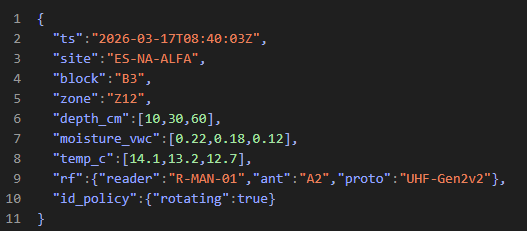
agri/{site}/{block}/{zone}/soil
agri/{site}/{block}/{manifold}/valve
agri/{site}/{block}/pump/flow
Soil snapshot (RFID)
Row trend (BLE)
NFC tap (service check)
Step 4 — Acceptance tests (one page, pass/fail)
- RFID sweep: ≥99% tag success ≤60 s; record worst tag orientation.
- BLE latency: median time‑to‑first‑detection ≤5 s; 95th ≤10 s.
- Valve open→flow event: ≤5 s to broker; debounce at edge.
- NFC spotcheck: cal vs live within ±2% VWC and ±0.3 bar (as applicable).
- Data contracts: schema validate at gateway; reject invalid upstream.
Step 5 — Operations (the parts future‑you will thank you for)
- Edge first: thresholds (too dry/wet, pressure loss) at the gateway.
- Version everything: topic/schema versions, config snapshots, and a roll‑back switch.
- Seasonal shifts: create presets for spring/summer irrigation regimes; flip thresholds, not code.
- Spare bins: enclosures, glands, stakes, and cable glands on site; a dead gateway should be a 10‑minute swap.
4) OPEX and yield outcomes
- Less trenching & fewer batteries by pushing battery‑free to touchpoints and BLE where continuity helps.
- Faster response: irrigation faults or leaks become edge alerts, not “tomorrow’s CSV.”
- Better water use: depth‑aware moisture trends drive zone‑specific watering; NFC spot checks provide confidence without opening boxes.
5) How Kliskatek helps (Engineering & T&M)
- Coverage survey (RFID/BLE/NFC/LTE/LoRa/Wi-Fi) + cell SLO plan.
- Sensor firmware (ULP sampling, TLV/JSON mapping, calibration).
- Gateways & middleware (MQTT/REST/Kafka, schemas, privacy by design).
- Commissioning kit (acceptance scripts, technician checklist, training).
Bottom line: Design by cells; use RFID to verify, BLE to watch, and NFC to trust. Ship calm—and calm scales.