
TL;DR
“Battery‑free” doesn’t mean “energy‑free.” It means we harvest tiny, intermittent bits of energy (RF, magnetic fields from NFC, ambient RF/2.4 GHz, sometimes light or motion), buffer them wisely, and spend them on sensing, compute, and communication at the right moments. The three pillars are: a robust power path, the right energy storage, and a disciplined duty‑cycling strategy. Get those right and you get sensors that feel like magic—and maintenance teams that don’t have to hunt for coin cells.
Why this matters (and who this is for)
If you’re integrating UHF RFID, battery‑free Bluetooth (broadcast‑style, bursty), or NFC tap‑to‑measure devices into real systems—data centers, cold‑chain, agriculture, rotating machinery—understanding the energy choreography is the difference between “works in the lab” and “works on a Tuesday at 3 am during inventory.” This post is a practical map you can use whether you’re an RF engineer, embedded dev, or an ops lead who simply wants reliable and maintenance‑light instrumentation.
The anatomy of a battery‑free sensor
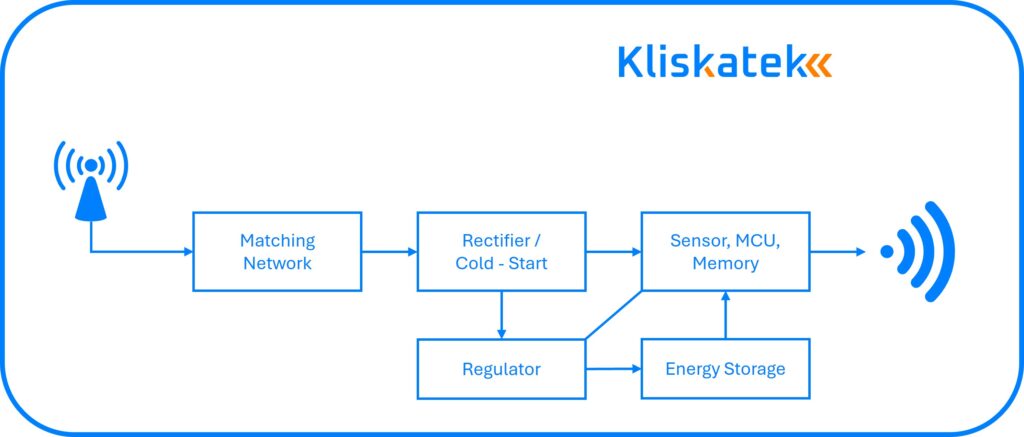
At a high level, all variants share the same skeleton:
[Antenna/Coil] → [Matching Network] → [Rectifier / AC-DC] → [Cold-Start DC-DC]
       → [Energy Storage (C)] → [Regulators / Supervisors]
           → [Sensing Front-End + MCU/State Machine + Memory]
                → [UHF backscatter | BLE burst | NFC tap I/O]
- Antenna/Coil & Matching: Maximize captured power in your band (UHF for RFID, 13.56 MHz coil for NFC, 2.4 GHz for BLE harvesters). Small detuning from packaging, liquids, or metal can tank your budget—treat the enclosure as part of the antenna design.
- Rectifier / Cold‑start: You’ll need a high‑efficiency rectifier and a converter that cold‑starts from micro‑watts. Pay attention to start‑up voltage/current; this is where many “great on paper” ideas stall.
- Storage: Your “battery” is typically capacitive: supercap or MLCC array sized for the worst‑case operation you must support.
- Regulators / Supervisors: Brown‑outs kill data. Supervisors keep you honest: no boot until Vcap ≥ V_start; no write if Vcap < V_safe.
- Application: Sensor front‑end (bridge/ADC/AFE), minimal compute (tiny MCU or state machine), and a comms block (backscatter, burst advertiser, or NFC memory update).
Storage: where your harvested energy really lives
A simple equation guides 80% of our sizing:
Energy in the cap: [E = ½ · C · (V_{high}² − V_{low}²)]
If your session (measure + compute + communicate) needs, say, 2 mJ, and you can operate between V_{high} = 3.3 V and V_{low} = 2.8 V, you solve for C. Remember to include converter efficiency and safety margins. MLCCs have voltage‑dependent capacitance and temperature drift; supercaps have leakage and ESR. Choose the devil you know:
- Supercaps (mF‑F): Great for bigger bursts (e.g., a flurry of BLE advertisements), but watch leakage at high temp and life at low temp.
- MLCC arrays (µF‑tens of µF): Low leakage, small, cheap, but effective C shrinks under bias; derate generously.
- Thin‑film: Beautiful leakage, limited capacity, cost/availability can bite.
Practical tip: Characterize E/session empirically. Log Vcap with a scope across real measurement+TX events. You’ll see where energy goes: sensor warm‑up, ADC, compute, and especially comms.
Duty cycling: your invisible superpower
“Battery‑free” lives or dies on when you spend energy, not just how much.
Four rules we use at Kliskatek
- Pre‑charge windows: Let the harvester fill the cap to V_{high} before any heavy work. In UHF RFID, the reader’s dwell time acts as your “pre‑charge.” In BLE harvesters, you accumulate in the background; in NFC, the user tap provides a strong, short energy burst.
- Atomic sessions: Treat measure → compute → communicate as a single atomic unit guarded by Vcap thresholds. If during the session Vcap dips below V_{safe}, abort gracefully and avoid partial writes.
- Progressive disclosure: Do the cheapest thing first (e.g., sensor presence check), promote to costlier steps (full precision read, compute), and only then transmit.
- Back‑off & adapt: If you brown‑out, automatically increase inter‑event intervals, reduce payload length/rate, or lower sensing resolution on next try.
A minimal state machine
IDLE (charge)
  |-- if Vcap >= V_start --> MEASURE
MEASURE
  |-- if success && Vcap >= V_compute --> COMPUTE
  |-- else --> IDLE (back-off)
COMPUTE
  |-- if Vcap >= V_tx --> TRANSMIT
  |-- else --> IDLE (retry later)
TRANSMIT
  |-- send minimal payload; if room, add extras
  |-- return to IDLE; adapt intervals based on Vcap_min seen
``
Tuning those V_start / V_compute / V_tx thresholds is where you convert theory into reliability.
Three reference architectures (chip‑agnostic)
1) UHF RFID, interrogator‑powered (EPC Gen2/ISO 18000‑6C)
When to use: Inventory + telemetry when a reader is nearby; perfect for on‑demand reads and large fleets.
Energy flow: Reader field → rectification → small buffer → sensor read → backscatter reply.
Design notes:
- Your “TX” cost is modulation of reflection—cheap energy‑wise—but you still pay for sensing and control logic.
- Many ICs offer sensor bridges/ADCs + user memory so you can map data into EPC/User banks (e.g., temperature, ID, flags).
- Critical: field strength & dwell time. If the reader rushes past, your pre‑charge window collapses. Test with real antennas in your environment (metal, liquids, orientation).
2) Battery‑free BLE burst (harvest‑then‑advertise)
When to use: You want ambient coverage (BLE scanners/phones) and a few meters of range without readers.
Energy flow: Slow harvest → bigger cap → burst of ADV packets (high current but very short) → sleep.
Design notes:
- Shape your ADV payload for minimum energy (short intervals, only essential bytes).
- Pre‑compute anything you can while charging (e.g., checksum) to shorten the radio‑on time.
- Consider pre‑charge indicators (an LED blink costs energy; use it sparingly or not at all).
3) NFC tap‑to‑measure (13.56 MHz, NDEF)
When to use: Audits/CRT: a person with a smartphone taps to read or trigger a fresh measurement in places where readers aren’t installed.
Energy flow: Strong local field from the phone → sensor read → NDEF update → user reads the result.
Design notes:
- Great UX: no batteries, no pairing.
- Keep the tap workflow snappy; if your sensor needs warm‑up, start it as soon as field is detected, then update NDEF only when you have valid data.
- Useful for calibration/config too (store parameters in NDEF or user memory).
Building an energy budget (a quick example)
Let’s say we need 1 sample from a temperature sensor, some simple filtering, and a UHF RFID response.
- Sensor & AFE: 80 µJ (includes warm‑up)
- MCU compute (few ms @ low MHz): 20 µJ
- Backscatter TX control logic: ~5 µJ
- Supervisory overhead & losses: ~45 µJ
- Total session ~150 µJ
If your harvester plus field conditions give you P_harvest ≈ 150 µW steady for 1 s, you’re good. But conditions fluctuate; plan for ¼ of that power and budget ≥4 s of pre‑charge. In BLE bursts, the TX spike (few mA for <10 ms) dominates—hence the larger capacitor and fewer, shorter advertisements. In NFC, the phone gives you a luxury power bath for ~100–300 ms; your job is to finish within that bath.
Firmware & hardware tips we’ve learned the hard way
- Cold‑start first: Verify your converter’s true cold‑start behavior on your board, with your antenna/coil and enclosure. Bench eval boards lie (nicely).
- Gate everything: GPIO‑gate sensor power and pull‑ups so they’re off while charging.
- ADC timing: Many sensors + ADCs have warm‑up/settle times. Budget them first; everything else is easier.
- Write‑minimize: Non‑volatile writes cost energy. Cache in RAM; write only when value changes beyond a threshold or when you must persist.
- Supervisor hysteresis: Use brown‑out + hysteresis so you don’t oscillate around V_start.
- Calibration hooks: Add an NFC back‑door for calibration/diagnostics even if your primary is UHF or BLE; it’s a fantastic field tool.
- Packaging matters: Plastics absorb/shift RF; metals detune; condensation kills. Treat mechanical + RF + thermal as one design.
Deployment gotchas (so you don’t get surprised later)
- Reader dwell & power (RFID): A fast forklift scan isn’t the same as a rack audit. Tune reader EIRP, dwell, and antenna geometry for the energy you need, not just ID reads.
- Body and water loading (BLE/NFC): Human bodies are mostly water; expect range and coupling changes when a person interacts.
- Rotation and speed: On rotating assets, exposure time to the field might be milliseconds; consider pre‑charge phases or higher‑Q antennas and position the interrogator accordingly.
- Temperature: Capacitance, leakage, and sensor bias drift with temperature—characterize cold rooms and hot enclosures separately.
What “battery‑free” really means (my quick rant)
We tend to say “battery‑free,” not “zero‑power.” The device does consume energy—we just harvest it and store it temporarily so you never replace cells. It’s great for ESG (no battery waste), OpEx (no maintenance rounds), and safety (no swollen cells in hot areas). But it works only when RF, magnetic, light, or motion conditions match the duty cycle you choose. Honest scoping beats hype every time.
Where this goes next
In the coming weeks we’ll braid through DCIM, RF deep‑dives, cold chain/CRT, automotive/rotating, agriculture, logistics, security/standards/WPT‑HP, and verticals like healthcare and smart city—so there’s something useful for everyone on a regular cadence. [Synch Editorial | Excel]
A simple checklist you can steal
- Define one atomic session and measure its energy.
- Pick V_start / V_compute / V_tx and enforce them with a supervisor.
- Size C from E = ½·C·(V_high² − V_low²) with realistic derating.
- Model pre‑charge time under worst‑case field conditions.
- Verify RF + enclosure + temperature impacts together.
- Add NFC maintenance hooks even if not primary.
- Test graceful aborts and retry back‑off.
Want help?
If you’re scoping a pilot—be it reader‑powered UHF sensing, harvest‑then‑burst BLE, or NFC tap‑to‑audit—we’re happy to review your energy budget and duty‑cycling plan and suggest a chip‑agnostic architecture that fits your constraints.
Thanks for reading. If there’s a section you want me to expand into a deep‑dive (e.g., cold‑start converter choices or ADV payload shaping), ping me—I’ll queue it up.