
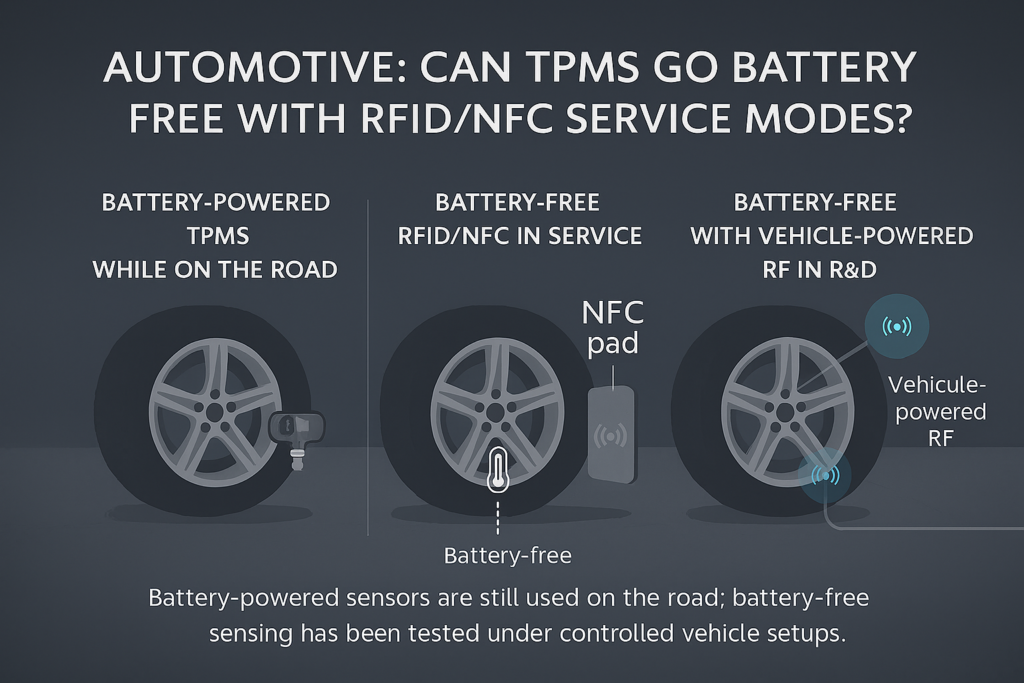
Today’s road‑legal TPMS remains battery‑powered—production systems use 315/433 MHz in‑wheel sensors to warn while driving; that’s how current type‑approval and industry practice are met.
Battery‑free is already valuable in “service modes.” Use embedded UHF RFID for tire identity (ISO 20909/20910/20911/20912) and HF/NFC harvest at the line/workshop to read pressure/temperature without coin cells.
Feasibility note: battery‑free wireless sensing inside the tire has been demonstrated in controlled vehicle setups when the car integrates RF power transmit (reader + antennas) in the wheel well to energize the in‑tire device. Backscatter UHF RFID or low‑duty 2.4 GHz (BLE/proprietary) uplinks are technically possible—but taking this to volume production requires significant vehicle‑level integration and qualification.
What “TPMS” must do—on the road
Regulations require that under‑inflation be detected and indicated while driving. In Europe, UN/ECE R141 defines behavior and tests; industry guidance like SAE J2657 covers performance and environments. Production systems therefore place a battery‑powered radio in each wheel, transmitting at 315 or 433 MHz to a receiver.
Bottom line: With today’s rules, live in‑motion TPMS uses onboard energy in the wheel.
Where battery‑free already fits: service modes you control
A) Embedded UHF RFID for lifecycle identity
The tire industry standardized on UHF RAIN RFID: ISO 20909 (tyre tags), ISO 20910 (coding), ISO 20911 (attachment), ISO 20912 (conformance). This gives each tire a robust, battery‑free ID from factory to recycling and aligns with Digital Product Passport initiatives underway in the EU. Programs from leading tire makers are in scale‑up today.
B) HF/NFC “tap‑to‑service” sensing
At the assembly line or workshop, HF/NFC readers can energize an in‑tire (or valve‑module) front‑end long enough to sample and return pressure/temperature—no in‑wheel battery needed for that interaction. Practical energy harvests are tens of milliwatts in close‑coupled conditions, sufficient for brief measurements.
Feasibility note — Battery‑free in‑tire sensing with on‑vehicle RF power (tested)
We’ve tested battery‑free, in‑tire sensing in controlled vehicle setups by adding RF power transmit capability to the vehicle (reader + antennas integrated in the wheel well). Under these conditions, the in‑tire device harvests enough energy to take a measurement and send it off‑tire:
- Power path: vehicle‑mounted RF transmit (near‑field or UHF) → in‑tire harvester → short duty‑cycle measurement.
- Comms choices:
- UHF RFID backscatter to the reader (efficient, proven at scale for ID); or
- 2.4 GHz uplink (either BLE or proprietary) when the energy budget supports a short broadcast.
- State of the art: Passive SAW‑based pressure/temperature sensors have been run wirelessly on moving automotive parts (e.g., TPMS/torque demonstrators), proving the physics of battery‑free, backscatter‑style sensing in harsh environments.
Reality check: To move from demo to series production, OEMs must solve integration at scale—reader placement, coupling efficiency, EMC/EMI, coexistence with 315/433 MHz TPMS, thermal/pressure derating, and cost across vehicle variants. That is a multi‑discipline, multi‑platform effort.
Pragmatic architecture (2026+)
While driving (regulatory alerts):
- Keep battery‑powered 315/433 MHz TPMS to satisfy UN/ECE R141 / SAE J2657 today.
When parked / at service (battery‑free):
- UHF RFID (ISO 20909/20910/20911/20912) for tire ID + workflow.
- NFC/HF taps for occasional sensor reads without a coin cell.
R&D track (controlled fleets/trim lines):
- Vehicle‑integrated RF power transmit + in‑tire harvester to enable battery‑free sensing; UHF backscatter or 2.4 GHz bursts depending on link budget. (Feasible, tested; not yet in series production).
Thermal & packaging realities (why projects win or fail)
- Thermal paths: map die→package→TIM→case→air; tires and wheel wells swing widely in temperature.
- RF tuning in rubber: embedded UHF tags are over‑tuned for in‑tire dielectric—copy supplier fixtures and verification (e.g., Voyantic Tagsurance used in tire programs) rather than “in‑air” assumptions.
- NFC coils: match geometry to the pad/phone to maximize coupling; EH budget is geometry‑dominated.
Buyer’s guide (quick)
- Need road‑legal, in‑motion alerts? Stay with battery TPMS for now.
- Want paperless ID + service efficiency? Embed UHF RFID and add NFC pads at your touchpoints.
- Exploring battery‑free sensing? Pilot vehicle‑integrated RF power in a controlled fleet; start with UHF backscatter for the return link and quantify the energy budget before trialing 2.4 GHz bursts.
How Kliskatek can help (Engineering & T&M)
- Vehicle‑side RF power design (antenna placement, EMC/EMI, coexistence).
- In‑tire harvester & firmware (ULP sampling, burst comms, calibration).
- Embedded UHF tire ID (ISO 20909/20910 coding; DPP‑ready data plumbing).
- Acceptance tests from bench to dyno: link budget, thermal drift, repeatability.
Bottom line: Battery‑free is already great for identity and service‑time measurements. Battery‑free in‑motion sensing is feasible with vehicle‑integrated RF power and has been tested, but scaling it to series production will take coordinated OEM effort.