
Over the past two weeks we’ve established that SenseID, SenseBLE and SenseNFC share the same sensing core and explored how to choose between protocols based on infrastructure and use case. This week we go into the economics — the part of the conversation that matters most when the decision moves from the engineering lab to the budget approval meeting.
The question we hear most often: “Why does an RFID reader cost so much more than an RF transmitter plus a BLE gateway?” The answer is physics. And once you understand the physics, the cost structure makes perfect sense — and so does the decision about which path to take.
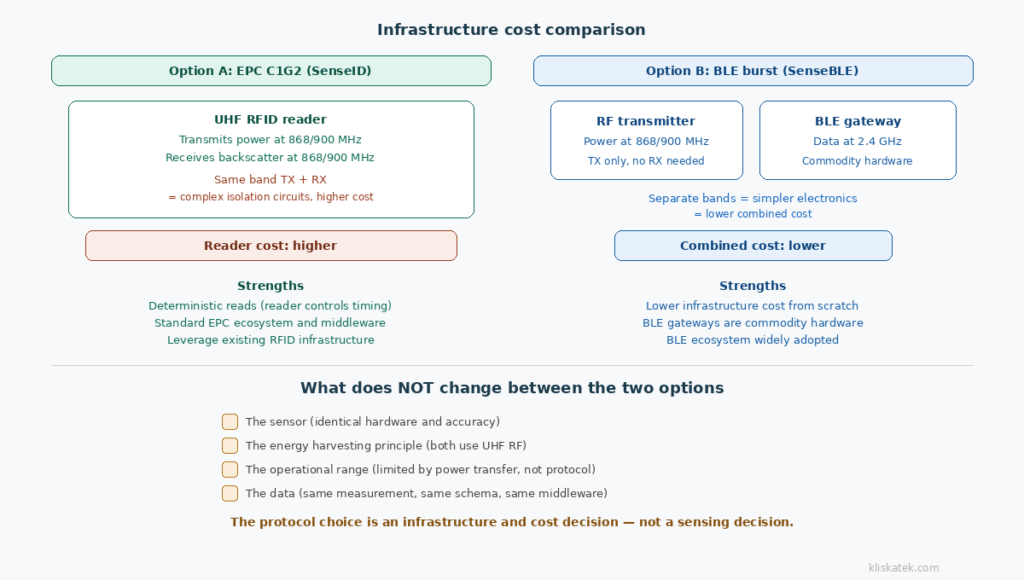
1) Why RFID readers are more expensive: same-band TX and RX
A UHF RFID reader does two things simultaneously in the same frequency band (868 or 900 MHz): it transmits a powerful RF signal to energise the tag, and it listens for the very faint backscatter signal the tag reflects back.
This is technically demanding. The reader is transmitting at 30+ dBm (1 watt or more) and trying to detect a return signal that’s been attenuated by the round trip to the tag and back — often arriving 60-80 dB weaker than the transmitted signal. That’s like trying to hear someone whisper while you’re shouting through a megaphone, in the same room, at the same frequency.
To make this work, RFID reader designers use sophisticated techniques: directional couplers, circulators, careful impedance matching, and advanced signal processing to separate the transmitted signal from the received backscatter. These components and the engineering behind them add cost. It’s mature, proven technology — commercial RFID readers from Impinj, Zebra, Nordic ID and others are reliable, well-documented, and widely deployed. But they’re not commodity hardware.
2) Why RF TX + BLE gateway is cheaper: separate bands
With SenseBLE, the architecture splits the two functions across different frequency bands. A dedicated RF transmitter handles power delivery at 868/900 MHz. Its only job is to generate a strong enough field to energise the sensor tags — it doesn’t need to listen for anything in return.
The sensor data comes back via BLE at 2.4 GHz — a completely separate frequency band. A standard BLE gateway picks up the advertising burst. Because the gateway is receiving at 2.4 GHz while the transmitter is operating at 868/900 MHz, there’s no same-band interference problem to solve. No circulators, no complex isolation circuits.
BLE gateways are commodity hardware. They’re manufactured in massive volumes for consumer and industrial IoT applications, supported by every major chipset vendor, and available at a fraction of the cost of a UHF RFID reader. The RF transmitter, being a simpler device than a full RFID reader (transmit only, no receive chain), is also less expensive.
The combined cost of an RF transmitter plus a BLE gateway is typically lower than a comparable RFID reader setup. How much lower depends on the specific hardware, deployment scale, and vendor — but the structural cost advantage comes from the physics, and it’s consistent.
3) But reader cost is not the whole story
This is where the conversation gets more nuanced — and more useful for actual budgeting decisions. The reader or transmitter is one component of the total infrastructure cost. To compare fairly, you need to consider the full picture.
Installation and cabling. Both RFID readers and RF transmitters need power and, typically, a network connection. Installation costs are similar. BLE gateways are often smaller and can be powered over PoE, which may simplify installation in some facilities.
Coverage per device. This varies significantly by application. An RFID reader with a high-gain antenna might cover a portal or a specific zone effectively. A BLE gateway might cover a broader area for data reception, but the power delivery from the RF transmitter still needs to reach the tags. In both cases, the limiting factor for battery-free tags is the RF field strength at the tag location.
Software and middleware. EPC C1G2 has a well-established middleware ecosystem (Impinj Octane, Zebra RFID SDK, etc.). BLE has MQTT, standard BLE SDKs, and a wide range of IoT platforms. The software cost depends more on your existing systems than on the protocol choice. If you already have EPC middleware, extending it is cheap. If you’re building on a modern IoT stack that speaks MQTT and BLE, that path is natural.
Maintenance. For battery-free sensor tags, this is where the real savings materialise — and it’s the same for both protocols. Zero battery replacements, zero maintenance visits to the tag side. The infrastructure (readers, transmitters, gateways) requires standard IT maintenance, which is equivalent for both options.
4) When RFID is actually the cheaper path
Despite the higher reader cost, there are clear scenarios where the EPC C1G2 path is the more economical choice:
You already have readers. This is the most common case, and the most powerful argument. If your facility has RFID readers deployed for track-and-trace, inventory, or access control, the incremental cost of adding battery-free sensor tags is just the tags themselves plus a software update. The reader is already paid for, installed, cabled, and connected. Adding sensing to an existing RFID infrastructure is remarkably cost-effective.
You need dense read points at portals. Dock doors, production line checkpoints, and other fixed points where items pass through are natural RFID territory. An RFID reader with multiple antenna ports can instrument a portal efficiently, and the deterministic read pattern (reader decides when to interrogate) gives you guaranteed reads at known points.
Your organisation has EPC expertise. If your operations team already manages RFID systems, adding sensor tags means training on the sensor data format, not on a new technology stack. The institutional knowledge is an asset that doesn’t show up on a hardware cost comparison.
5) When BLE is the cheaper path
You’re starting from scratch. No existing readers, no existing middleware, no existing expertise. In this case, the lower hardware cost of the RF transmitter plus BLE gateway approach adds up quickly, especially across multiple zones.
You need many coverage zones. In a large facility where you want environmental monitoring (temperature, humidity) across many areas, the cost per zone matters. BLE gateways are inexpensive enough to deploy densely without the budget pain of multiple RFID readers.
Your IoT stack is already BLE-native. If your edge platform, your dashboards, and your data pipeline already handle BLE data, adding SenseBLE tags means the data flows naturally through your existing architecture with no translation layer.
6) The third option: no fixed infrastructure at all
SenseNFC deserves a mention in the economics conversation because it eliminates fixed infrastructure entirely for certain use cases. The smartphone your technicians already carry is the reader. The cost is effectively zero on the hardware side — the investment is in the mobile application that processes the NFC sensor data.
For applications like periodic maintenance rounds, spot audits, and compliance inspections, the economics of SenseNFC are compelling precisely because there’s nothing to install, nothing to cable, and nothing to maintain. The trade-off is that readings are human-initiated and near-field only, so it doesn’t replace automated monitoring — but it’s a very cost-effective complement.
7) Total cost of ownership: the battery argument
Regardless of which protocol you choose, the most significant economic benefit of battery-free sensing is on the tag side, not the reader side. And this is where the conversation should often start — especially when presenting to operations directors or financial decision-makers.
Consider a deployment with 500 monitoring points. With battery-powered sensors, each sensor contains a coin cell or similar battery that needs replacement every 2-5 years depending on the duty cycle. That’s 100-250 battery replacements per year, each requiring a technician visit, the battery itself, and the logistics of scheduling. In facilities with restricted access (high voltage equipment, cleanrooms, sealed environments), each replacement visit has additional costs: permits, safety procedures, downtime.
With battery-free sensors, that entire maintenance operation disappears for the lifetime of the deployment. The tag has no battery to replace — it works from harvested energy every time it’s interrogated. The upfront cost per tag is higher than a passive RFID ID tag, but lower than a battery-powered wireless sensor when you factor in the total cost of ownership over 5, 10, or 20 years.
For high voltage equipment with a 40-year lifecycle, the math is especially clear: a battery-free sensor installed during manufacturing can deliver data for the entire life of the asset without a single maintenance intervention.
8) How to build the cost comparison for your case
Every deployment is different, so we can’t give you a universal cost table. But here are the line items to include when you’re building the comparison for your specific situation:
Reader/infrastructure side. How many read points or zones? What’s the unit cost of the reader (RFID) or transmitter + gateway (BLE)? What’s the installation cost per point (power, cabling, mounting, network)? What existing infrastructure can you leverage?
Tag side. How many monitoring points? What’s the tag cost per unit (which depends on the sensor type and volume)? Battery-free vs. battery-powered: what’s the maintenance cost you’re eliminating over the expected life of the deployment?
Software and integration. What middleware or edge software is needed? Can you extend existing systems or do you need something new? What’s the integration effort with your ERP, CMMS, or WMS?
Ongoing operations. What’s the annual cost of maintaining the infrastructure (readers, gateways, network)? What’s the annual cost of maintaining the tags (zero for battery-free, non-zero for battery-powered)?
We can help you build this comparison for your specific application. If you share the basic parameters — number of monitoring points, facility layout, existing infrastructure, expected deployment lifetime — we’ll put together a cost framework that reflects your reality, not a generic brochure number.
9) What comes next
This post closes the three-part series on protocol selection. You now understand that the sensor is the same across all three lines, you know how to choose between EPC C1G2, BLE and NFC based on your deployment context, and you understand the economics behind each path.
The next step is getting your hands on the hardware. Our evaluation kits for SenseID and SenseBLE let you validate the technology in your environment with KL-OSIRIS — our free evaluation software.
Need help building the cost comparison for your specific case? Contact us with a brief description of your application. We’ll help you put together a realistic cost framework — including which protocol (or combination) makes the most economic sense for your situation.
Next week: “Getting Started: Your First Battery‑Free Measurement with KL‑OSIRIS” — a hands-on tutorial for running your first measurement with our free evaluation software.