
Modern DCIM doesn’t need more cabling or battery swaps. A hybrid edge—UHF RFID sensor tags (battery‑free) energized by readers + BLE/WiFi‑equipped gateways—lets you instrument racks, power strips, doors, and aisles with near‑zero maintenance. Firmware does the heavy lifting: map sensor data to EPC/User memory (RFID), aggregate and normalize at the gateway (BLE/MQTT), and push clean signals into your DCIM/CMMS. Where you need truly continuous monitoring at high rates, keep powered or wired sensors in the mix. This is about right‑sensing, right‑place, right‑power.
Why DCIM needs a new sensing layer
- Batteries don’t scale. Swapping thousands of coin cells is OPEX you feel every quarter.
- Cables fight airflow and change management. Each cable you pull is one more thing to reroute when racks move.
- Coverage should be flexible. Hot spots come and go (workloads shift). Your sensing should be as easy to move as your servers.
Battery‑free RFID sensors and BLE/WiFi‑enabled gateways give you a movable, low‑maintenance sensing fabric that plays nicely with the DC you already run.
Architecture at a glance
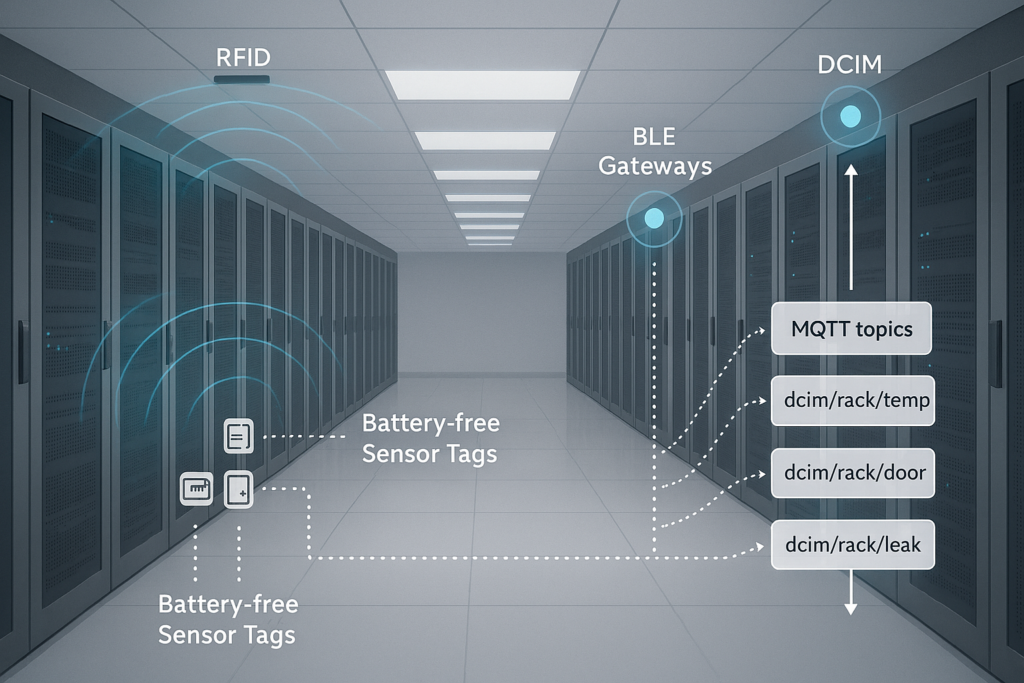
- Edge tags (battery‑free, UHF RFID):
Live dormant until a reader’s RF field is present (e.g., a ceiling/over‑rack antenna or mobile sweep). On wake, the tag samples the sensor, stores values, and backscatters via EPC/User memory. When the reader moves away, it goes back to sleep. (Battery‑free ≠ zero energy; it’s harvest‑and‑transmit from RF). - Gateways (UHF + BLE/WiFi):
Compact nodes that include a UHF RFID reader to energize/read tags and a BLE/WiFi radio to:- relay local events (as BLE/WiFi service data or to bridge nearby battery‑powered nodes where continuous sensing is needed),
- run edge logic (thresholds, smoothing, rate limits),
- publish upstream (MQTT, REST) with retries if backhaul hiccups.
- Back end:
Normalize by asset EPC → asset ID, attach row/rack/zone metadata, and store time‑series with calibration.
We like this split because UHF delivers power + ID + sensor read in one shot, and BLE/WiFi is fantastic for local aggregation and low‑overhead backhaul in noisy RF environments.
Firmware Integration: from sensor IC to DCIM signal
On‑tag (ULP micro / state machine)
- Boot on RF: Rectified UHF field charges storage → brown‑in threshold crossed.
- Sample: Trigger I²C/SPI read (e.g., temperature, humidity, door reed, leak strip impedance).
- Encode:
- EPC: fixed or rotating base ID (for privacy).
- User memory: TLV payload (e.g., T=22.8°C; H=41%; D=1; L=0).
- Duty: If the reader supports sessions/anti‑collision, keep active long enough to complete exchanges; then sleep.
On gateway (RFID + BLE/WiFi app)
- Reader config: Antenna cycling per cell (e.g., front‑of‑rack, mid‑aisle, rear‑of‑rack).
- Parse TLV: Map EPC→asset, apply calibration, debounce door/leak, clip outliers.
- Local decisions:
- Thresholds (e.g., >27°C for 90 s) → edge alert.
- Publish via MQTT (
dcim/rowA/rack12/temp) or REST with ISO timestamps.
- BLE roles:
- Bridge mode: periodic BLE advertisements carrying compact summaries (Service Data TLV: {asset_ptr, metric_code, value}).
- Private mode: use BLE private addresses; rotate per policy to minimize correlation.
Back end
- Data model:
- EPC/TID for identity,
- Per‑metric streams (temp, humidity, door state, leak),
- Provenance (antenna/reader) for RF coverage audits.
- Integrations: DCIM (alerts/dashboards), CMMS (work orders), ERP (asset registry).
Coverage & cadence (how “real‑time” is it?)
- RFID cells: Think zones, not blanket coverage. Ceiling or aisle antennas energize the tags in bursts (duty‑cycled) and sweep through the room. For environmental metrics (temp/ humidity), cadences of 30–180 seconds are usually enough for actionable DCIM alerts.
- Continuous or high‑rate needs (e.g., fast current transients): keep a few wired or battery‑powered sensors where sub‑second detection matters. The gateway happily ingests those over BLE/WiFi and publishes a unified stream.
Where battery‑free fits (and where it doesn’t)
Great fit
- Rack inlet/outlet temperature
- Aisle humidity
- Door state (front/back)
- Leak detection tapes/trays
- Presence / position audits (smart assets, smart pallets)
Use powered or wired
- Very fast or high‑resolution electrical monitoring
- Continuous vibration analysis on rotating equipment
- Critical alarms that must never miss an edge
Security & privacy in an industrial setting
- Rotate identifiers (EPC variants) on schedule; gate read/write with Access passwords.
- BLE privacy: use resolvable private addresses; keep advertisement payloads minimal (no PII).
- Edge filtering: aggregate counts and thresholds instead of raw spams.
- Auditability: every published point carries who/where/how (reader/antenna ID) for compliance trails.
A simple DCIM deployment playbook
- Start with one row: mount two antennas per side, one gateway per row.
- Tag minimally: top/bottom rack temp, door, leak—prove value fast.
- Tune dwell: adjust antenna dwell and session settings until your cadence and read reliability meet SLA.
- Harden routing: MQTT topics, retries, offline buffering.
- Scale by cloning: replicate the row template; add specialty sensors where needed.
Why this matters for OPEX
- No battery rounds for 80–90% of environmental sensing.
- Fewer truck rolls: firmware updates and thresholds happen in gateways.
- Faster moves/adds/changes: tags move with the rack, not with the cabling.
How we can help (Engineering & T&M)
If you’re considering a pilot, Kliskatek’s team can:
- Run an RF coverage survey (UHF + BLE/WiFi) and antenna plan,
- Build your on‑tag firmware (sensor → TLV mapping, calibration),
- Implement gateway logic (RFID/BLE integration, MQTT/REST, edge thresholds),
- Validate privacy & security (EPC rotation, BLE private addressing),
- Provide T&M services (reader conformance, sensor accuracy, throughput testing).
Let’s co‑design your first row and put numbers on the board in two weeks.