
“Battery‑free” doesn’t mean “no energy.” It means sensors harvest energy on demand (often from sub‑1 GHz RF) and buffer it (e.g., in capacitors/supercapacitors) to take a measurement and backscatter the data. That subtle difference is what makes deployments practical, compliant, and maintenance‑free.
Why the term “battery‑free” exists (and what it doesn’t mean)
In everyday language, battery‑free, batteryless, and even zero‑power get tossed around as if devices magically work without energy. They don’t. The point is where the energy comes from and how often you need to service that source.
- Battery‑free sensors harvest energy from their surroundings or an infrastructure emitter (e.g., a RAIN RFID reader) and operate intermittently—long enough to sense and report—without any disposable battery.
- “Zero‑power” here means no installed battery pack on the tag; it doesn’t mean perpetual operation without energy. Sensing and backscatter still consume power; it’s just harvested rather than replaced.
Where the energy comes from: RF (sub‑1 GHz), light, vibration, heat
There are four broad energy sources for maintenance‑free sensing:
- RF (UHF/sub‑1 GHz) — Predictable, on‑demand energy delivered by a reader (RAIN RFID) with excellent building penetration and global standards (EPC Gen2/ISO 18000‑6C). It’s our default in industrial settings because it scales and is predictable.
- Light (photovoltaic) — Great when you have consistent illumination; weak where you don’t (dark enclosures, night shifts).
- Vibration/kinetic — Can work on rotating machinery or rail; performance depends on frequency stability and available amplitude.
- Thermal gradients — Useful where there’s a sustained ΔT (e.g., exterior vs. interior surfaces), not everywhere.
Comparative reviews repeatedly show RF harvesting’s practical advantage in industrial IoT: it’s deterministic (bring a reader → you have energy) and works through obstacles better than higher‑frequency options.
Why Kliskatek favors sub‑1 GHz RF (UHF/RAIN RFID)
Three reasons:
- Reliability & determinism
With a RAIN RFID reader, you control when energy is available. That makes SLA‑grade sensing possible in data centers, factories, and warehouses—not just labs. - Standards & interoperability
EPC Gen2/ISO 18000‑6C is a mature, globally deployed air interface. It means our tags are read by commercial readers and play nicely with existing middleware. - Compliance across regions
In Europe, ETSI EN 302 208 governs RAIN RFID (865–868 MHz at up to 2 W ERP; upper band 915–921 MHz with 4 W ERP channels). In the US, FCC Part 15.247 governs 902–928 MHz (hopping/dwell‑time rules). We engineer for both so you can ship globally without surprises.
Inside a battery‑free sensor tag (what’s actually on the PCB)
A practical RAIN RFID sensor tag includes:
- Antenna & matching to capture RF and maximize RF‑to‑DC efficiency.
- Rectifier & power management to charge storage (capacitor/supercapacitor), gate subsystems on/off, and meet sensor peak‑current needs.
- Sensing element(s) — temperature, humidity, strain, vibration, pressure, voltage, etc.
- Backscatter logic (EPC Gen2) — we return ID + measurement using mandatory commands (no proprietary extensions) via a memory‑mapping approach: reading a specific user‑memory address returns the latest measurement.
- This matters because it keeps the entire RAIN ecosystem compatible—readers, portals, handhelds—and avoids vendor lock‑in.
How we do it: See Kliskatek’s UHF RFID Sensors (SenseID family) for examples that encode ID + sensor data in EPC and work with standard inventory commands.
What “range” and “rate” really look like (and why harvest matters)
Battery‑free sensing is a power‑limited dance: the tag must harvest enough energy to initialize, sample, and respond within the reader’s RF field. Practical implications:
- Range depends on reader power, antenna gains, environment (metal/liquid), tag sensitivity, and sensor peak current.
- Throughput depends on the harvest‑measure‑reply cycle; it’s shorter for simple ambient sensors and longer for low‑noise analog front‑ends.
- Duty cycling is the hero: sensors are disconnected most of the time and are only connected to measure when the reader requests it, keeping energy budgets sane.
Where battery‑free shines (today)
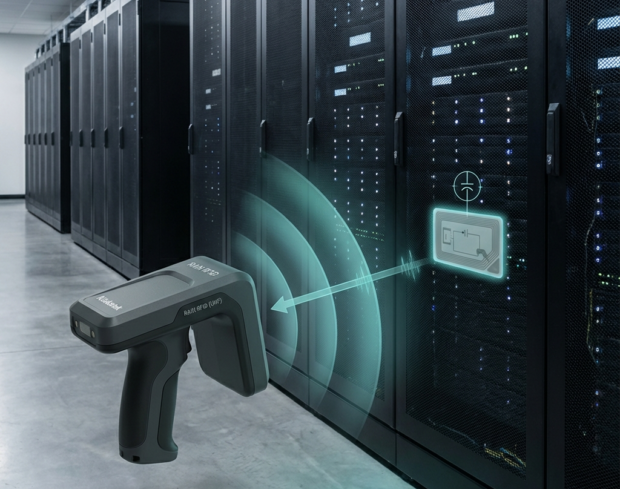
- Data centers (DCIM) — No battery change programs. More granular monitoring (per rack/zone) and energy savings from safe HVAC set‑point rises. Recent industry wins prove feasibility at rack scale.
- Cold chain / CRT — Item/pallet checks at hand‑off points; no logger battery failures; compliance data on demand.
- Structural Health Monitoring — Embedded, maintenance‑free accelerometers/strain sensors in buildings/bridges yield objective data for inspection and disaster recovery.
- Rotating machinery — On‑rotor temperature and strain (no slip rings, no battery swaps).
Where battery‑free is the wrong tool (and what’s next)
If you need continuous streaming, high duty‑cycle telemetry, or multi‑kilometer range without infrastructure, classic battery‑free RFID isn’t your best fit. Ambient/LoRa/Mioty technologies show long‑range links at μW power.
FAQs we hear a lot
“Will the tag work when no reader is nearby?”
No. Battery‑free tags need the reader to deliver energy. If you need autonomous logging between checkpoints, consider battery‑assisted passive (BAP) or active tags; otherwise, reader checkpoints are the pattern.
“Is this safe and compliant globally?”
Yes, when engineered to ETSI EN 302 208 in the EU and FCC Part 15.247 in the US (plus GS1 channel plans). We ship with profiles for your geography.
“Can we read ID + sensor in one shot?”
Yes. Our EPC/memory‑mapping approach returns ID + measurement via standard inventory/read—no custom commands required.
Getting started (a simple, scalable plan)
- Pick one pilot where maintenance is painful or access is limited (e.g., a row of racks, a cold‑room hand‑off, a critical motor).
- Reader layout: choose handhelds for mobile checks or fixed readers for portals/points of interest; validate read range against your environment.
- Data integration: read EPC/TID + user‑memory; map sensor values into your ERP/DCIM/WMS—no custom command set required.
Final thought
Words matter. “Battery‑free” is not magic; it’s good engineering + the right energy source. Pick predictable power (sub‑1 GHz RF), stick to open standards, and design for on‑demand sensing. That’s how you get maintenance‑free, compliant, and scalable deployments in the real world.