
Spec sheets love the phrase “up to X meters.” In practice, RFID “read range” (a two‑way, power‑and‑backscatter problem) is not the same thing as BLE “coverage” (a one‑way or two‑way comms problem shaped by scanning strategy and PHY). This article shows how to translate marketing range claims into design‑level numbers, how to plan hybrid layers (RFID + BLE) that actually work, and where high‑power WPT is nudging roadmaps next.
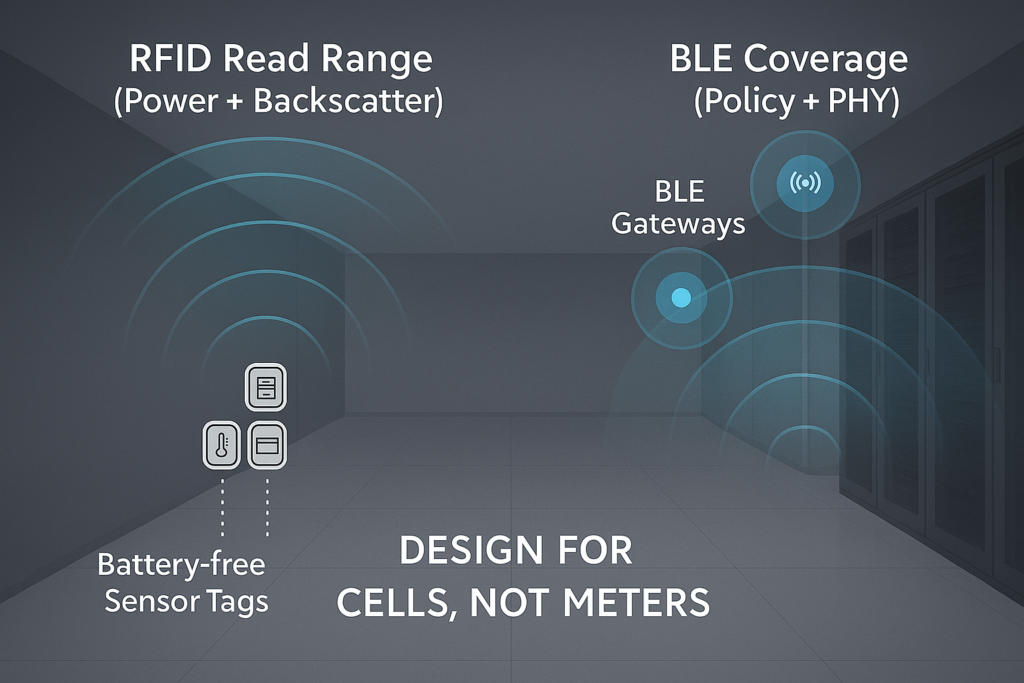
“Range” is not “coverage”
- RFID read range answers: At what distance can a reader both power a passive tag and reliably receive its backscatter?
- BLE coverage answers: From where can a scanner (or peer) reliably decode adverts or maintain a connection at a given PHY and duty cycle?
Different questions → different math → different field behavior. Treat them separately and you’ll avoid most surprises.
RFID (UHF/RAIN): what “read range” really means
Two links to close:
- Forward (powering) link — can the reader’s RF field energize the tag above its turn‑on sensitivity given antenna gains, polarization, cable loss, ERP/EIRP limits, and tag orientation?
- Reverse (backscatter) link — once awake, can the reader hear the tag’s modulated reflection at the chosen data rate and session settings amid multipath and interference?
Practical variables you won’t see highlighted on a datasheet:
- Polarization & orientation: Linear vs circular matters; 90° misalignment can halve you.
- Antenna height & Fresnel zone: “Open‑air lab” numbers rarely survive low ceilings, tall racks, or humans.
- Population & motion: Anti‑collision settings, dwell time, and speed across the beam tighten your usable window.
- Dense reader mode & regional limits: Co‑located readers and local EIRP/ERP rules will bound your cell size.
- Tag sensitivity variance: The “typical” tag in a chart is not the worst unit on your reel.
Spec‑to‑field translation: Treat any “up to 10 m” claim as a ceiling achieved in LOS, isolation, correct polarization, and with a demo tag. In a real aisle with metal, cables, and moving hands, design for reliable zones (front‑of‑rack, mid‑aisle) instead of a single max distance.
BLE: why “coverage” depends more on policy than physics
Levers that matter:
- PHY & data rate: BLE 1M vs Coded PHY (S=2/S=8) trades throughput for range and robustness.
- TX power & RX sensitivity: Gateways ≠ phones; phones often have lower TX power and noisier environments.
- Advertising interval & scan window: Longer intervals + short scans save power but shrink discovery probability.
- Address & payload policy: LE Privacy (rotating addresses) + minimal advertising data improves privacy but requires smarter backends.
- Interference & duty cycling: Wi‑Fi neighbors, elevator shafts, and busy 2.4 GHz air will change the shape of your cells.
Spec‑to‑field translation: A beacon “rated for 100 m” in open field often yields 10–30 m useful radius indoors, depending on walls, bodies, and scan duty cycles. For connected use, budget for fall‑back PHY in marginal spots.
Decoding the fine print: a quick glossary
- RFID Read Range (demo): Often LOS on a fixture, single tag, matched polarization, empty spectrum.
- Tag sensitivity (Pth): The gate to even start talking—varies by IC, lot, and temperature.
- Reader sensitivity: Sets your reverse‑link floor; matters more as antennas and cables age.
- BLE Coverage: A probability, not a radius; your scan settings are as important as TX power.
- Coded PHY: Extra redundancy → better range, lower throughput, higher airtime.
Hybrid design: where RFID shines, where BLE carries
Pattern that scales:
- RFID (UHF): Energize and read on demand for ID, presence, and battery‑free sensor samples (T/RH/door/leak).
- BLE at the gateway: Aggregate, filter at the edge, and backhaul via MQTT/REST; optionally bridge a few powered nodes where you truly need sub‑second telemetry.
- BLE beacons (optional): Use sparingly for zone awareness, with privacy‑friendly payloads and RPA enabled.
Why it works: RFID gives you deterministic snapshots when—and only when—you ask. BLE gives you continuous context with controllable duty‑cycle costs.
Worked examples (how we talk to vendors)
When a vendor says “10 m read range” on RFID:
- Ask: Antenna type, polarization, EIRP, tag IC, data rate, session settings, and test setup.
- Convert: Plan cells, not meters. If they won’t give session and data‑rate creds, assume lab tuning.
When a vendor says “100 m BLE coverage”:
- Ask: PHY, TX power, gateway/phone class, advert interval, scan window, and target detection latency.
- Convert: For indoor deployments, halve it, then halve it again, and prove with a walk test.
Acceptance tests we recommend
- RFID: Per‑cell dwell/sweep → % reads across top/bottom tags per rack face; test with worst‑case tag orientation.
- BLE: Floor‑by‑floor heatmaps with advert interval/scan window set to production values; include people‑present trials.
- Regression: Re‑run after antenna moves, new APs, or racking changes.
Where this is going (WPT‑HP & the roadmap)
As high‑power wireless power transfer (WPT‑HP, ~5–100 W) matures, expect hybrid sites where:
- RFID keeps the ID + audit + occasional sensing roles battery‑free,
- WPT‑HP feeds actuators or high‑rate sensors only where justified,
- BLE remains the control/telemetry backhaul at the edge.
Translation: range specs will matter less than power budgets, safety envelopes, and duty‑cycle economics.
How Kliskatek can help (Engineering & T&M)
- RF coverage surveys (UHF + BLE) and antenna/cell planning
- On‑tag firmware for battery‑free sensors (TLV mapping, calibration)
- Gateway apps (RFID + BLE + MQTT/REST, privacy by design)
- Acceptance test harness + reporting for your DCIM/CMMS
- WPT‑HP feasibility: safety envelope, coil/antenna placement, and duty‑cycle modeling
Want a half‑day workshop? We’ll decode your current spec sheets and leave you with a pilot‑ready test plan.